
The AI coding agent race is getting more competitive. Meta has entered the market with Muse Code, a new terminal-based coding agent powered by its Muse Spark 1.2 model.
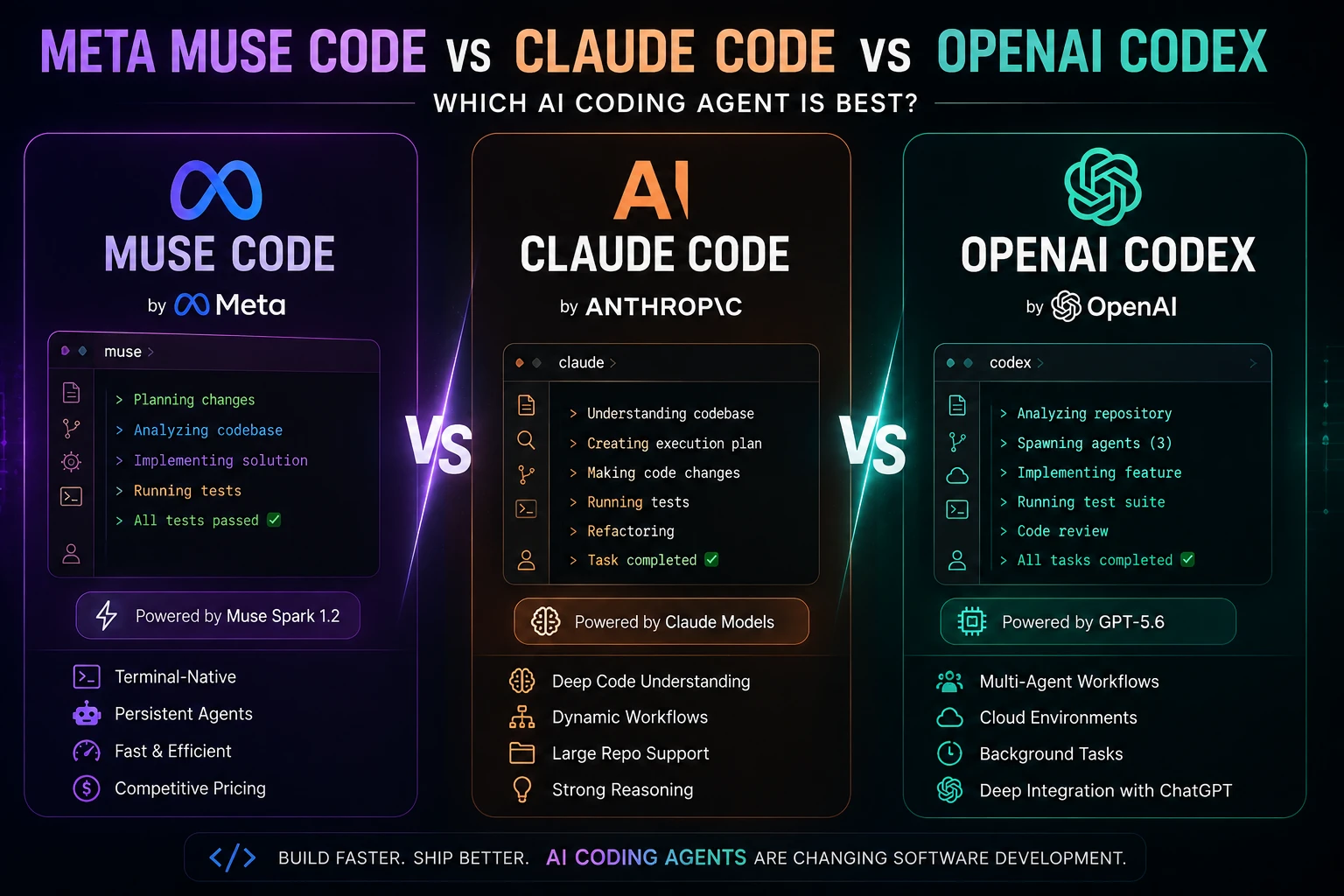
Muse Code joins two established competitors: Anthropic's Claude Code and OpenAI's Codex. All three tools are designed to go beyond simple code generation by planning changes, editing repositories, running tools, testing software, and working through complex engineering tasks.
But which one is actually the best?
The answer depends on what you value most. Claude Code has a strong reputation for software engineering, Codex combines OpenAI's latest coding models with cloud and multi-agent workflows, while Muse Code is entering the market with an aggressive focus on agentic coding and cost efficiency.
What Is Meta Muse Code?
Muse Code is Meta's first dedicated AI coding agent. Meta launched it in beta on August 5, 2026, alongside Muse Spark 1.2, a coding-focused update to the company's Muse model family.
The tool is designed to work across large software repositories and can plan code changes, implement them, run tests, and validate the results.
Unlike many developer tools that are centered around a graphical interface, Muse Code is terminal-native. The beta initially targets macOS and Linux users.
Meta also designed Muse Spark 1.2 and the Muse Code agent together, allowing the model and its software-engineering harness to be optimized as a single system. Reuters reports that Muse Code can execute multiple sub-agents concurrently and maintain a persistent activity log that helps it resume work after interruptions.
What Is Claude Code?
Claude Code is Anthropic's coding agent for developers. It gives users access to Claude models directly from the terminal and supported development environments.
Claude Code can inspect a codebase, understand project instructions, modify files, run commands, test changes, and work through complex software-engineering tasks.
Anthropic has continued to expand Claude Code as its Claude models have improved. Claude Opus 4.8, for example, introduced dynamic workflows in Claude Code for handling very large-scale problems. Anthropic says the feature allows Claude Code to tackle larger problems more effectively.
What Is OpenAI Codex?
Codex is OpenAI's AI coding agent for software engineering. It is available through ChatGPT, the terminal, supported IDEs, and cloud environments.
OpenAI describes Codex as an agent designed to handle software-engineering work from start to finish, including building features, complex refactoring, migrations, testing, and code review.
Codex also supports multi-agent workflows, cloud environments, worktrees, skills, and background tasks.
OpenAI's current GPT-5.6 family is particularly important to Codex. OpenAI says GPT-5.6 Sol is its strongest coding model and reports state-of-the-art results on several coding-agent evaluations, including Terminal-Bench 2.1 and DeepSWE.
Muse Code vs Claude Code vs Codex
| Feature | Muse Code | Claude Code | OpenAI Codex |
|---|---|---|---|
| Developer | Meta | Anthropic | OpenAI |
| Main model | Muse Spark 1.2 | Claude models | GPT-5.6 family |
| Primary interface | Terminal | Terminal and supported IDE workflows | ChatGPT, terminal, IDE and cloud |
| Agentic coding | Yes | Yes | Yes |
| Multi-agent workflows | Yes | Yes | Yes |
| Large repositories | Yes | Yes | Yes |
| Background work | Persistent sub-agents | Dynamic workflows | Background and scheduled tasks |
| Cloud environments | Limited compared with Codex | Available through supported workflows | Yes |
| Beta availability | Yes | No | No |
How Muse Code Works
Muse Code is built around an agent loop that can coordinate persistent background agents.
Instead of repeatedly starting a completely new agent for every step, Meta's architecture allows specialized background agents to continue working during a session. This is intended to reduce repeated context gathering and the amount of manual steering required for complex tasks.
Muse Code also maintains an append-only activity log. The system records important actions such as model calls, tool executions, approvals, and edits. This design is intended to make long-running coding sessions more resilient to crashes.
The result is a coding workflow that looks more like delegating a software project to an AI engineer than asking a chatbot to generate individual functions.
How Claude Code Works
Claude Code takes a similar agentic approach but has been available longer and has built a mature developer ecosystem around Claude.
A developer can give Claude Code a high-level objective, and the agent can inspect the repository, find relevant files, make changes, execute commands, run tests, and continue iterating until the task is complete.
Claude Code is particularly useful when the developer wants the AI to understand the existing architecture instead of generating isolated snippets.
Anthropic's current Claude Code capabilities also include workflows designed for very large-scale engineering problems.
How OpenAI Codex Works
Codex is designed around the same fundamental idea: give the AI access to the development environment and let it perform real engineering work.
Codex can work in the terminal, editor, ChatGPT, and cloud environments. OpenAI also supports parallel agents, worktrees, skills, and background tasks.
This makes Codex particularly interesting for teams that want to delegate multiple engineering tasks simultaneously.
OpenAI describes Codex as a command center for agentic coding, with agents able to work in parallel across projects.
Which Has the Best Coding Performance?
There is no single benchmark that can determine the overall winner.
Meta's published comparisons show Muse Spark 1.2 performing competitively against leading models. In one Terminal-Bench 2.1 comparison reported from Meta's evaluation, Muse Spark 1.2 scored 82.9%, compared with 86.7% for Claude Opus 5 and 81.8% for GPT-5.6 Terra.
However, this should not be interpreted as proof that Muse Code is universally better than Codex. The exact model configuration matters, and OpenAI's current Codex stack uses the GPT-5.6 family, with GPT-5.6 Sol positioned as its frontier coding model.
OpenAI reports that GPT-5.6 Sol reaches a leading score on its Coding Agent Index and sets new state-of-the-art results on Terminal-Bench 2.1 and DeepSWE.
Claude also remains highly competitive. Anthropic's Claude Opus 4.8 was released with improvements across coding and agentic benchmarks and new Claude Code workflows.
Muse Code Pricing
Pricing is one of Muse Code's most interesting advantages.
The standard Muse Code pricing reported at launch is $1.25 per million input tokens and $4.25 per million output tokens.
Meta also offers a heavily discounted contributor tier. Reports indicate pricing as low as $0.10 per million input tokens and $0.20 per million output tokens, but the discounted option comes with different data-use terms and should therefore be evaluated carefully before using it with sensitive or proprietary source code.
For developers primarily concerned with API cost, this makes Muse Code an interesting alternative to established coding agents.
Claude Code Pricing
Claude Code is available through Anthropic's subscription plans, including Pro and Max, as well as Team and Enterprise offerings.
Anthropic's current documentation confirms that Pro and Max subscribers can use Claude Code alongside Claude's other applications.
This subscription approach is different from Muse Code's token-based pricing and can be attractive for developers who prefer predictable monthly costs.
Codex Pricing and Access
Codex is integrated with ChatGPT and is available with eligible ChatGPT plans. OpenAI currently lists Codex as included with Plus, Pro, Business, and Enterprise/Edu plans, with limited-time access also available to Free and Go users. Usage limits vary by plan.
Developers can also use Codex through OpenAI's developer ecosystem and API-based workflows.
Which One Is Best for Large Codebases?
All three tools are designed to work with large repositories, but they take somewhat different approaches.
Claude Code is a strong choice for developers who want an established terminal-first workflow and deep integration with Claude's coding models.
Codex is particularly compelling for teams that want cloud environments, parallel agents, worktrees, background tasks, and integration with ChatGPT.
Muse Code is attractive for developers who want a new terminal-based agent and are especially interested in cost-efficient inference and persistent background agents.
Which One Is Best for Beginners?
For beginners, the best choice is usually the tool that provides the easiest environment for understanding what the agent is doing.
Codex has an advantage here because it can be accessed through ChatGPT as well as developer-oriented environments. This allows users to move between conversational assistance and more autonomous coding workflows.
Claude Code is also straightforward once installed, but its terminal-first approach may be more comfortable for developers who already understand Git and command-line workflows.
Muse Code is currently more developer-oriented and is best suited to users who are already comfortable working in a terminal.
Which One Is Best for Professional Developers?
Professional developers should focus less on marketing claims and more on the workflow that fits their repository.
Consider:
- How well the agent understands your existing architecture.
- How reliably it runs and verifies tests.
- How much supervision it requires.
- How well it handles long-running tasks.
- How much context it can process.
- How it handles secrets and proprietary code.
- How much the complete workflow costs.
A model that performs slightly better on a benchmark may still be less useful if it requires more supervision or produces unreliable changes in your particular codebase.
Muse Code vs Claude Code vs Codex: Pros and Cons
Muse Code
Pros:
- Strong focus on agentic coding.
- Persistent background agents.
- Designed for long-running engineering tasks.
- Competitive token pricing.
- Terminal-native workflow.
Cons:
- Still in beta.
- Smaller ecosystem than Claude Code and Codex.
- Terminal-first experience may not suit everyone.
- Pricing tiers have different data-use implications.
Claude Code
Pros:
- Mature coding-agent workflow.
- Strong software-engineering capabilities.
- Excellent terminal integration.
- Claude's strong reasoning and coding models.
- Dynamic workflows for larger problems.
Cons:
- Can become expensive for heavy usage.
- Best suited to users comfortable with developer workflows.
- Performance varies depending on the selected Claude model.
OpenAI Codex
Pros:
- Deep integration with ChatGPT.
- Terminal, IDE, and cloud workflows.
- Parallel agents and worktrees.
- Background and scheduled tasks.
- Strong GPT-5.6 coding models.
Cons:
- Usage limits depend on the ChatGPT plan.
- Some advanced workflows require paid access.
- Costs can increase with intensive agentic workloads.
Which AI Coding Agent Should You Choose?
| If You Want... | Best Starting Point |
|---|---|
| Established terminal coding workflow | Claude Code |
| ChatGPT integration | Codex |
| Cloud and parallel coding agents | Codex |
| Low-cost experimentation | Muse Code |
| Persistent background agents | Muse Code or Codex |
| Large-scale engineering workflows | Claude Code or Codex |
| Trying a new AI coding agent | Muse Code |
Final Verdict
Meta Muse Code has arrived at an interesting moment in the AI coding market. Claude Code and OpenAI Codex already have strong developer adoption, but Meta is betting that a coding-focused model, persistent agents, and aggressive pricing can make Muse Code a serious alternative.
Claude Code remains one of the strongest choices for developers who want a mature terminal-first coding agent. Codex is particularly compelling for users who want OpenAI's coding models combined with ChatGPT, cloud environments, parallel agents, and background workflows.
Muse Code is the newcomer, and it still has to prove itself through broader independent testing and real-world developer adoption. Its early benchmark results are competitive, but they should be interpreted carefully because some comparisons come from Meta's own evaluation setup.
For now, there is no universal winner.
If you want the most established developer workflow, start with Claude Code. If you want a broad agentic ecosystem connected to ChatGPT, Codex is an excellent choice. If low cost and Meta's new agent architecture interest you, Muse Code is worth testing.
Frequently Asked Questions
What is Meta Muse Code?
Muse Code is Meta's terminal-based AI coding agent, powered by the Muse Spark 1.2 model. It is designed to plan, implement, test, and validate software changes across large repositories.
Is Muse Code better than Claude Code?
Not universally. Muse Code is competitive on several coding evaluations, but Claude Code and its underlying Claude models remain extremely strong. Independent real-world testing is still important before declaring an overall winner.
Is Muse Code better than OpenAI Codex?
Muse Code is competitive with some Codex configurations, but the answer depends on the model, benchmark, task, and workflow. OpenAI's current GPT-5.6 coding models remain among the strongest options for agentic software engineering.
Is Muse Code free?
Muse Code uses usage-based pricing. Meta also offers a discounted contributor tier with different data-use terms. Developers should check the current terms before using it with private repositories.
Does Muse Code work on Windows?
The initial beta availability focused on macOS and Linux. Developers using Windows should check Meta's current availability information before installing it.
Which is best for coding in 2026?
Claude Code, Codex, and Muse Code are all strong options. Claude Code is attractive for mature terminal workflows, Codex for integrated multi-agent and cloud workflows, and Muse Code for developers interested in a new agent architecture and competitive pricing.