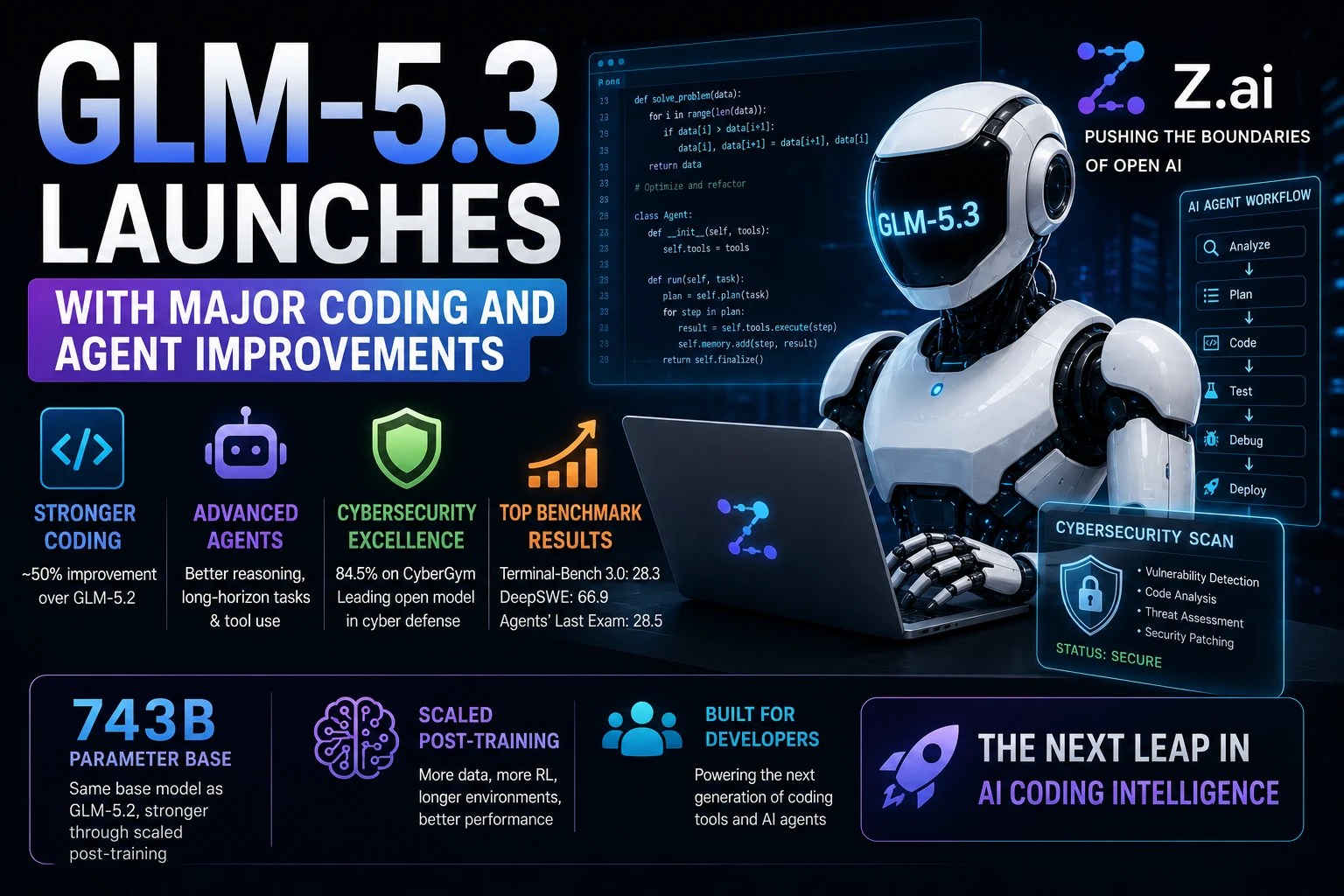

Z.ai has launched GLM-5.3, a major update to its GLM family of AI models focused heavily on coding, agentic software development, and cybersecurity.
Unlike a traditional model upgrade that introduces a larger or completely redesigned foundation model, GLM-5.3 uses the same 743-billion-parameter base model as GLM-5.2. Z.ai says the major improvements come from extensive post-training, reinforcement learning, longer task environments, and more diverse training environments.
The result is a model that Z.ai says delivers a major improvement in coding and agentic tasks while using fewer output tokens for some tasks.
GLM-5.3 also demonstrates unexpectedly strong cybersecurity capabilities, making the release important not only for software developers but also for the rapidly developing field of AI-powered security.
In this guide, we'll explain what GLM-5.3 is, what's new, how its coding and agent capabilities have improved, its benchmark results, cybersecurity capabilities, availability, and what the release means for developers.
What Is GLM-5.3?
GLM-5.3 is the latest flagship AI model from Z.ai, formerly known as Zhipu AI. It is designed to handle advanced coding, reasoning, agentic workflows, and cybersecurity tasks.
Z.ai introduced the model on August 14, 2026, positioning it as one of its strongest models for software development and open-weight AI.
One of the most interesting aspects of GLM-5.3 is that its improvements do not come from replacing the underlying foundation model.
Instead, Z.ai kept the same 743B base model used by GLM-5.2 and focused on significantly scaling the post-training process.
What's New in GLM-5.3?
GLM-5.3 focuses on several major areas of improvement.
- Stronger coding performance
- Improved agentic software development
- Better performance on long-running coding tasks
- Improved efficiency in some coding workflows
- Strong cybersecurity capabilities
- Improved performance on public agent benchmarks
- Expanded post-training and reinforcement learning
Z.ai describes the release as a major step forward for its coding models and says GLM-5.3 achieved these improvements primarily through post-training rather than a larger foundation model.
GLM-5.3 Coding Improvements
Coding is one of the main reasons GLM-5.3 has attracted attention.
Z.ai says the model's coding performance improved by approximately 50% compared with GLM-5.2 in its internal evaluations.
The company also reports significant improvements on public coding and agent benchmarks, including Terminal-Bench 3.0 and DeepSWE.
These benchmarks are particularly relevant because modern AI coding assistants need to do more than generate isolated functions.
A strong coding agent needs to understand a repository, modify multiple files, use development tools, execute commands, debug failures, and continue working through a long sequence of tasks.
Why Agentic Coding Matters
Traditional AI coding assistants typically operate on a relatively small piece of code.
Agentic coding systems work differently.
They can receive a larger objective and then determine the individual steps needed to complete it.
For example, instead of asking an AI to write one JavaScript function, a developer could ask it to:
- Inspect an existing repository
- Identify the relevant files
- Implement a new feature
- Update the application's API
- Modify the frontend
- Run tests
- Debug failures
- Refactor the implementation
- Prepare the final changes
This type of workflow requires considerably stronger reasoning and tool-use capabilities than simple autocomplete.
GLM-5.3 Benchmark Results
Z.ai reports strong results for GLM-5.3 across several coding and agent benchmarks.
| Benchmark | GLM-5.3 Result | What It Measures |
|---|---|---|
| Terminal-Bench 3.0 | 28.3 | Long-running terminal and coding tasks |
| DeepSWE | 66.9 | Software engineering tasks |
| Agents' Last Exam | 28.5 | Agentic reasoning and task completion |
| GDPVal-AA | 1769 | Professional and real-world task performance |
Z.ai says GLM-5.3 ranks highly among open models across a range of coding and agent evaluations.
Benchmark results should still be interpreted carefully because model performance can vary depending on evaluation methodology, prompting, tools, and whether results have been independently reproduced.
GLM-5.3 and AI Agents
Agentic AI is another major focus of GLM-5.3.
AI agents need to perform tasks over multiple steps rather than simply answer a single prompt.
For coding agents, this may involve reading files, editing code, running commands, analyzing errors, and repeating the process until the task is completed.
GLM-5.3 was designed to perform better in these long-horizon workflows.
What Can GLM-5.3 Coding Agents Do?
- Understand large software projects
- Modify multiple files
- Write and refactor code
- Debug programming errors
- Use terminal tools
- Run tests
- Analyze failed implementations
- Work through multi-step tasks
- Assist with software engineering workflows
This makes GLM-5.3 particularly interesting for developers building autonomous coding agents and AI-powered developer tools.
GLM-5.3 Cybersecurity Capabilities
One of the biggest surprises surrounding GLM-5.3 is its cybersecurity performance.
Z.ai says the model developed strong capabilities in vulnerability discovery and security analysis through post-training.
The model scored 84.5% on CyberGym, according to Z.ai and recent reporting, compared with 83.8% for Anthropic's Mythos 5 in the reported evaluation. :contentReference[oaicite:1]{index=1}
However, GLM-5.3 performed significantly lower than Mythos 5 on exploit development in the reported ExploitBench evaluation, scoring 54.4% compared with 78.0%.
This distinction is important because identifying a vulnerability and successfully developing an exploit are different capabilities.
Why Is This Important?
Advanced AI models can potentially help security teams identify vulnerabilities faster and review large amounts of source code.
At the same time, the same capabilities could potentially be misused.
Z.ai has therefore taken a staged approach to the release, with additional safety evaluations and restrictions around the most sensitive capabilities.
GLM-5.3 Uses the Same Base Model as GLM-5.2
One of the most technically interesting aspects of the release is that GLM-5.3 does not introduce a completely new foundation model.
The model uses the same 743B base model as GLM-5.2.
Instead, Z.ai focused on scaling post-training.
The company says this included longer training runs, more diverse environments, more extensive reinforcement learning, and improved training infrastructure.
This approach demonstrates how much performance can potentially be extracted from an existing model through better post-training.
What Is Post-Training?
Post-training refers to additional training performed after a foundation model has been pretrained.
While pretraining teaches a model broad patterns from enormous datasets, post-training can focus on making the model more useful for specific tasks.
For coding models, post-training can teach the system to:
- Follow software engineering instructions
- Use development tools
- Complete programming tasks
- Recover from errors
- Reason through multiple steps
- Improve code quality
- Complete longer tasks successfully
GLM-5.3 is an example of how scaling this process can produce significant capability improvements without necessarily increasing the size of the underlying foundation model.
GLM-5.3 vs GLM-5.2
| Feature | GLM-5.2 | GLM-5.3 |
|---|---|---|
| Base model | 743B | 743B |
| Coding | Strong | Significantly improved |
| Agentic coding | Strong | Major improvement |
| Post-training | Advanced | Much more heavily scaled |
| Cybersecurity | Strong | Major improvement |
| Open weights | Available | Staged release following safety evaluations |
The most important difference is therefore not the size of the underlying model but how extensively GLM-5.3 has been post-trained.
How Developers Can Use GLM-5.3
GLM-5.3 is initially available through Z.ai's coding products and selected partner services.
Z.ai says GLM-5.3 is available through its GLM Coding Plan and ZCode, while API access and complete model weights are being released in stages following safety evaluations. :contentReference[oaicite:2]{index=2}
This staged approach is particularly relevant because of the model's cybersecurity capabilities.
Potential Developer Uses
- Writing software
- Debugging applications
- Code refactoring
- Generating tests
- Repository analysis
- Building coding agents
- Automating development tasks
- Security code review
- Vulnerability discovery
- Developer productivity workflows
GLM-5.3 for Software Development
Developers can use advanced coding models like GLM-5.3 for more than simple code generation.
A useful workflow is to give the model a clearly defined task together with information about the project's architecture and requirements.
Analyze this repository and identify the files responsible for user authentication. Explain the current authentication flow, identify potential problems, and propose a safe implementation plan before making any changes.
Once the plan has been reviewed, developers can ask the coding agent to implement the changes and run the project's tests.
GLM-5.3 for Coding Agents
The model's agentic capabilities make it especially interesting for developers building AI-powered software engineering tools.
A coding agent powered by GLM-5.3 could potentially operate as follows:
- Receive a software development task.
- Inspect the repository.
- Determine which files need to change.
- Create an implementation plan.
- Modify the relevant files.
- Run tests and development commands.
- Analyze failures.
- Fix problems.
- Run the tests again.
- Return a summary of the completed work.
The ability to perform longer sequences of actions is one of the biggest differences between an AI coding assistant and a more autonomous coding agent.
GLM-5.3 and Open-Weight AI
GLM-5.3 is also important because of Z.ai's approach to open-weight AI.
Z.ai says the complete model weights will be released after additional security evaluations and model hardening.
The decision reflects a growing tension in the AI industry.
Open models provide developers and researchers with greater control and flexibility, but highly capable models can also create additional security and misuse risks.
GLM-5.3 demonstrates this tension particularly clearly because of its reported cybersecurity capabilities.
Why GLM-5.3 Matters for Open AI Models
The release highlights how quickly open models are improving in coding and agentic tasks.
Developers no longer need to rely exclusively on closed commercial models for advanced software development.
Open-weight models can offer several advantages:
- Greater control
- Flexible deployment
- Customization
- Research access
- Potentially lower infrastructure costs
- Reduced dependence on a single provider
However, running very large models locally or privately still requires substantial computing resources.
GLM-5.3 vs Closed AI Coding Models
GLM-5.3 enters a competitive market that includes coding and agent models from companies such as OpenAI, Anthropic, Google, and other AI labs.
Its biggest differentiator is the combination of advanced coding performance, agentic capabilities, and an open-weight strategy.
However, developers should not judge a model only by benchmark scores.
Real-world factors such as latency, cost, context handling, tool support, reliability, API availability, and deployment requirements can be just as important.
Potential Limitations of GLM-5.3
Despite the impressive reported results, GLM-5.3 has limitations that developers should consider.
- Some capabilities remain subject to staged access.
- Open weights are being released after additional safety evaluations.
- Very large models can require significant computing resources.
- Benchmark results may not represent every real-world coding workflow.
- AI-generated code still requires human review.
- Cybersecurity capabilities create additional safety considerations.
Developers should evaluate GLM-5.3 using their own applications and workloads rather than relying entirely on published benchmarks.
What GLM-5.3 Means for AI Coding
The release demonstrates that AI coding models are moving toward increasingly autonomous software development.
The next generation of coding assistants is likely to spend less time simply predicting the next line of code and more time completing complete engineering tasks.
This could change how developers work.
Instead of manually implementing every function, developers may increasingly act as supervisors who define requirements, review plans, evaluate generated changes, and verify the final implementation.
What GLM-5.3 Means for Cybersecurity
The model's cybersecurity capabilities are equally significant.
AI systems that can identify vulnerabilities and analyze source code at scale could become powerful tools for defensive security teams.
They could help organizations review large codebases, identify potential weaknesses, and prioritize security fixes.
At the same time, highly capable security models can introduce dual-use risks.
Z.ai's decision to delay the complete weight release while performing additional safety evaluations reflects this concern. :contentReference[oaicite:3]{index=3}
Key Takeaways
- Z.ai launched GLM-5.3 on August 14, 2026.
- The model uses the same 743B base model as GLM-5.2.
- Major improvements come from scaled post-training.
- Z.ai reports approximately 50% improvement in internal coding evaluations.
- GLM-5.3 shows major gains on coding and agent benchmarks.
- The model is designed for long-running agentic coding tasks.
- GLM-5.3 also demonstrates strong cybersecurity capabilities.
- Z.ai reported an 84.5% CyberGym score.
- API access and open weights are being released in stages.
- The model is already available through selected Z.ai coding products.
Final Verdict
GLM-5.3 is one of the most interesting AI model releases of August 2026, particularly for developers and researchers interested in coding agents and open-weight AI.
The most important part of the release is that Z.ai achieved major improvements without replacing the underlying 743B foundation model used by GLM-5.2.
Instead, the company dramatically scaled post-training, reinforcement learning, and long-horizon task environments.
The result is a model that Z.ai says delivers substantially stronger coding and agentic performance, while also developing impressive cybersecurity capabilities.
For developers, GLM-5.3 could become an important alternative to closed AI coding models, particularly as its API and complete model weights become more widely available.
For the broader AI industry, the release provides another example of how much performance can be unlocked through better post-training rather than simply making foundation models larger.
The cybersecurity capabilities also show why increasingly powerful open AI models require careful evaluation before unrestricted release.
Overall, GLM-5.3 represents an important step toward AI systems that can move beyond code completion and take on increasingly complex software engineering and agentic tasks.
Frequently Asked Questions
What is GLM-5.3?
GLM-5.3 is the latest flagship AI model from Z.ai, focused on advanced coding, agentic software development, reasoning, and cybersecurity.
Who created GLM-5.3?
GLM-5.3 was developed by Z.ai, the Chinese AI company formerly known as Zhipu AI.
When was GLM-5.3 released?
Z.ai announced GLM-5.3 on August 14, 2026.
Is GLM-5.3 better than GLM-5.2?
According to Z.ai's reported evaluations, GLM-5.3 provides substantial improvements over GLM-5.2, particularly in coding, agentic tasks, and cybersecurity.
What is the GLM-5.3 parameter size?
GLM-5.3 uses the same approximately 743-billion-parameter base model as GLM-5.2. The major improvements come from post-training rather than a larger base model.
Is GLM-5.3 good for coding?
Yes. Coding is one of GLM-5.3's primary strengths. Z.ai reports major improvements over GLM-5.2 across internal and public coding evaluations.
Can GLM-5.3 build software autonomously?
GLM-5.3 is designed for agentic coding workflows in which an AI system can work through multiple steps, use tools, modify files, and complete software engineering tasks. Human review remains important for production development.
Is GLM-5.3 open source?
Z.ai describes GLM-5.3 as part of its open model strategy, but the complete model weights are being released in stages after additional security evaluations and model hardening.
Can I use GLM-5.3 now?
GLM-5.3 is currently available through Z.ai's GLM Coding Plan and ZCode, with selected partner access. API access and complete model weights are being released in stages. :contentReference[oaicite:4]{index=4}
How good is GLM-5.3 at cybersecurity?
GLM-5.3 has demonstrated strong cybersecurity performance in reported evaluations. Z.ai reported an 84.5% CyberGym score, although performance varies considerably across different security tasks. :contentReference[oaicite:5]{index=5}
Is GLM-5.3 better than ChatGPT for coding?
There is no single answer for every coding task. GLM-5.3 has shown strong results on coding and agent benchmarks, while commercial models may offer advantages in areas such as tooling, reliability, ecosystem integration, or accessibility. Developers should compare models using their own workloads.
Is GLM-5.3 free?
Availability and pricing depend on the access method. Z.ai currently provides access through its coding products, while broader API and model-weight availability is being rolled out in stages.