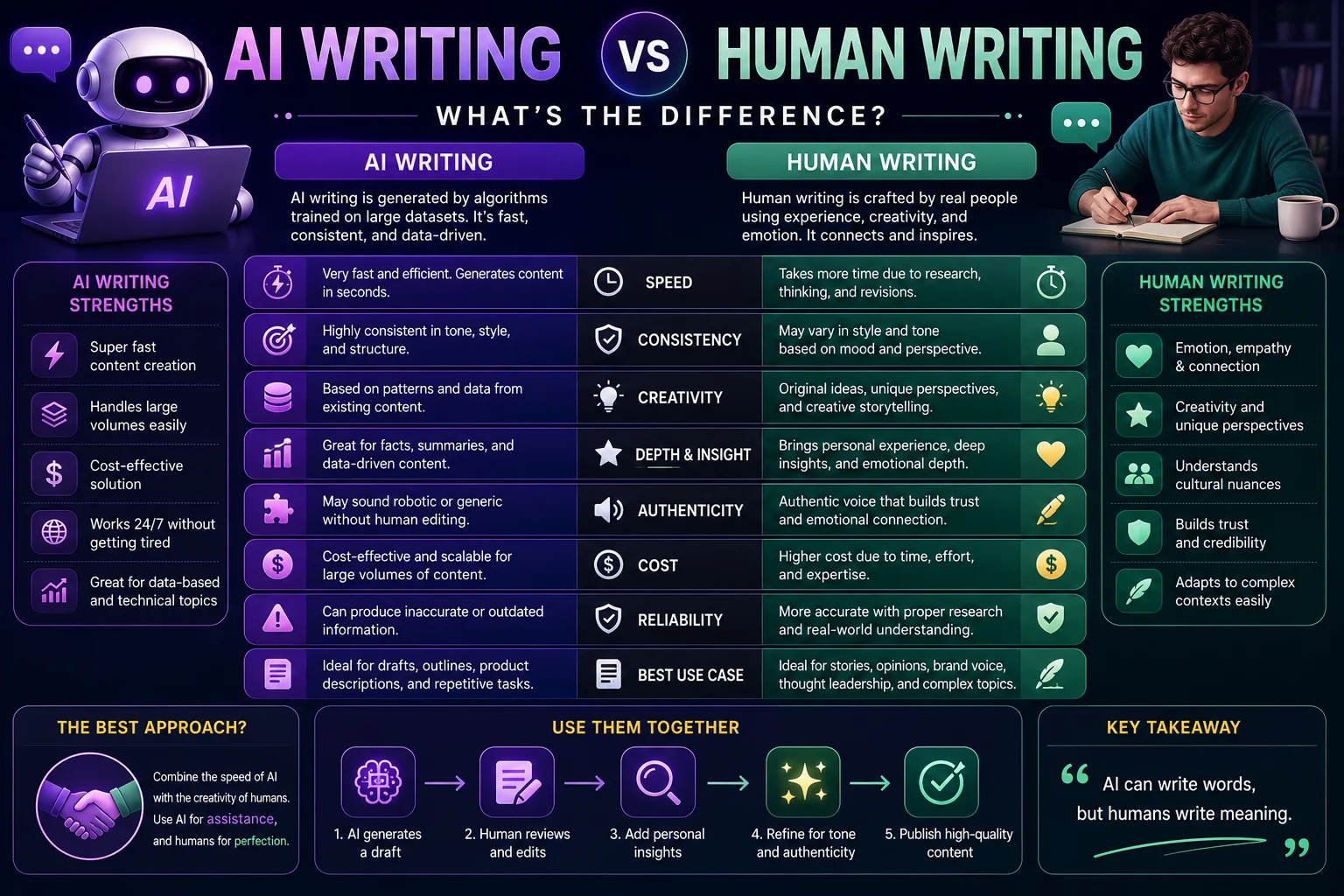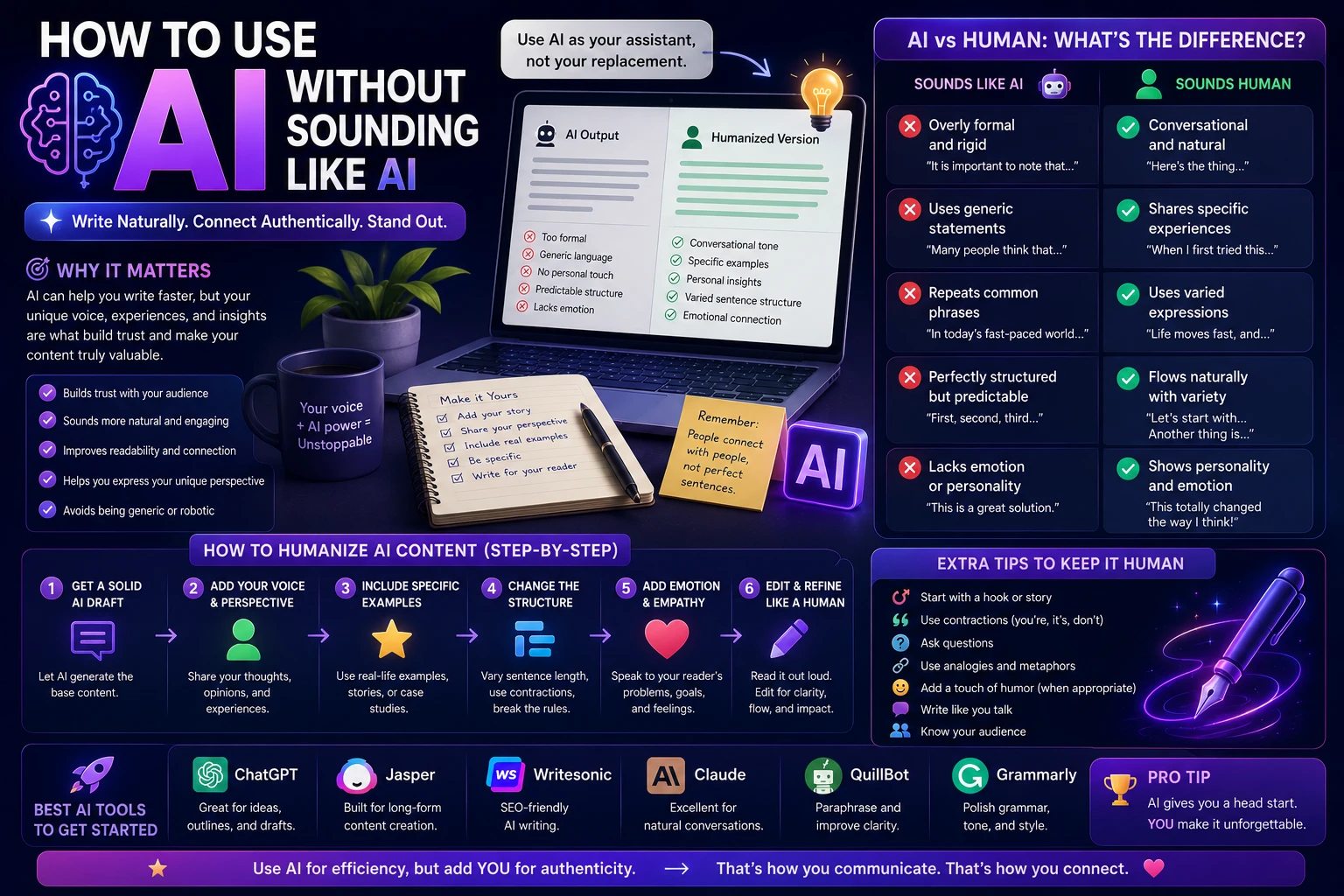

AI writing tools have become incredibly useful for brainstorming ideas, creating outlines, improving grammar, researching topics, and drafting content. But there is one problem many people encounter: the final text can sometimes sound too polished, generic, repetitive, or robotic.
If you've ever read something and immediately thought, "This sounds like AI," you already know what the problem looks like. The writing may be grammatically correct, but it lacks personality, specific details, natural variation, and a recognizable human voice.
The good news is that you don't have to stop using AI. The key is to use AI as a writing assistant rather than allowing it to completely replace your own thinking and voice.
In this guide, we'll explain how to use AI without sounding like AI and show you practical ways to make AI-assisted writing feel more natural and authentic.
Why Does AI Writing Sometimes Sound Like AI?
AI systems are trained to generate language that is statistically likely to fit a particular context. This makes them very good at producing clear and structured text, but the result can sometimes feel predictable.
AI-generated writing may frequently have characteristics such as:
- Generic introductions
- Repeated sentence structures
- Predictable transitions
- Overly formal language
- Too many unnecessary headings
- Broad statements without specific examples
- Excessive use of phrases such as "in today's world"
- Long explanations of simple ideas
- A consistently polished tone
- Limited personal experience or opinion
None of these characteristics automatically prove that something was written by AI. Human writers can use the same patterns. However, when many of them appear together, the writing can feel less natural.
The Best Way to Use AI Without Sounding Like AI
The most effective approach is simple: let AI help with the work, but keep yourself involved in the thinking and final writing.
Instead of asking AI to create an entire article and publishing the result immediately, use it at different stages of the writing process.
For example, you can use AI to:
- Brainstorm ideas
- Research questions
- Create an outline
- Suggest examples
- Identify weak arguments
- Improve grammar
- Find repetitive wording
- Give feedback on your draft
Then you can make the final decisions yourself.
1. Start With Your Own Ideas
One of the easiest ways to make AI-assisted writing sound more human is to begin with your own thoughts.
Before opening an AI tool, write down what you actually think about the topic. You don't need perfect sentences. A simple list of ideas, opinions, experiences, and examples is enough.
For example, instead of asking:
Write an article about working from home.
Start with your own perspective:
I have worked from home for several years. I like avoiding commuting, but I sometimes find it difficult to separate work from personal time.
You can then ask AI to help organize these ideas into an article.
The final content will have something that generic AI output often lacks: your actual perspective.
2. Give AI Your Writing Style
If you want AI to help edit your writing, give it an example of how you normally write.
You can provide a paragraph that represents your natural style and ask the AI to use it as a reference.
For example:
Here is a sample of my writing. When editing my next paragraph, keep my sentence length, vocabulary, tone, and level of formality. Improve clarity without making the writing sound overly polished or formal.
This is usually more effective than simply asking for "human-like writing."
3. Don't Ask AI to "Sound Human"
The instruction "make this sound human" is too vague.
Instead, describe exactly what you want to change.
For example, you can ask AI to:
- Use simpler vocabulary.
- Remove unnecessary filler.
- Vary sentence length.
- Keep my personal tone.
- Remove repetitive transitions.
- Make the introduction more direct.
- Preserve my opinions and examples.
- Rewrite only awkward sentences.
- Avoid overly formal language.
Specific instructions produce more useful results than vague requests.
4. Add Personal Experiences
Personal experiences are one of the strongest ways to make writing distinctive.
AI doesn't know what happened to you unless you tell it. Your experiences, observations, preferences, mistakes, and lessons learned can make content much more specific.
For example, instead of writing:
Exercise has many benefits for physical and mental health.
You could write:
I started walking every evening after spending most of the day sitting at my computer. After a few weeks, I noticed that I was sleeping better and felt less tired during the evening.
The second example contains a specific experience rather than a generic statement.
5. Use Specific Examples
Generic claims make writing feel generic.
Whenever possible, replace broad statements with concrete examples.
Instead of:
AI can save businesses a lot of time.
Try:
A marketing team can use AI to create several headline ideas in minutes, then spend its time reviewing and improving the strongest options.
The second version gives the reader something concrete to imagine.
6. Keep Your Own Opinions
AI assistants often try to present information in a balanced and neutral way. That can be useful for factual explanations, but it can also remove personality from your writing.
If you have an opinion, say it.
For example:
In my experience, the biggest advantage of AI writing tools isn't generating complete articles. It's getting past the blank page and creating a useful starting point.
A statement like this gives the content a clear point of view.
7. Avoid Overusing AI-Style Introductions
Many AI-generated articles begin with broad statements about how quickly the world is changing.
For example:
In today's fast-paced digital world, technology has transformed the way we work, communicate, and live.
This type of introduction is not necessarily wrong, but it is extremely general.
A stronger introduction usually gets to the point faster.
For example:
You can now use AI to summarize a long document, create an outline, or improve an email in a few seconds. The challenge is making the result still sound like you.
The second version immediately introduces the actual problem.
8. Vary Sentence Length
Human writing naturally contains variation. Some sentences are short. Others are longer and contain several ideas.
AI-generated text can sometimes use similar sentence patterns repeatedly.
During editing, look for paragraphs where every sentence has approximately the same structure and length.
You don't need to make every sentence dramatically different. Just allow natural variation.
9. Remove Unnecessary Filler
AI-generated writing can sometimes explain an obvious point multiple times.
For example, an article might introduce an idea, explain it, summarize it, and then repeat the same conclusion in another paragraph.
If a sentence doesn't add information, an example, an argument, or personality, consider removing it.
Good editing is often about deleting words rather than adding them.
10. Use Simple Language When Appropriate
Natural writing doesn't require complicated vocabulary.
If you normally say "use," don't replace it with "utilize" just because it sounds more sophisticated.
If you normally say "help," you don't need to write "facilitate the optimization of."
Clear writing is usually better than unnecessarily complex writing.
11. Don't Overuse Perfect Grammar
This doesn't mean intentionally adding grammar mistakes.
It means that natural writing can contain contractions, short sentences, informal expressions, and different rhythms depending on the context.
For example:
AI can be useful. But it isn't magic. You still need to check the result.
This can feel more conversational than an overly formal version of the same idea.
12. Edit AI Output Instead of Publishing It Immediately
One of the biggest mistakes is copying AI-generated text directly into a website, email, assignment, or social media post.
Even if the output is technically correct, it may not match your voice.
After generating content, read it from beginning to end and ask:
- Would I actually say this?
- Does this sound like me?
- Are there unnecessary sentences?
- Are there generic claims?
- Can I add a personal example?
- Is the tone appropriate for my audience?
- Did the AI introduce information I cannot verify?
Your editing pass is what transforms AI-assisted content into content that reflects your own judgment.
13. Use AI as an Editor, Not Just a Writer
AI can be extremely useful after you've written a first draft.
Instead of asking AI to write everything, give it your draft and ask it to identify problems.
For example:
Review this article for repetitive phrases, unclear sentences, unnecessary filler, and weak transitions. Don't rewrite the entire article. Give me specific suggestions while preserving my writing style.
This keeps more of your original voice in the final result.
14. Keep Some Imperfection
Human writing isn't always perfectly symmetrical.
One paragraph might be short. Another might contain a longer explanation. You might use a sentence fragment for emphasis in a casual article.
The goal isn't to make AI output imperfect simply for the sake of appearing human. The goal is to avoid replacing your natural style with an overly generic style.
15. Fact-Check Everything Important
Making content sound natural doesn't make it accurate.
AI systems can produce incorrect facts, outdated information, misleading claims, or references that don't support the statement being made.
For important content, verify:
- Statistics
- Dates
- Names
- Quotes
- Research findings
- Product information
- Legal or financial claims
- Links and references
Good AI-assisted writing should be both natural and accurate.
How to Prompt AI for More Natural Writing
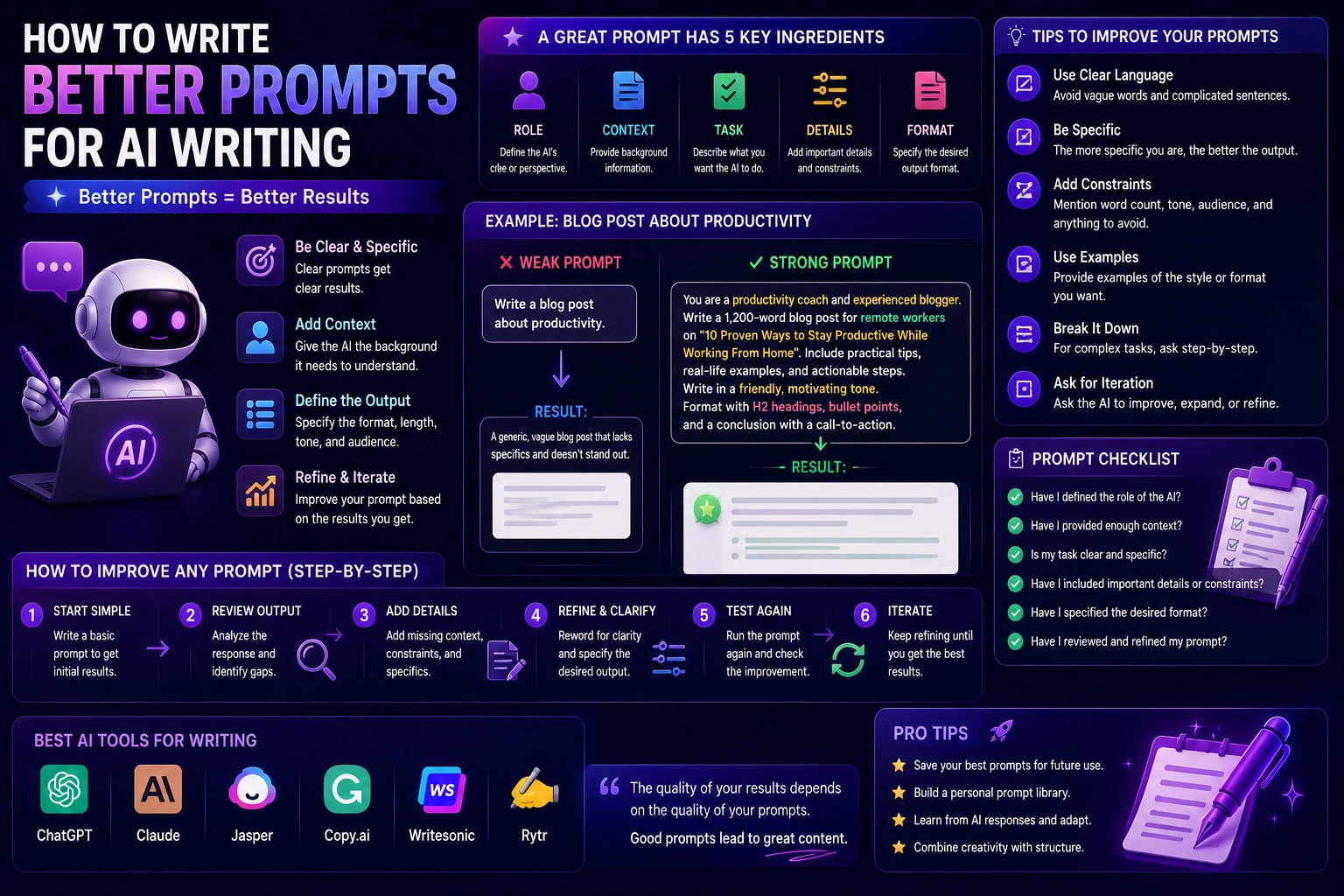
Instead of using a generic prompt such as "make this sound human," try giving the AI detailed instructions.
For example:
Edit this article while preserving my original voice. Use clear and natural language, vary sentence length, remove unnecessary filler, avoid generic introductions, and keep my personal examples. Don't add exaggerated claims or overly formal vocabulary. Don't rewrite sentences that are already clear.
You can also tell the AI what not to change.
Keep my opinions, examples, wording where possible, and overall structure. Only change sentences that are unclear, repetitive, grammatically incorrect, or unnecessarily awkward.
These instructions encourage the AI to act as an editor instead of completely replacing your writing.
A Simple AI Writing Workflow
You don't need a complicated system to use AI effectively.
- Think: Decide what you want to say.
- Research: Collect reliable information and examples.
- Outline: Organize the main ideas.
- Write: Create a first draft in your own voice.
- Use AI: Ask for feedback, editing, or suggestions.
- Review: Decide which AI suggestions are actually useful.
- Personalize: Add your experiences, opinions, and examples.
- Verify: Fact-check important information.
- Final edit: Read the complete piece yourself.
This workflow allows AI to save time without turning your content into generic AI-generated prose.
What Not to Do
If you want your writing to remain authentic, avoid these common mistakes:
- Publishing AI output without reading it.
- Asking AI to write everything from scratch.
- Removing all personal opinions.
- Using complicated vocabulary unnecessarily.
- Adding fake personal experiences.
- Trusting AI-generated facts without verification.
- Using the same AI-generated structure for every article.
- Trying to deliberately add grammar mistakes to fool detection tools.
Can AI Detectors Tell If Something Was Written by AI?
AI detection tools attempt to estimate whether text may have been generated or assisted by AI. However, these systems are not perfect and their results should not be treated as definitive proof of authorship.
A better goal is not to "beat" an AI detector. Instead, focus on producing genuinely useful content that reflects your own ideas, experiences, research, and editorial judgment.
If you're writing for school, work, or a publication, follow the applicable rules about AI assistance rather than trying to hide AI use.
How to Make AI-Assisted Content More Personal
A useful test is to ask yourself whether another person could have written the exact same paragraph.
If the answer is yes, look for opportunities to add something specific.
- A personal observation
- A real example
- A specific comparison
- Your own opinion
- A lesson you learned
- A practical recommendation
- A unique explanation
These details make your content more distinctive because they come from your perspective rather than from generic language patterns.
Final Verdict
Using AI doesn't automatically make your writing sound like AI. The difference is largely determined by how you use the technology.
If you ask an AI tool to generate an entire article and publish the result without editing, the content may feel generic. If you use AI to brainstorm, research, organize, critique, and edit while keeping your own ideas and voice, the result can be much more natural.
The most important principle is simple: AI should assist your writing, not replace your perspective.
Start with your own ideas, add specific examples, keep your opinions, use natural language, remove unnecessary filler, verify important facts, and always read the final version yourself.
The goal isn't to hide the use of AI. The goal is to create useful writing that genuinely reflects the person behind it.
Frequently Asked Questions
How can I use AI without sounding like AI?
Start with your own ideas and use AI for brainstorming, organization, editing, and feedback. Add personal experiences, opinions, specific examples, and language that reflects your natural writing style.
How do I make ChatGPT writing sound more natural?
Give ChatGPT a sample of your writing and provide specific instructions about tone, vocabulary, sentence length, and what should remain unchanged. Then review and edit the result yourself.
Should I ask AI to make my writing sound human?
You can, but the request is too vague by itself. More useful instructions specify what you want changed, such as removing filler, simplifying vocabulary, varying sentence length, and preserving your personal voice.
Can AI writing be personalized?
Yes. Providing your own ideas, examples, opinions, experiences, and writing samples gives AI more information to work with and makes the result more specific to you.
Should I intentionally add mistakes to AI writing?
No. Deliberately adding errors is not a good way to make writing authentic. Natural writing can be clear and grammatically correct while still having personality and variation.
Can AI detectors reliably identify AI writing?
AI detectors are not perfectly reliable. Their results should not be treated as definitive proof of who wrote a piece of content. Focus instead on producing original, accurate, useful writing and following the rules that apply to your situation.
Is it okay to use AI for blog writing?
AI can be useful for brainstorming, research, outlining, editing, and other parts of content creation. For published content, you should review the material carefully, verify important claims, and add genuine value rather than publishing unedited AI output.