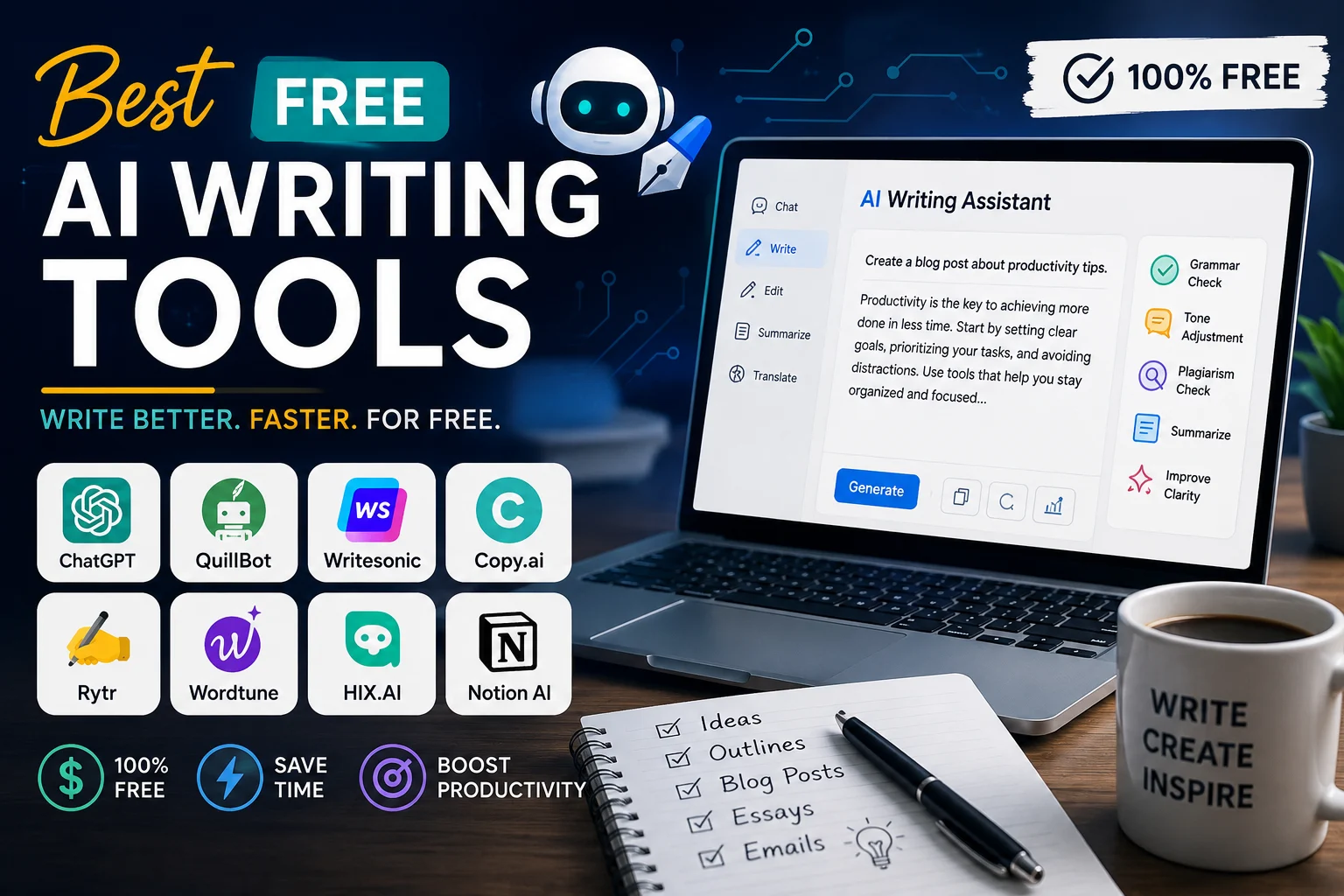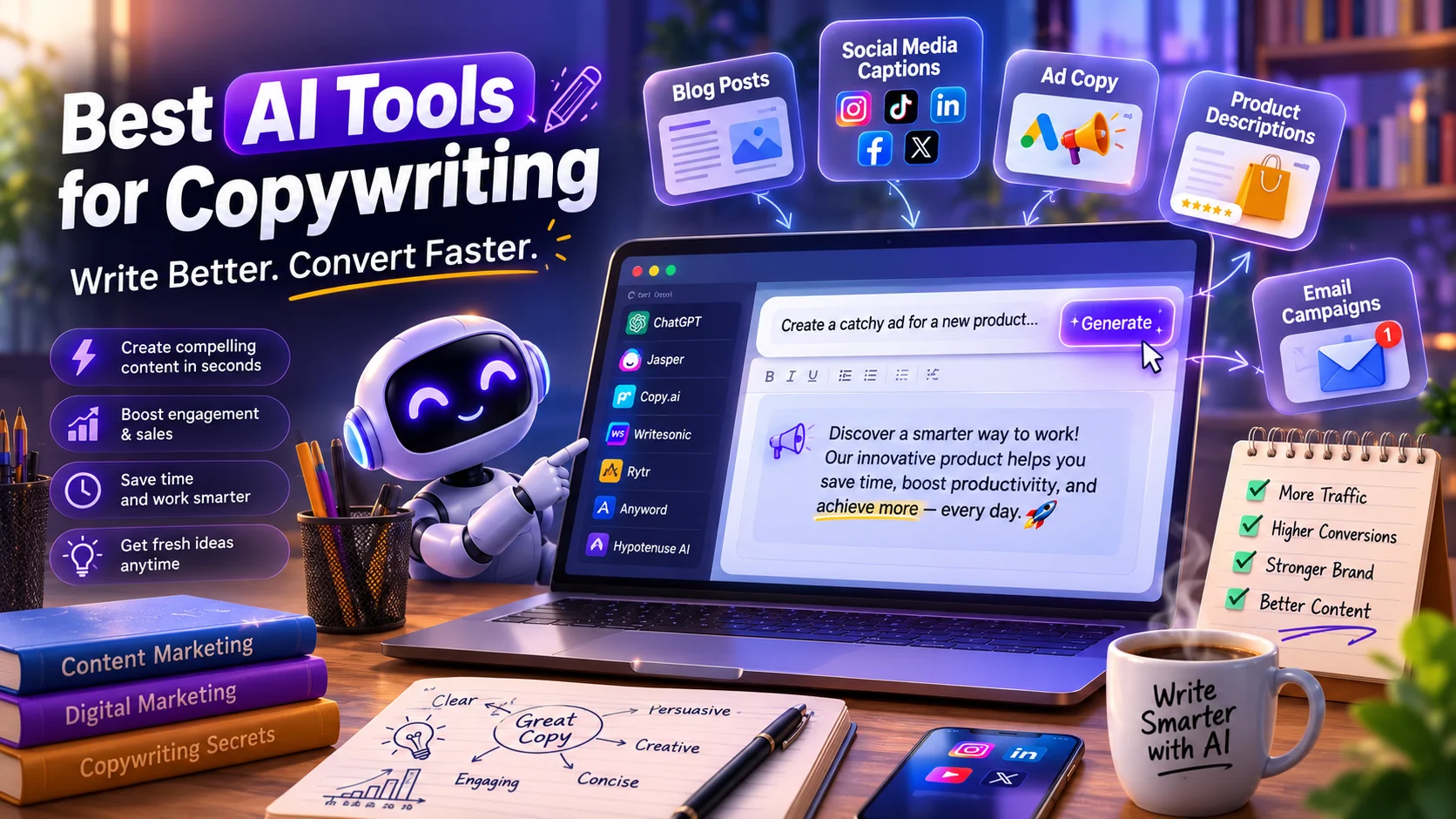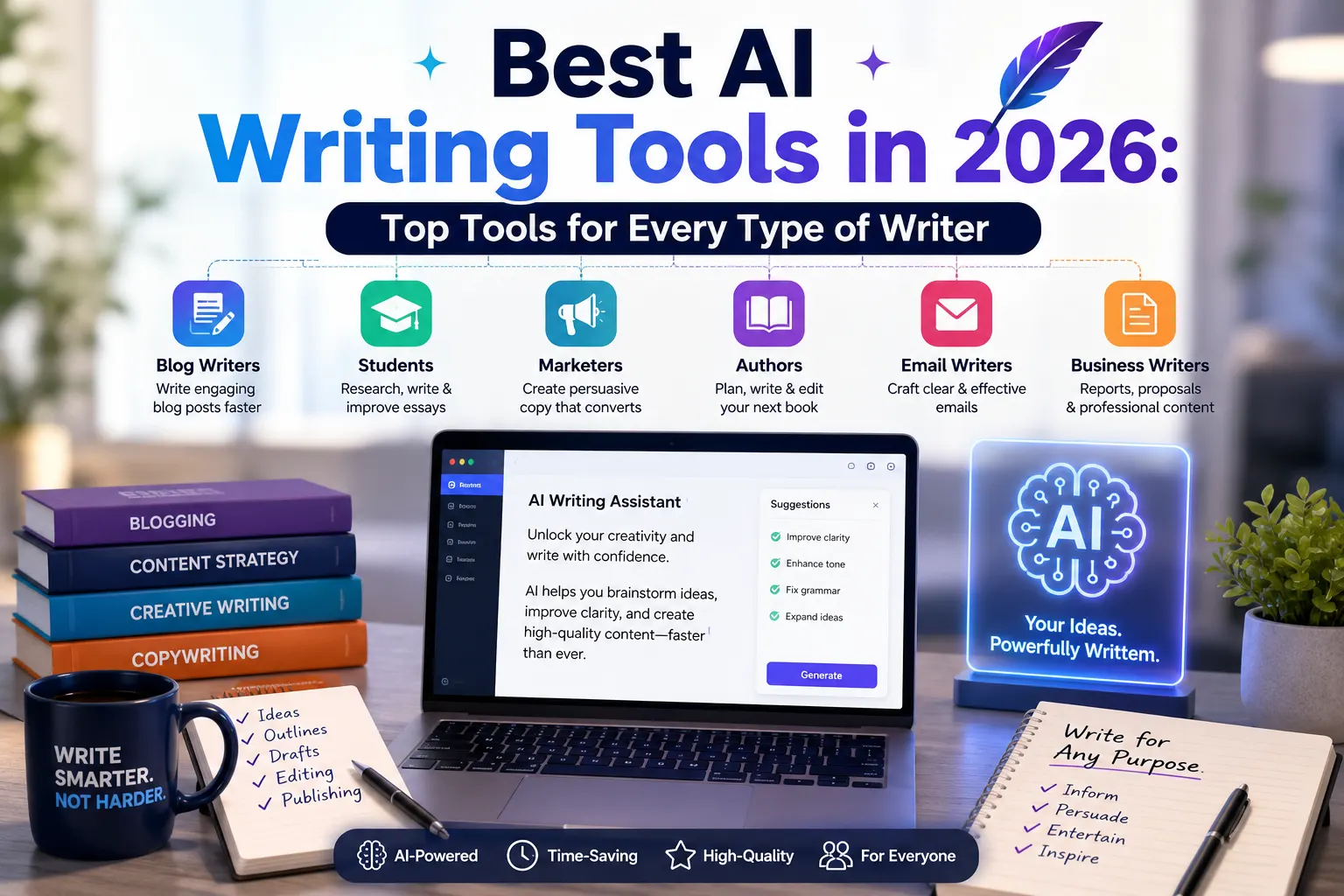

AI writing tools have evolved far beyond simple text generators. In 2026, writers, bloggers, marketers, students, entrepreneurs, and businesses can use artificial intelligence to brainstorm ideas, create drafts, improve grammar, rewrite content, optimize articles, and maintain a consistent brand voice.
But with so many AI writing tools available, choosing the right one can be difficult. Some tools are designed for general-purpose writing, while others focus on marketing, SEO, editing, business communication, or creative writing.
In this guide, we'll explore the best AI writing tools in 2026, what each tool does best, and which option may be right for your specific needs.
What Are AI Writing Tools?
AI writing tools are software applications that use artificial intelligence to help people create, edit, improve, or transform written content.
Depending on the platform, an AI writing assistant can help with tasks such as:
- Writing blog posts and articles
- Creating marketing copy
- Writing emails
- Brainstorming ideas
- Rewriting and paraphrasing text
- Correcting grammar and spelling
- Improving clarity and readability
- Creating social media content
- Generating product descriptions
- Creating outlines and content briefs
- Adapting content to different audiences and tones
The best choice depends on what you want to accomplish. A general-purpose AI assistant may be ideal for a blogger, while a marketing team may benefit more from a specialized platform with brand and workflow features.
Best AI Writing Tools in 2026
| Tool | Best For | Main Strength |
|---|---|---|
| ChatGPT | General writing | Versatility and brainstorming |
| Claude | Long-form writing | Natural and detailed prose |
| Jasper | Marketing teams | Brand-focused content workflows |
| Grammarly | Editing | Grammar, clarity, and tone |
| Copy.ai | Marketing and sales | Content and go-to-market workflows |
| Writesonic | SEO content | Content and search-focused workflows |
| Notion AI | Productivity | Writing inside a workspace |
| QuillBot | Paraphrasing | Rewriting and summarization |
1. ChatGPT — Best Overall AI Writing Tool
Best for: Bloggers, students, professionals, marketers, and general-purpose writing.
ChatGPT remains one of the most versatile AI writing assistants in 2026. It can help users move from an idea to an outline, draft, revision, and final version without needing a separate application for every stage.
You can use it to brainstorm blog topics, create article outlines, write first drafts, rewrite paragraphs, simplify complicated explanations, adjust tone, and turn notes into polished content.
One of its biggest advantages is flexibility. The same tool can be used for a blog post in the morning, an email in the afternoon, and a marketing campaign in the evening.
Why Choose ChatGPT?
- Excellent for many different writing tasks
- Useful for brainstorming and outlining
- Can rewrite and refine existing content
- Supports different tones and writing styles
- Useful for both short-form and long-form content
Best choice if: You want one versatile AI assistant that can handle many different types of writing.
2. Claude — Best for Long-Form and Natural Writing
Best for: Long-form articles, essays, reports, and nuanced writing.
Claude is another strong choice for writers who care about readability, structure, and natural-sounding prose.
It can be particularly useful when working with long documents or when you want an AI assistant to help analyze, reorganize, and rewrite substantial amounts of material.
Claude can help writers develop outlines, expand ideas, improve transitions, summarize information, and refine the tone of a document.
Why Choose Claude?
- Strong long-form writing capabilities
- Useful for detailed documents
- Good at restructuring and rewriting
- Useful for maintaining context across longer projects
- Suitable for professional and creative writing
Best choice if: Your priority is detailed, natural-sounding long-form content.
3. Jasper — Best AI Writing Tool for Marketing Teams
Best for: Marketing departments, agencies, and businesses.
Jasper is designed around marketing and business content rather than being simply a general-purpose chatbot.
Marketing teams can use specialized AI workflows to create content for campaigns, advertisements, websites, product pages, and other marketing channels.
One of the main reasons businesses consider Jasper is the importance of maintaining consistency across large amounts of content. Brand voice and marketing workflows become increasingly important when several people are producing content for the same company.
Why Choose Jasper?
- Designed with marketing teams in mind
- Useful for brand-focused content
- Suitable for campaign workflows
- Helpful for producing marketing content at scale
- Designed for business content operations
Best choice if: You manage marketing content for a business or team and need greater consistency.
4. Grammarly — Best AI Writing Tool for Editing
Best for: Grammar, spelling, clarity, tone, and polishing existing writing.
Grammarly takes a different approach from traditional AI content generators. Instead of focusing primarily on creating entire articles from scratch, it is especially useful for improving writing that already exists.
It can help identify grammar problems, improve clarity, adjust tone, and make writing easier to understand.
This makes Grammarly useful for emails, business documents, academic writing, website copy, and everyday communication.
Why Choose Grammarly?
- Useful for proofreading
- Helps improve grammar and spelling
- Can improve clarity and readability
- Useful for adjusting writing tone
- Works well as an editing layer alongside generative AI
Best choice if: You already write your content but want an AI assistant to polish and improve it.
5. Copy.ai — Best for Marketing and Sales Workflows
Best for: Marketing, sales, and business content workflows.
Copy.ai has expanded beyond simple copy generation and is increasingly focused on business workflows and go-to-market use cases.
It can be useful for creating marketing messages, sales content, social media copy, campaign material, and other business communications.
For organizations producing large volumes of marketing and sales content, workflow automation can be more valuable than simply generating individual paragraphs.
Why Choose Copy.ai?
- Useful for marketing content
- Useful for sales-related writing
- Designed around business workflows
- Can help create short-form marketing copy
- Suitable for teams producing content at scale
Best choice if: Your writing needs are closely connected to marketing, sales, or business growth.
6. Writesonic — Best for SEO-Focused Content
Best for: Bloggers, publishers, and SEO-focused content creators.
Writesonic is designed for people who want to combine AI-assisted writing with content and search-focused workflows.
For website owners, one of the most important advantages of an SEO-oriented writing platform is the ability to think about content as part of a larger search strategy rather than simply generating text.
However, AI-generated content should never be published without review. Writers should check facts, improve the originality of the article, add useful examples, and make sure the content genuinely satisfies the reader's search intent.
Why Choose Writesonic?
- Useful for SEO-oriented content workflows
- Designed for content creators and publishers
- Helpful for blog production
- Can accelerate content research and drafting
- Useful for websites producing content regularly
Best choice if: Your primary goal is producing content for a website and supporting an SEO strategy.
7. Notion AI — Best for Writing Inside a Workspace
Best for: Teams and individuals who already use Notion.
Notion AI is useful because the AI writing functionality is integrated directly into the Notion workspace.
Instead of moving information between different applications, users can work with notes, documents, databases, and AI assistance in the same environment.
This can be particularly useful for teams managing content calendars, documentation, project notes, meeting information, and internal knowledge.
Why Choose Notion AI?
- Integrated into the Notion workspace
- Useful for notes and documents
- Helpful for summarizing information
- Useful for brainstorming
- Good option for teams already using Notion
Best choice if: Your content and notes already live inside Notion.
8. QuillBot — Best for Paraphrasing and Rewriting
Best for: Paraphrasing, rewriting, and summarizing.
QuillBot is particularly useful when you already have text and want to express the same idea differently.
It can help rewrite sentences, improve wording, summarize longer passages, and experiment with alternative ways of expressing an idea.
This makes it useful for students, professionals, researchers, and writers who frequently need to revise existing text.
Why Choose QuillBot?
- Strong focus on paraphrasing
- Useful for rewriting sentences
- Helpful for summarization
- Can provide alternative wording
- Useful as a revision tool
Best choice if: Your main requirement is rewriting and paraphrasing existing content.
Which AI Writing Tool Is Best for You?
There is no single AI writing tool that is perfect for everyone. The right choice depends on your workflow.
For General Writing
ChatGPT is an excellent starting point if you need help with many different types of writing, from brainstorming and outlining to rewriting and polishing.
For Long Articles
Claude is a strong option when your work involves long-form documents, detailed explanations, or nuanced writing.
For Marketing Teams
Jasper is worth considering if your organization needs marketing-focused workflows and consistent brand communication.
For Grammar and Editing
Grammarly is particularly useful when you already have a draft and want to improve its grammar, clarity, and tone.
For SEO Content
Writesonic can be useful for publishers and bloggers who want AI writing combined with SEO-oriented content workflows.
For Sales and Marketing Copy
Copy.ai is a strong option for businesses that want AI assistance across marketing and sales workflows.
For Paraphrasing
QuillBot is a good choice when rewriting and paraphrasing are your primary needs.
Are AI Writing Tools Worth Using in 2026?
For many writers, the answer is yes—but the best results come from using AI as an assistant rather than treating it as a replacement for human judgment.
AI can dramatically reduce the time required to start a piece of content. It can help overcome writer's block, organize ideas, create initial drafts, and identify areas that need improvement.
However, automatically generated content can still contain inaccurate information, repetitive language, weak arguments, or generic explanations.
A strong workflow is therefore:
- Define the purpose and audience.
- Research the topic.
- Create an outline.
- Use AI to develop a draft.
- Fact-check important claims.
- Add your own expertise and examples.
- Edit the structure and writing style.
- Optimize the content for the reader.
- Proofread the final version.
- Publish only after human review.
How to Get Better Results From AI Writing Tools
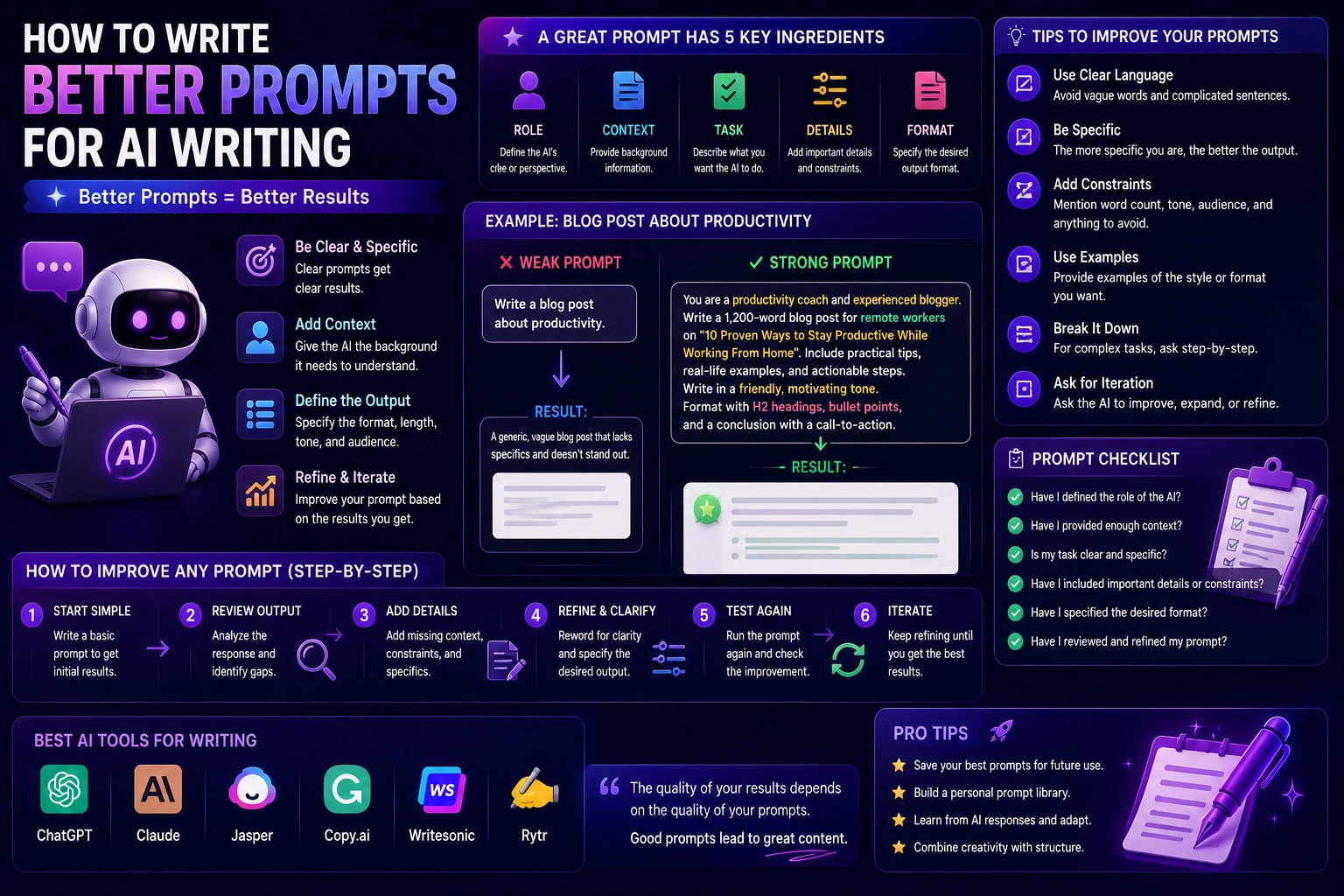
The quality of AI-generated writing depends heavily on the instructions you provide.
Instead of asking an AI tool to simply "write an article," provide useful context about the audience, purpose, tone, structure, and requirements.
For example, tell the AI:
- Who the target audience is
- What the reader should learn
- What tone the article should use
- How long the content should be
- Which sections should be included
- Which information must be verified
- Which words or claims should be avoided
For long-form content, it is often better to create an outline first and then develop each section rather than asking for thousands of words in a single step.
AI Writing Tools vs. Human Writers
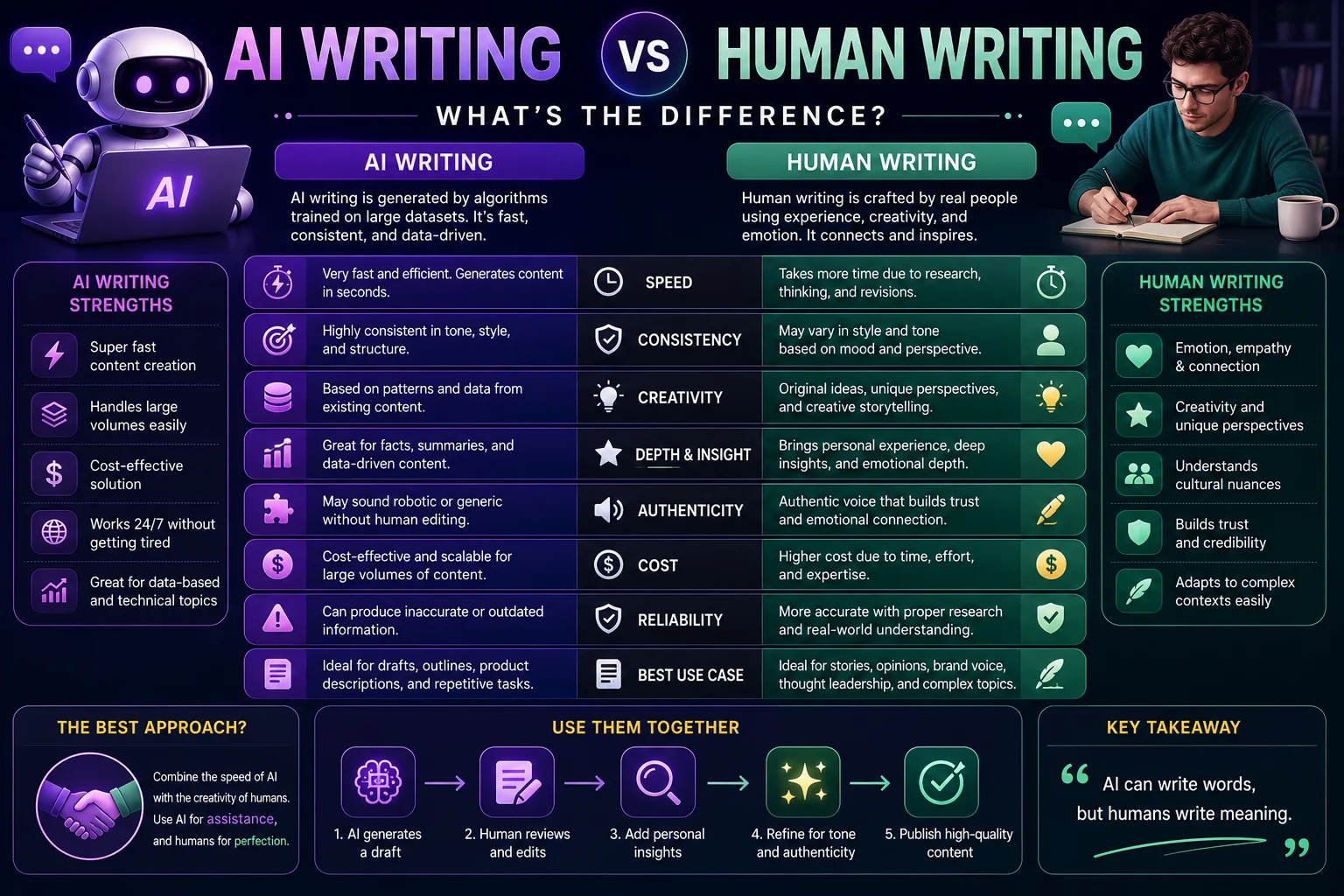
AI writing tools are excellent at speed, brainstorming, restructuring, and generating first drafts. Human writers remain essential for judgment, originality, expertise, fact-checking, storytelling, and understanding the real needs of an audience.
The most effective approach in 2026 is not necessarily AI versus human writers. It is often AI plus human expertise.
A writer can use AI to handle repetitive parts of the writing process while spending more time on research, ideas, personal experience, and editorial decisions.
Final Verdict
The best AI writing tool in 2026 depends on what you need to write.
ChatGPT is one of the best all-purpose choices for brainstorming, drafting, rewriting, and everyday writing. Claude is a strong option for long-form and nuanced writing. Jasper is better suited to marketing teams, while Grammarly excels at editing and polishing. Copy.ai focuses strongly on marketing and sales workflows, Writesonic is useful for SEO-focused content, Notion AI works well inside a productivity workspace, and QuillBot is particularly useful for paraphrasing.
The best strategy may not be choosing just one tool. Many professional writers use a combination: one tool for generating ideas and drafts, another for research or SEO, and an editing tool for the final review.
Whatever tool you choose, remember that AI should make your writing process faster and more effective—not remove the human thinking that makes content genuinely useful.
Frequently Asked Questions
What is the best AI writing tool in 2026?
There is no universal winner. ChatGPT is an excellent general-purpose choice, while Claude, Jasper, Grammarly, Copy.ai, Writesonic, Notion AI, and QuillBot each have different strengths.
Can AI writing tools write complete blog posts?
Yes. Many AI writing tools can generate complete drafts. However, you should review, fact-check, edit, and improve AI-generated content before publishing it.
Are AI writing tools good for SEO?
AI can help with brainstorming, outlining, drafting, and content optimization, but SEO success depends on the usefulness, originality, accuracy, and relevance of the final content—not simply whether AI was used.
Which AI writing tool is best for beginners?
ChatGPT is a strong starting point because it can handle many different writing tasks without requiring users to learn a specialized workflow.
Can AI replace professional writers?
AI can automate parts of the writing process, but professional writers still provide important skills such as research, judgment, storytelling, originality, fact-checking, and editorial expertise.
Should I use more than one AI writing tool?
You can. A combination of a general AI assistant, an editing tool, and an SEO or marketing platform can be useful when each tool serves a different purpose.