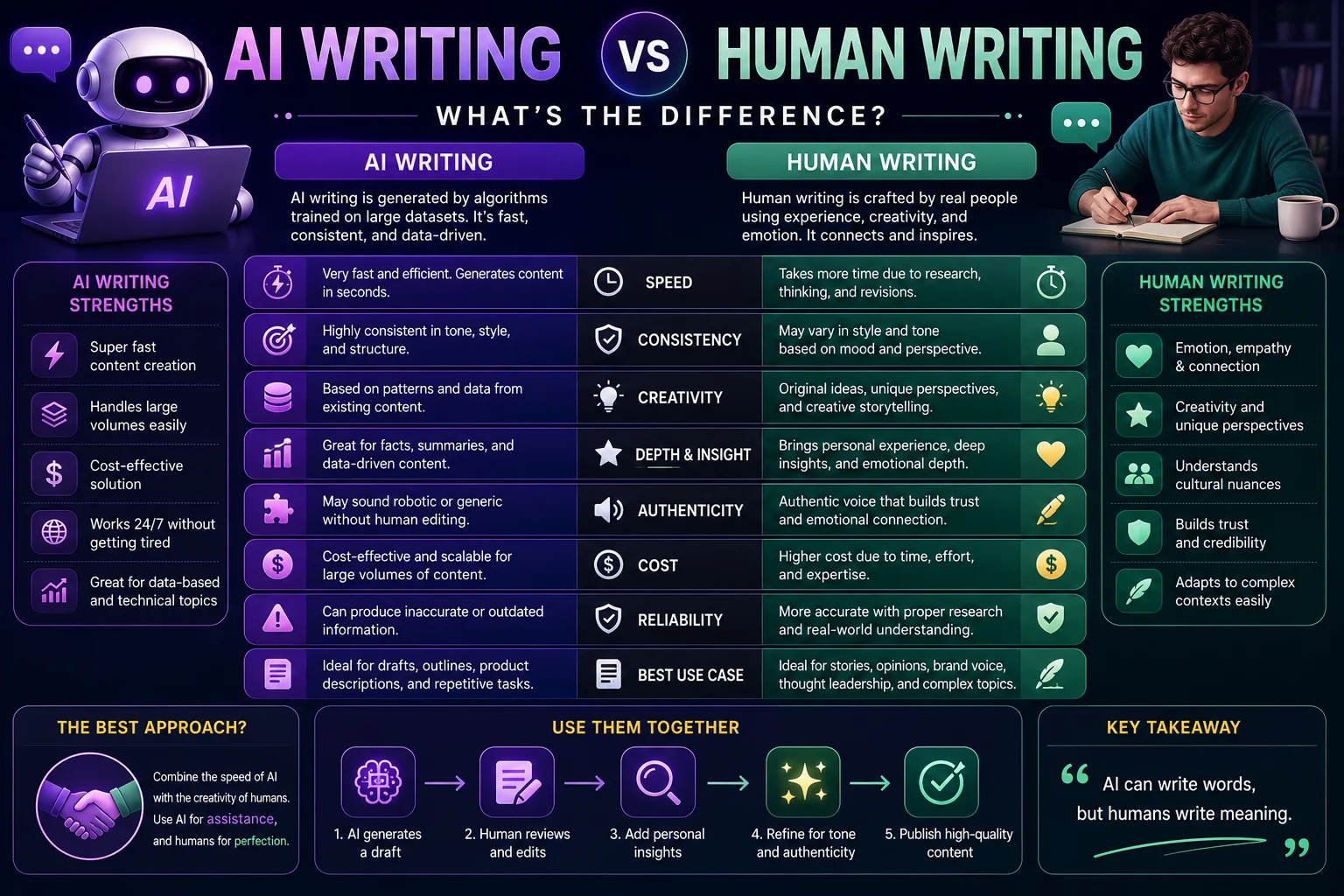

AI writing has changed the way people create content. Tools such as ChatGPT, Claude, and Gemini can generate articles, emails, advertisements, summaries, product descriptions, and other types of text in seconds.
But fast doesn't always mean better. Human writers bring experience, creativity, personal perspective, emotional understanding, and judgment that AI cannot automatically reproduce in every situation.
So which is better: AI writing or human writing?
The answer depends on the task. AI can be extremely useful for brainstorming, drafting, rewriting, and repetitive writing tasks, while humans remain essential for strategy, originality, personal experience, fact-checking, and final editorial decisions.
In this guide, we'll compare AI writing and human writing and explain the strengths and weaknesses of each approach.
What Is AI Writing?
AI writing is text generated or assisted by an artificial intelligence system. Modern AI writing tools use language models trained on large amounts of text to generate responses based on the instructions and context provided by the user.
AI writing tools can create many different types of content, including:
- Blog articles
- Emails
- Social media posts
- Product descriptions
- Advertisements
- Reports
- Summaries
- Brainstorming ideas
- Outlines
- Marketing copy
The quality of the result depends heavily on the AI model, the instructions provided, the available context, and the amount of human review.
What Is Human Writing?
Human writing is created by a person using their knowledge, experience, creativity, opinions, observations, and understanding of the intended audience.
A human writer can draw on personal experiences and make judgments based on context that may not be explicitly included in a prompt.
Human writing is especially valuable when a piece of content needs a distinctive voice, personal perspective, original research, emotional depth, or strong editorial judgment.
AI Writing vs Human Writing: Quick Comparison
| Factor | AI Writing | Human Writing |
|---|---|---|
| Speed | Extremely fast | Usually slower |
| Creativity | Can generate many ideas | Strong original perspective |
| Personal experience | Limited to provided context | Can draw from lived experience |
| Consistency | Highly consistent with clear instructions | Can vary naturally |
| Emotional understanding | Can imitate emotional language | Can understand and express personal emotion |
| Research assistance | Can help organize and summarize information | Can investigate, evaluate, and interpret sources |
| Repetitive tasks | Excellent | Time-consuming |
| Final judgment | Requires human oversight | Can make contextual editorial decisions |
1. Speed
Speed is one of the biggest advantages of AI writing.
An AI writing tool can produce a draft in seconds or minutes. A human writer may need much longer to research the subject, plan the structure, write the content, and edit the final version.
This makes AI particularly useful for tasks where producing an initial draft quickly is more important than creating a highly original final piece.
Winner for speed: AI.
2. Creativity
AI can generate a large number of ideas very quickly. For example, it can produce dozens of headlines, marketing angles, article ideas, or opening paragraphs.
However, generating many combinations of language is not necessarily the same as having a genuinely original creative perspective.
Human writers can connect ideas to personal experiences, cultural observations, emotions, and unusual perspectives. They can intentionally break conventions and make creative decisions based on their understanding of the audience.
Winner for original creative perspective: Human writing.
3. Personal Experience
One of the clearest differences between AI and human writing is personal experience.
A human writer can describe something they personally experienced, including specific observations, emotions, mistakes, lessons, and unexpected details.
AI does not have personal experiences in the human sense. It can write convincingly about an experience when given information about it, but it should not be treated as a person who actually lived that experience.
This makes human-written first-hand content particularly valuable for reviews, personal stories, case studies, travel experiences, interviews, and opinion pieces.
Winner for first-hand experience: Human writing.
4. Emotional Depth
AI can produce writing that sounds emotional. It can generate sympathetic, enthusiastic, dramatic, humorous, or encouraging language.
But there is an important distinction between generating emotional language and actually experiencing emotion.
Human writers can use their own feelings and experiences to communicate subtle emotional ideas. They can also make nuanced judgments about how a particular audience may react.
For deeply personal stories and emotionally sensitive writing, human involvement remains particularly important.
Winner for authentic personal emotion: Human writing.
5. Accuracy
Neither AI nor humans are automatically accurate.
AI systems can generate incorrect information, misunderstand a question, or present an unsupported claim with confidence. This is one reason AI-generated content should be reviewed before publication, especially when accuracy matters.
Human writers can also make mistakes, misunderstand sources, or publish outdated information.
The important difference is that responsible human writers can investigate sources, compare evidence, question assumptions, and make editorial decisions.
For important factual content, the best approach is to verify information regardless of whether the first draft was produced by AI or a human.
Winner: Neither automatically. Verification matters more than the authoring method.
6. Consistency
AI can be very consistent when given clear instructions.
For example, you can ask an AI tool to rewrite dozens of product descriptions using the same structure, tone, and formatting requirements.
A human writer can also maintain a consistent brand voice, but doing so across hundreds of repetitive pieces can require more time and careful editing.
This makes AI particularly useful for large-scale content production.
Winner for repetitive consistency: AI.
7. Understanding Context
Human writers naturally use context from their environment, experiences, conversations, and knowledge.
AI can understand a large amount of context when it is provided in the conversation or available through the system being used, but it does not automatically know everything about your business, audience, or situation.
The quality of an AI response therefore depends heavily on the quality of the context you provide.
A detailed prompt can significantly improve the result.
8. Writing Style
AI can imitate many different writing styles and tones.
You can ask it to write in a professional, friendly, educational, conversational, technical, persuasive, or humorous style.
However, AI-generated writing can sometimes feel generic, especially when the prompt contains little information about the desired voice.
Human writers can develop a distinctive voice over time based on their personality, experiences, preferences, and creative decisions.
Winner for distinctive personal voice: Human writing.
9. Editing and Rewriting
AI is particularly useful for editing existing text.
You can ask an AI tool to:
- Correct grammar
- Improve clarity
- Shorten paragraphs
- Remove repetition
- Change the tone
- Create alternative headlines
- Simplify complex language
- Rewrite content for a different audience
A human editor is still valuable for deciding whether the changes actually improve the content and preserve the author's intended meaning.
The combination can be more effective than relying entirely on either one.
10. Research and Source Evaluation
AI can help organize information, generate research questions, summarize supplied material, and identify areas that need further investigation.
However, AI-generated information should not automatically be treated as verified research.
Human researchers can evaluate the credibility of sources, compare conflicting information, inspect original documents, and decide whether evidence actually supports a claim.
For academic, medical, legal, financial, or other high-stakes topics, reliable sources and careful verification are especially important.
Advantages of AI Writing
AI writing has several practical advantages.
- Very fast content generation
- Useful for brainstorming
- Can generate many variations
- Useful for repetitive writing tasks
- Can help with editing and rewriting
- Available at any time
- Can help organize ideas
- Useful for overcoming writer's block
Disadvantages of AI Writing
- Can produce inaccurate information
- May sound generic without good instructions
- Does not provide genuine personal experience
- Can repeat common ideas and patterns
- Requires human review for important content
- May not fully understand an organization's context without sufficient information
- Can produce confident-sounding but unsupported claims
Advantages of Human Writing
- Personal experience
- Original perspective
- Distinctive voice
- Human judgment
- Emotional understanding
- Ability to conduct and interpret original research
- Deep understanding of personal and cultural context
Disadvantages of Human Writing
- Usually takes more time
- Can be expensive for large content projects
- Repetitive tasks can become inefficient
- Writers can make factual and grammatical mistakes
- Producing many variations can take significant effort
When Should You Use AI Writing?
AI is particularly useful when you need to save time or generate a starting point.
Consider using AI for:
- Brainstorming ideas
- Creating outlines
- Writing first drafts
- Generating headlines
- Creating social media variations
- Rewriting existing text
- Summarizing information
- Improving grammar and clarity
- Creating repetitive marketing content
When Should You Use Human Writing?
Human writing is especially important when the content depends on experience, judgment, originality, or a unique personal voice.
Examples include:
- Personal essays
- First-hand reviews
- Personal stories
- Opinion pieces
- Original research
- Investigative journalism
- Brand strategy
- Highly sensitive communication
The Best Approach: AI + Human Writing
The choice does not have to be AI versus humans.
For many content workflows, the strongest approach is to combine both.
AI can handle time-consuming tasks while the human writer remains responsible for ideas, research, judgment, editing, and the final result.
A practical workflow could look like this:
- Human: Define the goal and audience.
- AI: Brainstorm ideas and create an outline.
- Human: Add research, experience, and unique insights.
- AI: Help create or refine a draft.
- Human: Fact-check and edit the content.
- AI: Check grammar and suggest improvements.
- Human: Make the final editorial decisions.
This workflow uses AI where it is efficient while keeping human judgment at the center of the publishing process.
Can Readers Tell When Something Is AI-Written?
Sometimes AI-generated writing can be recognizable because it may contain repetitive structures, generic introductions, predictable transitions, excessive explanations, or phrases that appear frequently in AI-generated content.
However, there is no reliable way to determine authorship simply by reading every piece of text, and automated AI-detection systems are not perfect.
The better goal is not to hide AI assistance. Instead, focus on producing useful, accurate, original content that provides genuine value to the reader.
How to Make AI-Assisted Writing Better
If you use AI to help create content, there are several ways to make the final result stronger.
- Provide detailed context.
- Define the target audience.
- Use a clear and specific prompt.
- Add original examples and insights.
- Include first-hand experience where appropriate.
- Remove repetitive or generic language.
- Verify factual claims.
- Check sources when research is involved.
- Edit the final content yourself.
- Make sure the article actually answers the reader's question.
AI Writing vs Human Writing for SEO
AI can be useful for SEO content because it can help generate outlines, topic ideas, titles, FAQs, and initial drafts quickly.
However, producing text with AI does not automatically make content valuable or successful in search results.
Strong SEO content should satisfy search intent, provide useful information, demonstrate appropriate expertise, and offer a good experience to the reader.
Human editing can help add original insights, examples, first-hand experience, and information that makes the content more useful than a generic AI-generated summary.
AI Writing vs Human Writing: Which Is Better?
There is no universal winner.
If your priority is speed, scale, brainstorming, and repetitive tasks, AI writing has a major advantage.
If your priority is personal experience, originality, emotional depth, research judgment, and a distinctive voice, human writing has important advantages.
For most professional content workflows, the best solution is not choosing one over the other. It is using AI as a tool while keeping humans responsible for strategy, accuracy, creativity, and final editorial decisions.
Final Verdict
AI writing has become a powerful productivity tool, but it does not eliminate the value of human writers.
AI can generate content quickly, produce multiple ideas, rewrite text, and automate repetitive tasks. Human writers contribute personal experience, original perspectives, emotional understanding, research judgment, and distinctive voices.
The strongest approach is often a combination of both. Let AI help with the parts of writing where speed and repetition matter, then use human judgment to add originality, verify information, improve the voice, and make the final content genuinely useful.
In other words, the future of writing doesn't necessarily have to be AI vs human. It can be AI and human working together.
Frequently Asked Questions
Is AI writing better than human writing?
Not universally. AI is generally faster and useful for repetitive tasks, brainstorming, and drafting, while human writers offer personal experience, original perspective, judgment, and distinctive voice.
Can AI completely replace human writers?
AI can automate many writing tasks, but human involvement remains valuable for strategy, originality, first-hand experience, research evaluation, editing, and final judgment.
What is the biggest advantage of AI writing?
Speed is one of the biggest advantages. AI can generate drafts, ideas, summaries, and variations much faster than a person can manually create them.
What is the biggest advantage of human writing?
Human writing can provide personal experience, original perspective, emotional depth, and a distinctive voice that comes from the writer's own knowledge and experiences.
Can AI writing be used for SEO?
Yes. AI can assist with SEO content, but useful and accurate content should remain the priority. AI-generated text should be reviewed and improved rather than published automatically without human oversight.
Should I use AI or a human writer for my website?
For many websites, a combination works well. AI can help with brainstorming, drafts, and repetitive content, while human writers can add original insights, verify information, and maintain the site's unique voice.
How can I make AI writing sound more natural?
Give the AI detailed context and a clear description of your desired voice. Add original examples and personal insights, remove generic language, and carefully edit the final result.