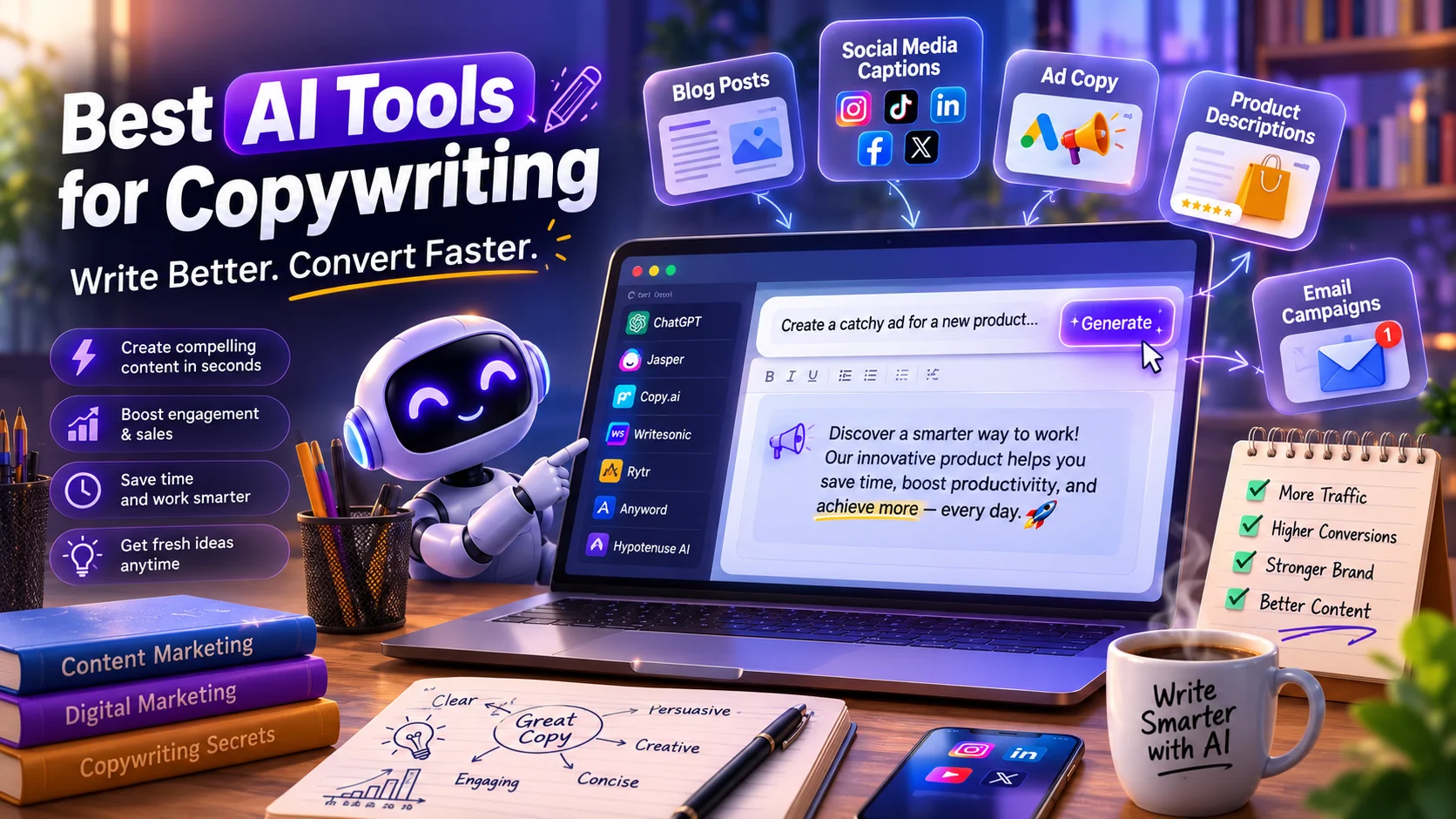

Good copywriting is about more than putting words on a page. A strong headline needs to attract attention, an advertisement needs to persuade, a landing page needs to communicate value, and an email needs to encourage the reader to take action.
AI copywriting tools can make this process much faster. They can help generate headlines, brainstorm campaign ideas, write product descriptions, create email sequences, develop advertising variations, and improve existing marketing copy.
In 2026, the AI copywriting market includes both general-purpose AI assistants and specialized marketing platforms. Current comparisons commonly highlight ChatGPT and Claude for flexible writing, while tools such as Jasper, Copy.ai, Writesonic, Grammarly, and Anyword focus on specific marketing workflows.
In this guide, we'll look at the best AI tools for copywriting and explain which one is best for different types of marketing content.
Best AI Tools for Copywriting in 2026
The right tool depends on what you are creating. A freelance copywriter may prefer a flexible AI assistant, while a marketing team producing hundreds of assets may benefit more from brand controls, templates, automation, and collaboration features.
- ChatGPT — Best overall for flexible copywriting and brainstorming
- Claude — Best for natural, nuanced, long-form copy
- Jasper — Best for marketing teams and brand consistency
- Copy.ai — Best for sales and marketing workflows
- Writesonic — Best for SEO-focused marketing content
- Grammarly — Best for editing and polishing copy
- QuillBot — Best for rewriting and paraphrasing
- Anyword — Best for performance-focused marketing copy
1. ChatGPT
ChatGPT is one of the most versatile AI tools for copywriting. It can help with everything from brainstorming campaign concepts to writing headlines, advertisements, emails, landing pages, social media posts, and product descriptions.
Current 2026 comparisons continue to identify ChatGPT as one of the strongest general-purpose options for copywriters because of its flexibility across different formats and workflows.
What can ChatGPT do for copywriters?
- Generate headline ideas
- Write advertising copy
- Create email campaigns
- Write landing page sections
- Create product descriptions
- Brainstorm marketing angles
- Rewrite existing copy
- Generate social media content
- Create calls to action
- Develop different versions for A/B testing
One of its biggest advantages is flexibility. You can give it a detailed customer profile, product information, brand voice, and campaign objective and ask it to generate multiple copy variations.
Best for: Freelancers, entrepreneurs, marketers, bloggers, and copywriters who need one flexible tool for many types of content.
2. Claude
Claude is a strong choice for copywriters who prioritize natural language, nuance, and long-form writing.
Recent 2026 comparisons frequently highlight Claude for long-form and nuanced copy, particularly when the writing needs to feel natural and maintain a consistent voice across a large amount of content.
Why use Claude for copywriting?
- Natural writing style
- Strong long-form capabilities
- Useful for brand storytelling
- Good at refining existing copy
- Useful for detailed briefs
- Can analyze lengthy brand and product information
Claude can be particularly useful when the copy needs personality rather than simply following a predefined marketing template.
Best for: Brand storytelling, long-form marketing content, website copy, newsletters, and sophisticated marketing campaigns.
3. Jasper
Jasper is specifically focused on marketing and content workflows. Unlike general-purpose AI assistants, it is designed around marketing teams that need consistent messaging across multiple campaigns and channels.
Current 2026 comparisons identify Jasper as a strong option for teams producing marketing content at scale and needing brand voice controls and campaign workflows.
Why use Jasper?
- Marketing-focused workflows
- Brand voice features
- Marketing templates
- Campaign content creation
- Team-oriented workflows
- Useful for producing content at scale
Jasper makes more sense when you are managing a marketing operation rather than occasionally writing a headline or email.
Best for: Marketing teams, agencies, businesses, and organizations producing large amounts of brand-controlled content.
4. Copy.ai
Copy.ai has evolved beyond simple AI text generation and increasingly focuses on sales and go-to-market workflows.
It can help marketing and sales teams create content such as email sequences, social posts, advertisements, and other short-form marketing assets. Current comparisons highlight Copy.ai particularly for marketing automation and GTM workflows.
What can Copy.ai help with?
- Sales emails
- Email sequences
- Social media copy
- Ad copy
- Product descriptions
- Marketing workflows
- Sales and marketing automation
Best for: Sales teams, marketing teams, startups, and businesses that want automated marketing workflows.
5. Writesonic
Writesonic is a useful option for marketers who care about SEO and content production as well as copywriting.
Current comparisons position Writesonic as an SEO-focused AI writing platform that can support blog content, landing pages, and other marketing materials.
Why use Writesonic?
- SEO-focused content creation
- Blog writing
- Landing page copy
- Marketing content
- Content optimization workflows
- Useful for producing content at scale
If your copywriting work is closely connected to SEO and organic traffic, Writesonic can be worth considering.
Best for: SEO marketers, bloggers, content teams, and businesses producing search-focused content.
6. Grammarly
Grammarly is different from most tools on this list. It is primarily an editing and writing-improvement platform rather than a dedicated copywriting generator.
It can help identify grammar problems, improve clarity, adjust tone, and polish marketing copy before publication. Current comparisons continue to position Grammarly as a useful editing layer that can work alongside other AI writing tools.
Why use Grammarly?
- Grammar checking
- Spelling corrections
- Clarity improvements
- Tone suggestions
- Sentence rewriting
- Final copy editing
For many copywriters, Grammarly works best alongside a generation tool such as ChatGPT or Claude.
Best for: Editing, proofreading, polishing, and improving marketing copy.
7. QuillBot
QuillBot is best known for paraphrasing and rewriting. It can be useful when you already have a piece of copy but want to explore alternative wording.
What can QuillBot do?
- Rewrite sentences
- Paraphrase existing copy
- Improve readability
- Reduce repetitive wording
- Generate alternative versions
- Summarize content
For example, you could use it to create several versions of a product description and then select the strongest one for your campaign.
Best for: Rewriting, paraphrasing, alternative copy variations, and improving existing text.
8. Anyword
Anyword focuses heavily on marketing copy and performance-oriented content. It is designed for marketers who want to create different versions of copy and evaluate messaging based on predicted performance.
Recent 2026 comparisons include Anyword among the leading tools for marketing copy and performance-focused workflows.
Why use Anyword?
- Marketing copy generation
- Advertising copy
- Multiple copy variations
- Performance-focused workflows
- Marketing content optimization
Best for: Performance marketers, advertisers, and teams testing multiple marketing messages.
AI Copywriting Tools Compared
| AI Tool | Best For | Main Strength |
|---|---|---|
| ChatGPT | General copywriting | Versatility and brainstorming |
| Claude | Long-form copy | Natural and nuanced writing |
| Jasper | Marketing teams | Brand voice and workflows |
| Copy.ai | Sales and marketing | GTM workflows and automation |
| Writesonic | SEO content | SEO and content workflows |
| Grammarly | Editing | Grammar, clarity, and tone |
| QuillBot | Rewriting | Paraphrasing and variations |
| Anyword | Performance marketing | Marketing copy optimization |
Which AI Copywriting Tool Should You Choose?
Best overall: ChatGPT
ChatGPT is a strong starting point for most people because it can handle many different copywriting tasks without requiring a specialized marketing workflow.
Best for natural writing: Claude
Claude is a strong option when the quality and natural feel of the copy are more important than having dozens of marketing templates.
Best for marketing teams: Jasper
Jasper is better suited to organizations that need brand consistency, collaboration, and large-scale content production.
Best for sales and GTM: Copy.ai
Copy.ai is a useful option for businesses that want to connect AI-generated content with sales and marketing workflows.
Best for SEO: Writesonic
Writesonic is worth considering when SEO is a major part of your content strategy.
Best for editing: Grammarly
Grammarly is an excellent companion tool for checking and polishing copy before publishing.
Best for rewriting: QuillBot
QuillBot is useful when you already have copy and need alternative wording or clearer phrasing.
Best for performance marketing: Anyword
Anyword is designed for marketers who want to create and compare different versions of marketing messages.
What Can AI Copywriting Tools Create?
AI copywriting is useful across many marketing channels.
- Facebook advertisements
- Instagram advertisements
- Google Ads copy
- Email campaigns
- Sales emails
- Landing pages
- Product descriptions
- Website headlines
- Calls to action
- Social media posts
- YouTube titles and descriptions
- Marketing slogans
- Promotional campaigns
- Blog introductions
How to Use AI for Copywriting
Step 1: Define your audience
Before asking AI to write anything, explain who the target customer is.
Include information such as age range, industry, interests, problems, goals, and buying motivation when relevant.
Step 2: Explain the product
Give the AI enough information about the product or service to avoid generic copy.
Include its main benefits, important features, pricing information when relevant, and what makes it different from alternatives.
Step 3: Define the goal
Tell the AI what the copy should accomplish.
For example:
- Generate leads
- Increase sales
- Get newsletter signups
- Increase clicks
- Promote a product
- Build brand awareness
Step 4: Specify the format
Tell the AI exactly what you need: a headline, Facebook ad, email, landing page, product description, or another format.
Step 5: Provide your brand voice
Explain whether your brand should sound professional, friendly, playful, technical, premium, direct, conversational, or persuasive.
Step 6: Generate multiple variations
Don't stop with the first result. Ask the AI for several different angles and hooks.
For example, you can request ten headlines using different approaches such as curiosity, urgency, benefit-focused messaging, and problem-solution framing.
Step 7: Edit and test
AI-generated copy is a starting point, not a guaranteed winning campaign. Review the content, remove generic language, verify claims, and test different versions with your audience.
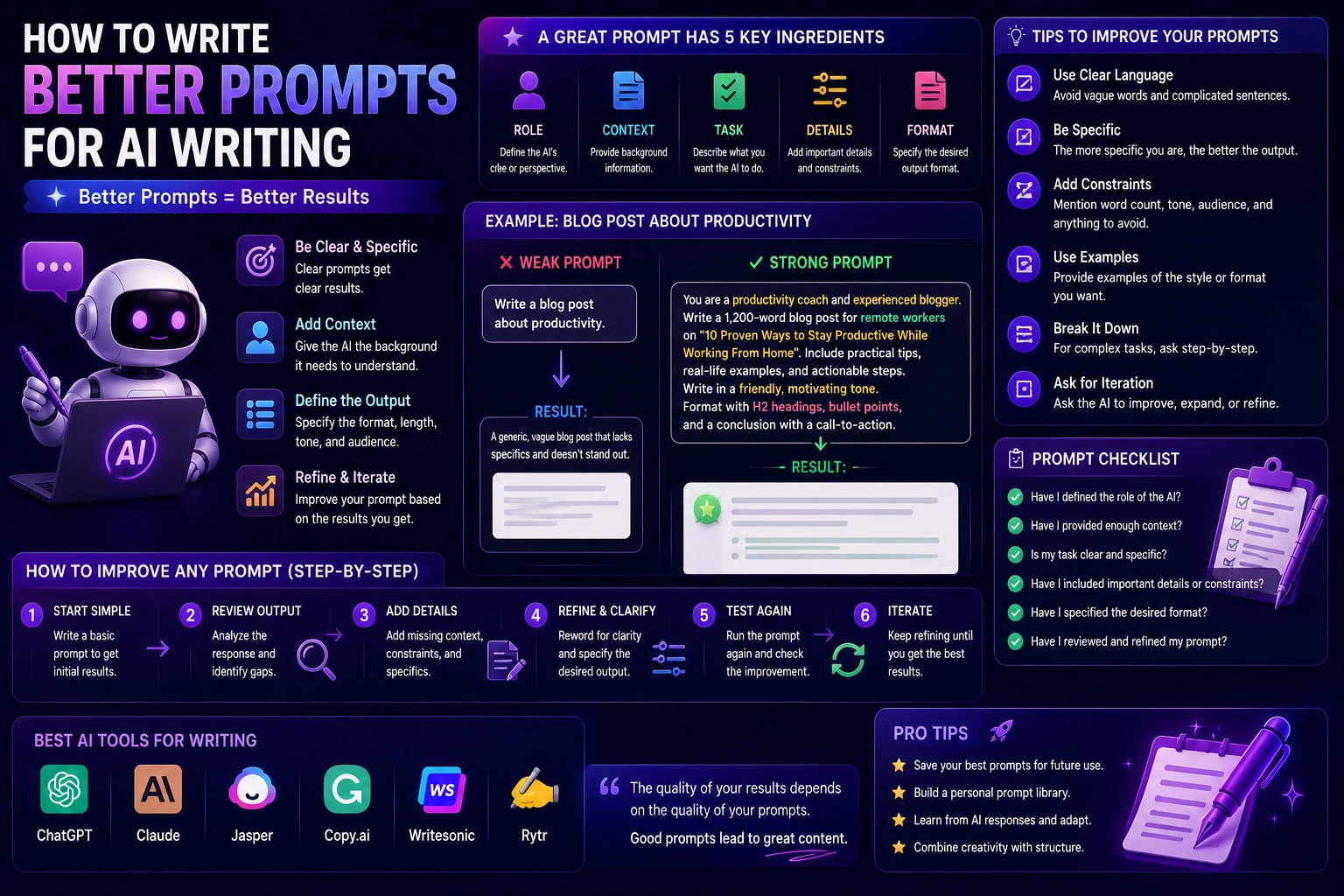
Example AI Copywriting Prompt
A detailed prompt usually produces better results than simply asking AI to "write an ad."
You are an experienced direct-response copywriter. Write five Facebook ad variations for a productivity app aimed at freelancers who struggle to organize their daily tasks. The main benefit is saving time and reducing distractions. Use a clear, conversational tone. Each variation should include a strong hook, a short benefit-focused body, and a clear call to action. Avoid exaggerated claims, clichés, and generic marketing language.
You can adapt this structure to almost any product or marketing campaign.
How to Make AI Copy Sound More Human
One common problem with AI copywriting is that the text can sound generic.
Instead of publishing the first output, add information that only your business or audience would know.
- Customer experiences
- Real product benefits
- Specific examples
- Customer language
- Brand personality
- Real objections
- Industry-specific terminology
You can also ask AI to remove unnecessary filler and preserve your existing brand voice.
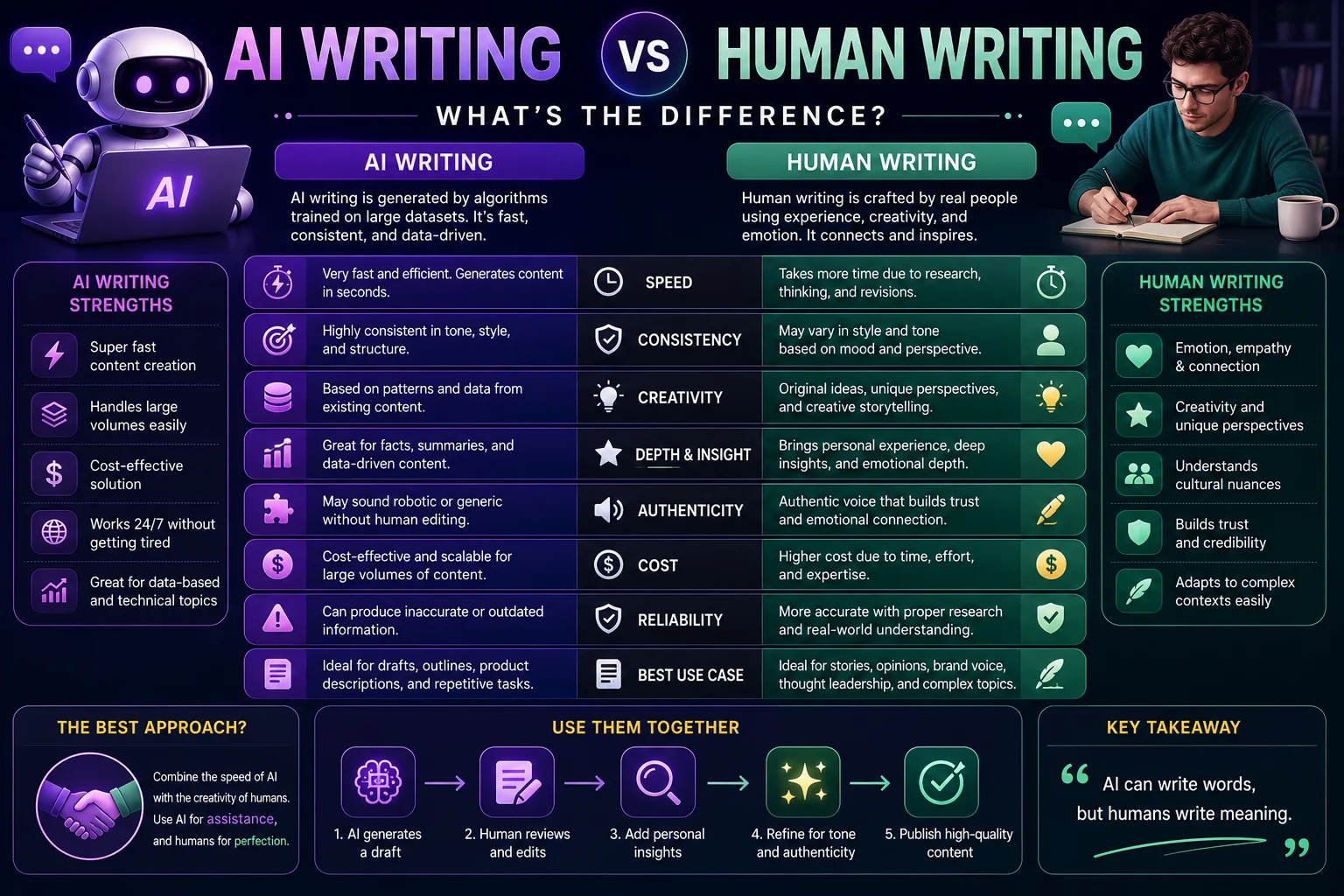
AI Copywriting vs Traditional Copywriting
AI doesn't necessarily replace professional copywriters. In many workflows, it acts as a productivity tool.
| AI Copywriting | Traditional Copywriting |
|---|---|
| Fast idea generation | Deep human research |
| Many variations quickly | Highly customized messaging |
| Useful for first drafts | Strong strategic thinking |
| Can reduce repetitive work | Strong understanding of brand and audience |
| Requires human review | Human judgment throughout the process |
The strongest workflow is often a combination of both. AI can handle repetitive drafting and idea generation while a human copywriter provides strategy, creativity, research, editing, and final judgment.
Are AI Copywriting Tools Good for SEO?
AI can help create SEO-related content, but simply generating text with AI does not guarantee search rankings.
Good SEO copy should satisfy the reader's search intent, provide useful information, demonstrate expertise where appropriate, and offer something valuable beyond generic summaries.
Tools such as Writesonic can be useful when SEO is a central part of the workflow, while general-purpose tools can also help with keyword ideas, outlines, titles, and content development.
Can AI Copywriting Replace Copywriters?
AI can automate many repetitive copywriting tasks, but that does not mean professional copywriters are no longer useful.
Strong copywriting involves understanding the audience, positioning a product, developing a persuasive strategy, identifying customer objections, choosing the right message, and knowing what should not be said.
AI can generate hundreds of ideas, but a human still needs to decide which ideas are strategically appropriate.
For this reason, AI is often more useful as a productivity multiplier than as a complete replacement for a skilled copywriter.
Common AI Copywriting Mistakes
- Publishing AI-generated copy without editing it.
- Using generic marketing language.
- Giving AI too little information about the audience.
- Making unsupported product claims.
- Using the same tone for every campaign.
- Generating only one version of an advertisement.
- Ignoring customer research.
- Focusing on features instead of benefits.
- Failing to test different messages.
Tips for Getting Better Results From AI Copywriting
- Give AI a detailed brief.
- Define the target audience clearly.
- Explain the desired outcome.
- Provide examples of your existing brand voice.
- Ask for multiple creative directions.
- Use specific constraints.
- Remove generic phrases during editing.
- Verify factual and product claims.
- Test different headlines and calls to action.
- Use human judgment for the final version.
Final Verdict
AI copywriting tools can dramatically speed up the process of creating marketing content, but different tools are designed for different workflows.
ChatGPT is an excellent overall option for flexible copywriting and brainstorming. Claude is particularly useful when you want natural, nuanced, long-form copy. Jasper is better suited to marketing teams that need brand consistency and large-scale workflows.
Copy.ai is useful for sales and marketing automation, while Writesonic is worth considering when SEO is a major part of your content strategy. Grammarly works well as an editing layer, QuillBot is useful for rewriting, and Anyword focuses on performance-oriented marketing copy.
There is no single AI copywriting tool that is perfect for everyone. The best choice depends on whether you need flexible writing, brand management, SEO, sales automation, editing, or performance marketing.
For many individual copywriters, starting with a general-purpose AI assistant and an editing tool can be enough. As your content volume grows, specialized platforms can become more valuable because of their templates, brand controls, automation, and team workflows.
Frequently Asked Questions
What is the best AI tool for copywriting?
ChatGPT is one of the best overall choices because it can handle many copywriting formats. Claude is another strong option for natural and nuanced writing, while Jasper and Copy.ai are particularly useful for marketing teams and specialized workflows.
What is the best free AI copywriting tool?
Free versions of tools such as ChatGPT, Claude, Grammarly, QuillBot, and Copy.ai can be useful for getting started. Free features and limits vary, so compare the current plans before choosing a long-term tool.
Can AI write advertising copy?
Yes. AI can generate headlines, ad text, calls to action, product benefits, and multiple advertising variations. Human review and testing are still important because the first AI-generated version is not necessarily the most effective.
Can AI write website copy?
Yes. AI can help create headlines, hero sections, product descriptions, feature explanations, calls to action, FAQs, and other website content.
Is AI copywriting good for SEO?
AI can assist with SEO copywriting, but generating text alone does not guarantee search visibility. The content should satisfy search intent, be accurate, useful, original, and edited for the intended audience.
Can AI replace copywriters?
AI can automate parts of copywriting, especially brainstorming and repetitive drafting. However, strategy, customer understanding, creativity, positioning, editing, and final judgment remain important parts of professional copywriting.
How can I make AI copy sound less robotic?
Give the AI detailed information about your audience and brand voice, provide examples of existing copy, ask for specific language and tone, and edit the final output yourself. Adding real customer insights and specific examples can make the copy more distinctive.