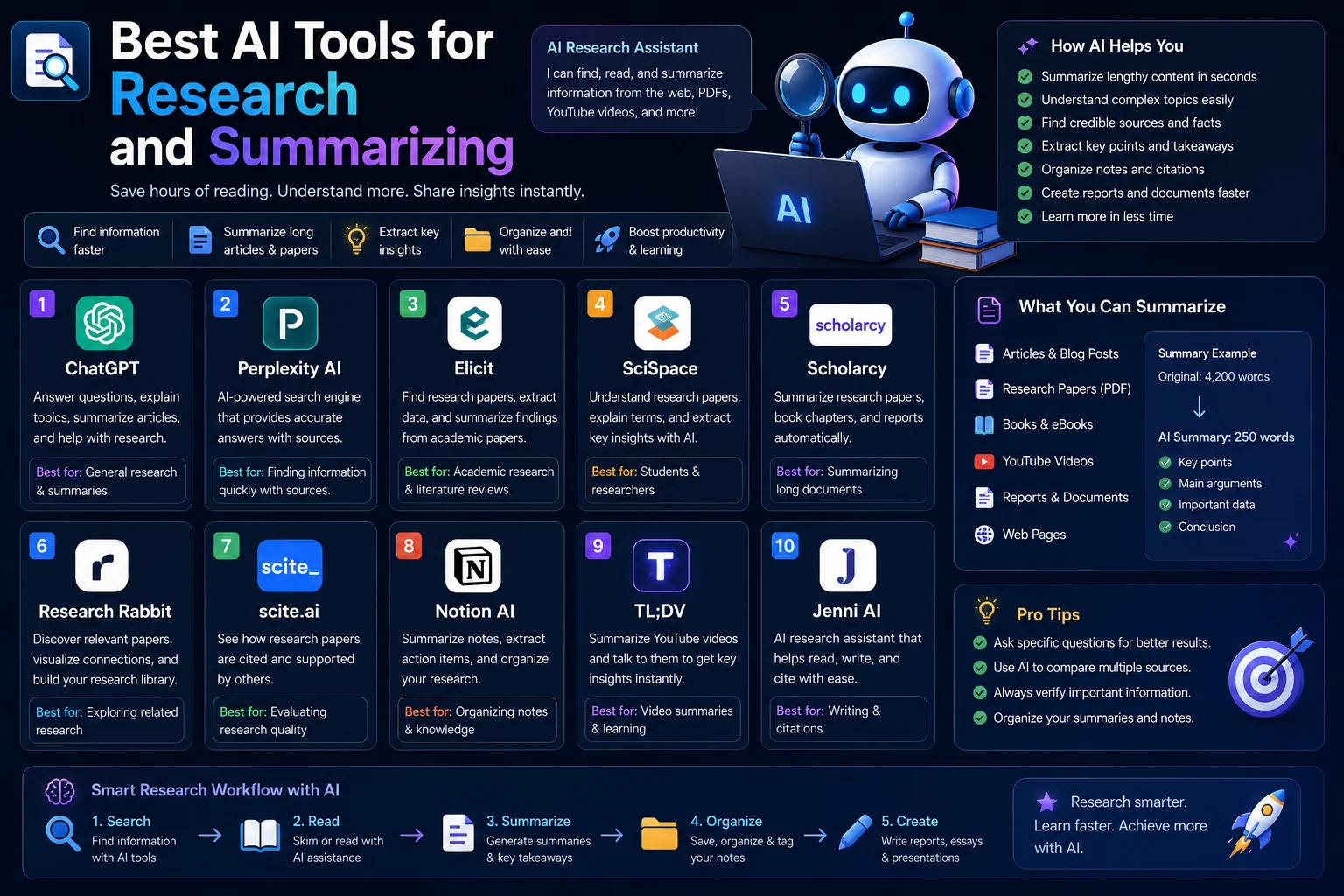

Research can take hours when you have to search through articles, academic papers, reports, websites, PDFs, and other sources to find the information you need. AI research tools can make this process much faster by helping you discover sources, analyze documents, summarize information, compare findings, and organize research.
Modern AI research tools are also becoming more specialized. Some are designed for general web research, while others focus on academic papers, scientific literature, or documents you provide yourself.
The best AI tools for research and summarizing in 2026 can help you move from a simple question to a structured research report much faster. However, they should be used as research assistants rather than replacements for checking original sources.
In this guide, we'll look at the best AI tools for research and summarizing, what each tool is best for, how to use AI for research, how to summarize long documents, and how to verify AI-generated information.
Best AI Tools for Research and Summarizing in 2026
Different AI research tools are designed for different types of work. Some are better for web research, while others are specifically designed for academic literature or working with your own documents.
- ChatGPT — Best for general research, analysis, and detailed reports
- Perplexity — Best for web research and source discovery
- Gemini — Best for research and information analysis
- Gemini Notebook — Best for researching and summarizing your own sources
- Claude — Best for analyzing and summarizing long documents
- Elicit — Best for academic research and literature reviews
- Consensus — Best for finding evidence from scientific research
1. ChatGPT
ChatGPT is a versatile AI assistant that can help with research, summarization, analysis, brainstorming, and writing. It can be useful for everything from quickly understanding a topic to organizing a large research project.
For research tasks, ChatGPT can help you break a question into smaller research questions, analyze information, compare sources, summarize documents, and turn research findings into structured reports.
Why use ChatGPT for research?
- General-purpose research assistance
- Document summarization
- Research planning
- Information comparison
- Data analysis
- Writing and synthesis
- Follow-up questions and interactive research
- Long-form research workflows
ChatGPT is particularly useful when you don't simply want a list of search results and instead want to explore a topic through multiple questions and iterations.
Best for: Students, professionals, writers, researchers, and anyone who wants a flexible AI research assistant.
2. Perplexity
Perplexity is an AI-powered search and research tool designed around answering questions using information gathered from online sources.
It can be particularly useful when you want to research a current topic and inspect the sources behind the answer rather than relying only on a traditional search-results page.
Why use Perplexity?
- AI-powered web search
- Source discovery
- Research questions in natural language
- Follow-up research
- Web-based information gathering
- Research summaries
- Deeper research workflows
Perplexity is a strong option when your research depends heavily on information published online and you want to investigate multiple sources efficiently.
Best for: Web research, current information, source discovery, and quick research reports.
3. Gemini
Gemini can help users research topics, summarize information, analyze documents, and organize complex information.
It can be particularly useful for people who already use Google's ecosystem and want AI assistance as part of their existing workflow.
Why use Gemini?
- AI-assisted research
- Document analysis
- Summarization
- Information synthesis
- Long-form analysis
- Research and brainstorming
- Interactive follow-up questions
Gemini is useful for general research tasks as well as summarizing and analyzing information you provide to the model.
Best for: Users who want an AI assistant for research, documents, and information analysis.
4. Gemini Notebook
Gemini Notebook is designed to help users understand and work with their own research materials. It is particularly useful when you want an AI assistant to work from a collection of sources rather than relying primarily on general web knowledge.
You can organize research materials around a specific topic and use the AI to explore those materials, identify important information, create summaries, and develop a better understanding of the source material.
Why use Gemini Notebook?
- Research based on your own sources
- Document summarization
- Source-grounded questions
- Research organization
- AI-generated summaries
- Analysis of multiple sources
- Research notes and reports
- Data analysis in supported workflows
One of the biggest advantages is that you can organize research materials around a specific topic and use the AI to explore those materials instead of starting from a blank page.
Best for: Students, researchers, writers, and professionals who need to understand a collection of documents or sources.
5. Claude
Claude is a general-purpose AI assistant that can be useful for reading, analyzing, summarizing, and restructuring large amounts of information.
It can help turn long documents into concise summaries while preserving important context, and it can also compare multiple pieces of information.
Why use Claude for research?
- Long-document analysis
- Document summarization
- Research synthesis
- Comparing multiple documents
- Writing research reports
- Explaining complex information
- Follow-up analysis
Claude can be particularly useful when the main challenge isn't finding information but understanding and organizing a large amount of information you already have.
Best for: Long documents, detailed summaries, qualitative analysis, and research synthesis.
6. Elicit
Elicit is specifically designed for scientific and academic research rather than general-purpose web searching.
Its research workflows can help researchers find academic papers, generate summaries relevant to a research question, extract information into structured tables, and organize literature-review workflows.
Why use Elicit?
- Academic paper search
- Semantic search
- Literature reviews
- Paper summaries
- Research data extraction
- Structured research tables
- Systematic review workflows
- Research-focused citations
Elicit's semantic search approach can help researchers discover papers based on the meaning of a research question rather than relying only on exact keyword matches.
For systematic reviews, specialized research workflows can also help with screening studies and extracting structured information from research papers.
Best for: Academic research, scientific literature reviews, and evidence-based research.
7. Consensus
Consensus is an AI research tool focused on finding and synthesizing evidence from scientific literature.
Instead of treating research as a general web-search problem, Consensus is designed around questions that can be answered using scientific research.
It can help researchers discover relevant papers, analyze evidence, compare findings, and develop citation-backed answers to research questions.
Why use Consensus?
- Scientific literature search
- Peer-reviewed research discovery
- Evidence synthesis
- Citation-backed research
- Research filtering
- Multi-paper analysis
- Research questions in natural language
Consensus is particularly useful when your question is about what scientific research says about a particular topic.
Best for: Students, researchers, and professionals looking for evidence from scientific literature.
Best AI Research Tools by Use Case
| AI Tool | Best For | Main Strength |
|---|---|---|
| ChatGPT | General research | Flexible research, analysis, and writing workflows |
| Perplexity | Web research | Search-focused research and source discovery |
| Gemini | General research | Research and information analysis |
| Gemini Notebook | Research from your own sources | Source-grounded document analysis and research organization |
| Claude | Long documents | Detailed analysis and summarization |
| Elicit | Academic research | Scientific paper search, extraction, and literature reviews |
| Consensus | Scientific evidence | Research-backed answers from scientific literature |
What Can AI Do for Research?
1. Find Relevant Sources
AI research tools can help you discover articles, papers, reports, websites, and other sources related to your research question.
Instead of starting with a broad search such as:
AI in education
you can create a more specific research question:
What does recent research say about the effect of generative AI tools on student learning outcomes in higher education?
A precise question makes it easier to identify relevant information.
2. Summarize Long Documents
AI can summarize reports, academic papers, articles, transcripts, and other long documents.
For example:
Summarize this report in 500 words. Identify the main argument, three important findings, supporting evidence, limitations, and final conclusion. Do not introduce information that isn't contained in the document.
3. Compare Sources
AI can help compare several sources and identify where they agree or disagree.
Compare these three research papers. Create a table showing their research question, methodology, sample size, main findings, limitations, and conclusions. Clearly distinguish between what each paper actually reports and your interpretation.
4. Extract Important Information
Researchers often need specific information from a large number of documents.
AI can help extract information such as:
- Research methodology
- Sample size
- Key findings
- Dates
- Statistics
- Research limitations
- Recommendations
- Authors and publication details
5. Organize Research
AI can help transform unstructured research notes into organized categories, outlines, tables, or summaries.
For example:
Organize these research notes into five themes. Under each theme, list the supporting sources, key findings, disagreements between sources, and unanswered questions.
6. Identify Research Gaps
When working with a collection of studies, AI can help identify areas that appear to receive less attention.
However, research-gap analysis should be treated as a starting point rather than proof that no other research exists.
How to Summarize an Article With AI
AI can summarize an article in seconds, but the prompt you use affects the usefulness of the result.
A basic prompt is:
Summarize this article in five bullet points.
A better prompt provides a specific structure:
Summarize this article for a professional reader. Include the main argument, key evidence, important statistics, major conclusions, limitations, and any claims that require further verification. Keep the summary under 400 words.
This produces a more useful research summary than simply asking for a short version.
How to Summarize a Research Paper With AI
Research papers often contain more technical information than general articles, so it helps to ask AI to separate the methodology, findings, and limitations.
Analyze this research paper and provide: 1. Research question 2. Study design 3. Participants or dataset 4. Methodology 5. Main findings 6. Statistical results 7. Limitations 8. Authors' conclusion 9. What the study does not prove 10. Questions for further research
This structure helps prevent an important problem: confusing what a study actually demonstrated with what someone might assume it demonstrates.
How to Summarize Multiple Sources With AI
When researching a topic, you often need to understand several sources rather than one document.
Give the AI the sources and ask it to synthesize them.
Analyze these five sources and create a synthesis of the evidence. Identify points of agreement, disagreements, differences in methodology, important limitations, and areas where more research is needed. Cite each major claim to the relevant source.
For academic work, specialized research tools such as Elicit and Consensus can be particularly useful because they are designed around scientific literature and evidence synthesis.
How to Use AI for Academic Research
Academic research requires more caution than casual information gathering.
A useful workflow is:
- Define a specific research question.
- Search for relevant academic literature.
- Identify the most relevant papers.
- Read the original sources.
- Use AI to summarize and compare them.
- Extract important findings into a structured table.
- Check claims against the original papers.
- Organize the evidence.
- Write your own analysis.
Specialized academic research tools can be particularly useful for literature searches, paper screening, data extraction, and evidence organization.
AI Tools for Students
Students can use AI research tools to understand difficult topics, summarize assigned readings, organize research, compare sources, and prepare study materials.
For example, you can provide a chapter or collection of sources and ask:
Explain this material at a university level, then create a concise summary, a glossary of important terms, five questions for self-testing, and a list of concepts I should review.
Students should still follow their school's academic-integrity policies and avoid presenting AI-generated work as their own when that is not permitted.
AI Tools for Researchers
Professional researchers often need more than a simple summary. They may need to search large collections of papers, screen studies, extract structured information, compare methodologies, and create evidence syntheses.
This is where specialized research tools can be particularly valuable.
Academic research platforms can support literature searches, structured extraction, paper screening, and systematic-review workflows.
How to Choose the Right AI Research Tool
If You Need General Web Research
Choose a tool designed around web search and source discovery. Perplexity is a strong option when you want to investigate online information efficiently and follow up on sources.
If You Need to Analyze Your Own Documents
Use a document-focused AI workflow. Gemini Notebook is particularly relevant when you want to organize a collection of sources and ask questions grounded in those materials.
If You Need Long-Document Summaries
A general AI assistant such as Claude, ChatGPT, or Gemini can be useful when your primary task is understanding and restructuring lengthy documents.
If You Need Academic Papers
Use a specialized academic research tool such as Elicit or Consensus. These tools are designed around research literature rather than general web content.
If You Need a Complete Research Workflow
A general AI assistant can be useful for planning, analysis, writing, and follow-up questions, while specialized research tools can handle source discovery and evidence extraction.
You don't necessarily need to use one tool for everything.
How to Write Better AI Research Prompts
The quality of an AI research response depends heavily on the research question and context you provide.
Instead of:
Research AI in education.
try:
Research the impact of generative AI on higher education students. Focus on studies published from 2023 onward. Identify evidence about learning outcomes, academic performance, student engagement, and potential risks. Distinguish empirical findings from opinions and provide the original sources for important claims.
A strong research prompt should usually specify:
- Research question
- Topic or industry
- Time period
- Geographic scope when relevant
- Type of sources required
- Desired level of detail
- Output format
- Evidence requirements
- Important limitations
Useful AI Research Prompts
General Research
Research this topic using reliable and recent sources. Identify the most important facts, explain competing viewpoints, distinguish established information from uncertain claims, and provide the original sources for important statements.
Source Comparison
Compare these sources on the same topic. Identify where they agree, where they disagree, what evidence each source provides, and which claims require additional verification.
Research Summary
Summarize this research in plain English. Include the research question, methodology, main findings, limitations, and conclusion. Do not exaggerate what the evidence demonstrates.
Literature Review
Organize these academic papers into major research themes. For each theme, summarize the strongest evidence, identify conflicting findings, explain methodological differences, and identify unanswered questions.
Executive Summary
Create a one-page executive summary of this report. Include the most important findings, business implications, risks, recommendations, and decisions that need to be made. Remove unnecessary background information.
How to Verify AI-Generated Research
One of the biggest risks of AI research is assuming that a confident answer is automatically a correct answer.
AI systems can make mistakes, misunderstand sources, omit important context, or provide incorrect citations.
Before using AI-generated research, verify important claims against the original sources.
A simple verification workflow is:
- Identify the claim: Determine exactly what the AI is saying.
- Find the source: Locate the original article, paper, report, or dataset.
- Read the relevant section: Don't rely only on the title or abstract.
- Check the context: Make sure the AI did not remove an important qualification.
- Compare sources: Check whether other reliable sources support the claim.
- Record the source: Keep the original citation with your research notes.
Don't Let AI Replace Critical Thinking
AI can make research faster, but faster research is not automatically better research.
A good researcher still needs to evaluate:
- Source quality
- Publication date
- Research methodology
- Sample size
- Potential bias
- Conflicts of interest
- Evidence quality
- Whether conclusions are supported by the data
AI should help you investigate these questions rather than make the final judgment for you.
AI Research vs Traditional Research
| Task | Traditional Research | AI-Assisted Research |
|---|---|---|
| Source discovery | Mostly manual | Can be AI-assisted |
| Reading long documents | Manual | AI can summarize and analyze |
| Source comparison | Manual | Can be partially automated |
| Data extraction | Often manual | Can be AI-assisted |
| Research organization | Manual | AI can structure information |
| Fact verification | Manual | Still requires human review |
| Final conclusions | Human judgment | Human judgment remains important |
A Practical AI Research Workflow
- Define: Turn your topic into a specific research question.
- Discover: Find relevant sources using search and research tools.
- Filter: Remove irrelevant or low-quality sources.
- Read: Review the most important original sources.
- Summarize: Use AI to create concise summaries.
- Compare: Ask AI to identify agreements and disagreements.
- Extract: Put important findings into a structured table.
- Verify: Check important claims against original sources.
- Synthesize: Combine the evidence into a coherent understanding.
- Write: Create your final report using verified information.
How to Use AI to Summarize Books, PDFs, and Reports
Long documents can be difficult to process manually, especially when you only need a specific type of information.
Instead of asking AI for a generic summary, tell it exactly what you need.
Analyze this PDF and create a structured summary with the following sections: main argument, key findings, important statistics, methodology, limitations, recommendations, and conclusion. Quote only short passages when necessary and identify the page or section where important information appears.
For very long documents, consider processing the material in sections and then asking AI to combine the section summaries into a final overview.
Privacy and Security When Using AI for Research
Research materials can contain confidential business information, unpublished work, personal information, proprietary data, or sensitive documents.
Before uploading a document to an AI service, check:
- How uploaded files are stored
- Whether your data may be used for training
- Data retention policies
- Who can access uploaded information
- Enterprise privacy controls
- Data deletion options
- Third-party integrations
Do not upload confidential or sensitive research materials to an AI service unless you are authorized to do so and understand the service's data policies.
Final Verdict
AI research tools have made it much easier to discover information, summarize long documents, compare sources, and organize research. However, the best tool depends heavily on what you are researching.
For general research and analysis, ChatGPT is a flexible option that can help with research planning, document analysis, summarization, and synthesis.
For web-focused research, Perplexity is useful when source discovery and current online information are important.
For research based primarily on your own documents, Gemini Notebook is particularly useful because it allows you to organize and analyze a collection of source materials.
For long documents and detailed qualitative analysis, Claude is a strong option because it can help transform large amounts of information into structured summaries and explanations.
For academic and scientific research, Elicit and Consensus are better suited to specialized research workflows because they focus on scientific literature and evidence.
The most effective research workflow may involve more than one tool. You might use an AI search tool to discover sources, a specialized academic tool to analyze research papers, a document-focused assistant to summarize your own files, and a general AI assistant to organize the final findings.
Most importantly, AI should accelerate research without replacing source evaluation. Always verify important claims, inspect original sources, and use human judgment before treating AI-generated research as reliable.
Frequently Asked Questions
What is the best AI tool for research?
The best AI research tool depends on the type of research. ChatGPT is useful for general research and analysis, Perplexity is useful for web research, Gemini Notebook is useful for working with your own sources, and Elicit and Consensus are particularly useful for academic and scientific research.
What is the best AI tool for summarizing articles?
ChatGPT, Claude, and Gemini can all summarize articles and documents. The best choice depends on the length of the material, the type of analysis you need, and whether you want the summary grounded in specific sources.
What is the best AI tool for summarizing PDFs?
Several general-purpose AI assistants can analyze PDFs and other documents. Gemini Notebook is particularly useful when you want to organize multiple source documents around a research project, while ChatGPT and Claude can also be useful for document analysis and summarization.
What is the best AI tool for academic research?
Elicit and Consensus are strong options for academic research because they are designed around scientific literature. Elicit provides literature-review and data-extraction workflows, while Consensus focuses on finding and synthesizing evidence from research papers.
Can AI summarize research papers?
Yes. AI can summarize research questions, methodologies, findings, limitations, and conclusions. However, important claims should always be checked against the original paper.
Can AI do research for me?
AI can automate or assist with many parts of research, including source discovery, summarization, comparison, information extraction, and report generation. It should not replace human judgment, source verification, or critical analysis.
Can AI research tools provide citations?
Some AI research tools provide citations or source information behind their answers. These features can make it easier to trace important claims back to the underlying research, but citations should still be checked against the original sources.
Can AI summarize multiple documents at once?
Yes. Many AI tools can analyze multiple documents and compare their contents. This can be useful for literature reviews, business reports, research projects, and document comparison.
Is AI reliable for research?
AI can significantly accelerate research, but it should not be treated as automatically reliable. Important information should be verified against the original sources, especially when the research involves scientific, medical, legal, financial, or other high-stakes claims.
Should students use AI for research?
Students can use AI to understand difficult material, summarize sources, organize notes, and identify areas for further study, provided they follow their institution's academic-integrity rules and verify important information.