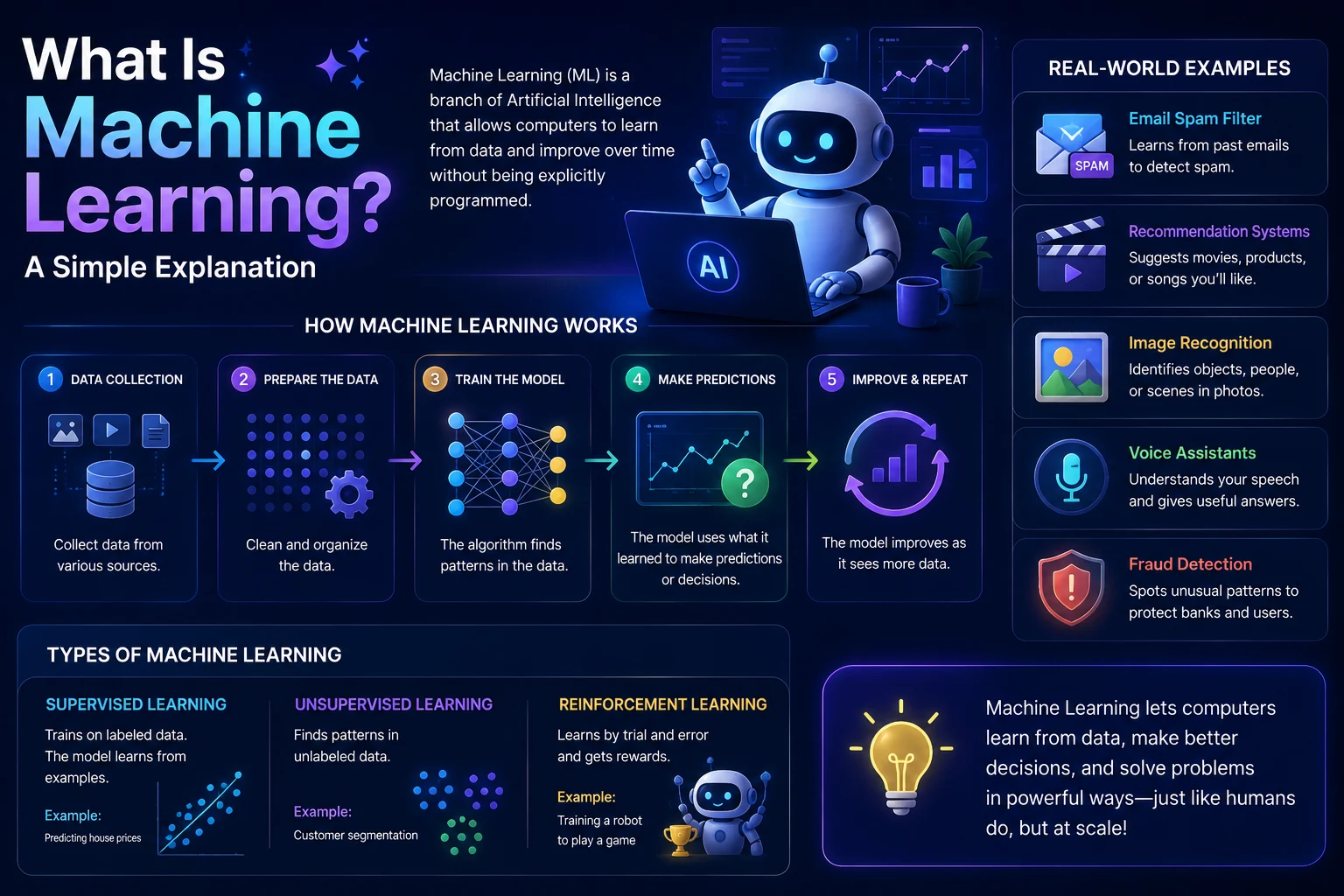

Machine learning (ML) is a type of artificial intelligence that allows computers to learn patterns from data and use those patterns to make predictions, recommendations, or decisions.
Instead of programming a computer with a specific rule for every possible situation, machine learning allows the system to learn from examples.
For example, instead of manually programming an email system with thousands of rules for identifying spam, you can train a machine learning model using examples of spam and legitimate emails. The model can then learn patterns that help it identify new messages.
Machine learning is behind many technologies we use every day, including recommendation systems, voice assistants, image recognition, fraud detection, search engines, and many modern AI applications.
Machine Learning Explained Simply
Imagine teaching a child to recognize cats.
You don't need to give the child a mathematical definition of a cat. Instead, you show them many examples of cats.
After seeing enough examples, the child starts recognizing common patterns:
- Shape of the body
- Four legs
- Fur
- Eyes and ears
- Typical facial features
Machine learning works in a similar way. A computer receives data, finds patterns in that data, and uses what it learned to make predictions about new information.
How Does Machine Learning Work?
Most machine learning workflows can be understood through a few basic steps.
| Step | What Happens |
|---|---|
| 1. Collect Data | Gather examples relevant to the problem. |
| 2. Prepare Data | Clean and organize the information. |
| 3. Train the Model | The algorithm learns patterns from the data. |
| 4. Test the Model | Evaluate how well it performs on new data. |
| 5. Make Predictions | The trained model processes new information. |
| 6. Improve | The system can be refined using better data or techniques. |
What Is a Machine Learning Model?
A machine learning model is a mathematical system that has learned patterns from data.
During training, the model analyzes examples and adjusts its internal parameters to perform a particular task.
Once trained, the model can receive new data and produce an output.
For example:
Input: Information about a house
Model: A machine learning model trained on house prices
Output: An estimated house price
The model doesn't simply memorize one answer. Ideally, it learns relationships that allow it to generalize to new examples.
Machine Learning vs Traditional Programming
Traditional programming and machine learning solve problems in different ways.
| Traditional Programming | Machine Learning |
|---|---|
| Rules are explicitly programmed | Patterns are learned from data |
| Programmer defines the logic | Algorithm learns parameters |
| Input + Rules → Output | Data + Examples → Model |
| Works well with clearly defined rules | Useful for complex patterns |
A simple way to think about it is:
Traditional programming: Data + Rules → Answer
Machine learning: Data + Answers → Learned Model
The Main Types of Machine Learning
Machine learning is commonly divided into several major approaches. The three foundational categories are supervised learning, unsupervised learning, and reinforcement learning.
1. Supervised Learning
Supervised learning uses labeled training data. The model receives examples where the desired answer is already known.
For example, suppose you want to build a system that identifies whether an email is spam.
You provide the model with many examples:
- Email → Spam
- Email → Not spam
- Email → Spam
- Email → Not spam
The model learns patterns associated with each category.
Supervised learning is commonly used for:
- Classification
- Price prediction
- Risk prediction
- Image recognition
- Fraud detection
- Spam detection
2. Unsupervised Learning
Unsupervised learning works with data that doesn't have predefined labels.
The model tries to discover patterns, structures, or groups within the data.
For example, a company could give a machine learning system information about thousands of customers without telling it which customers belong to which group.
The algorithm might discover groups based on purchasing behavior.
Common applications include:
- Customer segmentation
- Pattern discovery
- Data clustering
- Anomaly detection
- Recommendation systems
3. Reinforcement Learning
Reinforcement learning involves an agent learning by interacting with an environment.
The system receives rewards for desirable actions and penalties or negative feedback for undesirable actions.
Over time, it learns strategies that help maximize its rewards.
Reinforcement learning has been used in areas such as:
- Robotics
- Game-playing systems
- Control systems
- Simulation
- Optimization
What Is Deep Learning?
Deep learning is a specialized area of machine learning that uses neural networks with multiple layers.
These networks can learn complex patterns from large amounts of data.
Deep learning has played a major role in advances in:
- Computer vision
- Speech recognition
- Natural language processing
- Generative AI
- Image generation
- Large language models
In simple terms:
Artificial Intelligence → Machine Learning → Deep Learning
These terms are related, but they are not interchangeable. AI is the broader field, machine learning is one major approach to AI, and deep learning is a subset of machine learning.
What Are Neural Networks?
A neural network is a machine learning model inspired loosely by the way biological neural networks process information.
Artificial neural networks contain interconnected computational units arranged into layers.
A basic neural network can include:
- Input layer
- Hidden layers
- Output layer
Each layer transforms information and passes it to the next layer.
Modern deep learning systems can contain many layers and millions or even billions of learned parameters.
Real-World Examples of Machine Learning
You probably interact with machine learning more often than you realize.
Netflix and Streaming Recommendations
Recommendation systems can analyze viewing behavior and other signals to suggest content that may interest you.
YouTube Recommendations
Machine learning helps personalize recommendations and rank content for individual users.
Google Search
Machine learning is used throughout modern search systems to understand queries and help determine relevant results.
Email Spam Filters
Spam detection systems can learn patterns associated with unwanted messages.
Voice Assistants
Speech recognition systems use machine learning to convert spoken language into text and interpret what users say.
Fraud Detection
Financial institutions can use machine learning to identify unusual transaction patterns that may indicate fraud.
Image Recognition
Machine learning models can identify objects, faces, scenes, and other patterns in images.
Machine Learning and Generative AI
Many modern generative AI systems are built using machine learning and deep learning techniques.
Generative AI systems can learn patterns from large datasets and use those learned representations to generate new content.
Examples include systems that generate:
- Text
- Images
- Audio
- Video
- Computer code
Large language models are a particularly important example of modern machine learning. They are trained on large amounts of data to learn statistical patterns in language and generate responses based on input.
Why Is Machine Learning Important?
Machine learning is important because many real-world problems are too complex to solve efficiently with manually written rules.
Consider image recognition. Writing a rule for every possible shape, lighting condition, camera angle, and object would be extremely difficult.
Machine learning provides another approach: give the system many examples and allow it to learn useful patterns from the data.
This makes machine learning useful for:
- Automation
- Prediction
- Personalization
- Pattern recognition
- Decision support
- Data analysis
- Content generation
What Does a Machine Learning Engineer Do?
A machine learning engineer builds, deploys, and maintains systems that use machine learning models.
Their work can include:
- Preparing datasets
- Training machine learning models
- Evaluating model performance
- Building machine learning pipelines
- Deploying models into applications
- Monitoring models after deployment
- Improving model performance
Machine learning engineers often work with programming languages such as Python and tools for data processing, model development, cloud computing, and deployment.
What Skills Are Needed to Learn Machine Learning?
You don't need to become an expert mathematician before starting with machine learning.
However, several skills are useful.
| Skill | Why It Matters |
|---|---|
| Python | One of the most widely used ML programming languages. |
| Statistics | Helps understand data and model performance. |
| Linear Algebra | Important for understanding many ML concepts. |
| Data Analysis | Helps prepare and understand datasets. |
| Algorithms | Helps you understand how models learn. |
| Problem Solving | Useful for designing and improving ML systems. |
Can Beginners Learn Machine Learning?
Yes. You don't need to understand every advanced concept before building your first machine learning project.
A practical learning path could look like this:
- Learn basic Python.
- Learn fundamental statistics.
- Understand datasets and data preprocessing.
- Learn basic supervised learning.
- Build simple prediction projects.
- Study neural networks.
- Explore deep learning.
- Build real-world projects.
The best way to learn is to combine theory with practice. Even a small project, such as predicting house prices or classifying simple data, can help you understand how machine learning works.
Common Machine Learning Terms
| Term | Simple Meaning |
|---|---|
| Dataset | A collection of data used for analysis or training. |
| Feature | An input characteristic used by a model. |
| Label | The known answer associated with training data. |
| Model | A learned mathematical representation of patterns. |
| Training | The process of learning from data. |
| Inference | Using a trained model to produce an output. |
| Prediction | The model's output for new data. |
| Accuracy | A measure of how often predictions are correct. |
| Overfitting | When a model learns training data too closely and performs poorly on new data. |
What Is Overfitting?
Overfitting happens when a machine learning model becomes too closely adapted to its training data.
Imagine a student memorizing answers to a practice test instead of learning the underlying concepts. They might perform extremely well on the practice questions but struggle when the questions change.
A similar problem can happen with machine learning models.
A good model should learn useful patterns that generalize to new data rather than simply memorizing the training examples.
What Are the Limitations of Machine Learning?
Machine learning is powerful, but it isn't magic.
Its performance depends heavily on the quality and relevance of the data and on how the model is designed and evaluated.
Some important limitations include:
- Poor-quality data can produce poor results.
- Models can contain or reproduce biases present in their training data.
- Complex models can require significant computing resources.
- Predictions are not guaranteed to be correct.
- Models may perform poorly when real-world conditions differ from training data.
- Some models can be difficult to interpret.
This is why machine learning systems need careful testing, monitoring, and human oversight, especially when they are used for important decisions.
Machine Learning vs Artificial Intelligence
Artificial intelligence and machine learning are closely related, but they mean different things.
| Artificial Intelligence | Machine Learning |
|---|---|
| Broad field focused on intelligent systems | One major approach used to build AI systems |
| Can include rule-based systems | Learns patterns from data |
| Includes reasoning, planning, perception, and more | Focuses on learning from examples |
A useful analogy is that AI is the larger field, while machine learning is one of the most important methods used within it.
The Future of Machine Learning
Machine learning will continue to play a major role in artificial intelligence and software development.
As models become more capable and computing infrastructure improves, machine learning is likely to become increasingly integrated into everyday applications.
Potential areas of continued development include:
- More capable AI assistants
- Advanced robotics
- Personalized education
- Scientific research
- Healthcare applications
- Autonomous systems
- Smarter business software
- More efficient AI models
At the same time, responsible development will remain important. Privacy, security, fairness, transparency, and reliability are all important considerations when deploying machine learning systems.
Our Simple Definition
If you remember only one thing from this article, remember this:
Machine learning is a way of teaching computers to learn patterns from data so they can make predictions or decisions without being explicitly programmed for every situation.
Machine learning is one of the foundations of modern artificial intelligence. From recommendation systems and spam filters to generative AI and advanced robotics, machine learning is helping computers perform tasks that once required significant human effort.
Frequently Asked Questions
What is machine learning in simple words?
Machine learning is a method that allows computers to learn patterns from examples and use those patterns to make predictions or decisions.
Is machine learning the same as AI?
No. AI is the broader field of creating intelligent computer systems, while machine learning is one of the main approaches used to build AI systems.
What are the three main types of machine learning?
The three commonly discussed categories are supervised learning, unsupervised learning, and reinforcement learning.
Is ChatGPT machine learning?
Yes. ChatGPT is built using machine learning, particularly deep learning and large neural networks trained on large datasets.
Do I need to know math to learn machine learning?
Basic mathematics and statistics are helpful, especially as you move into more advanced machine learning. However, beginners can start learning practical machine learning without mastering advanced mathematics first.
Is Python good for machine learning?
Yes. Python is one of the most popular programming languages for machine learning because of its large ecosystem of data science and machine learning libraries.
What is deep learning?
Deep learning is a subset of machine learning that uses neural networks with multiple layers to learn complex patterns from data.
Where is machine learning used?
Machine learning is used in recommendation systems, search engines, spam detection, fraud detection, image recognition, speech recognition, advertising, robotics, healthcare, finance, and many other fields.