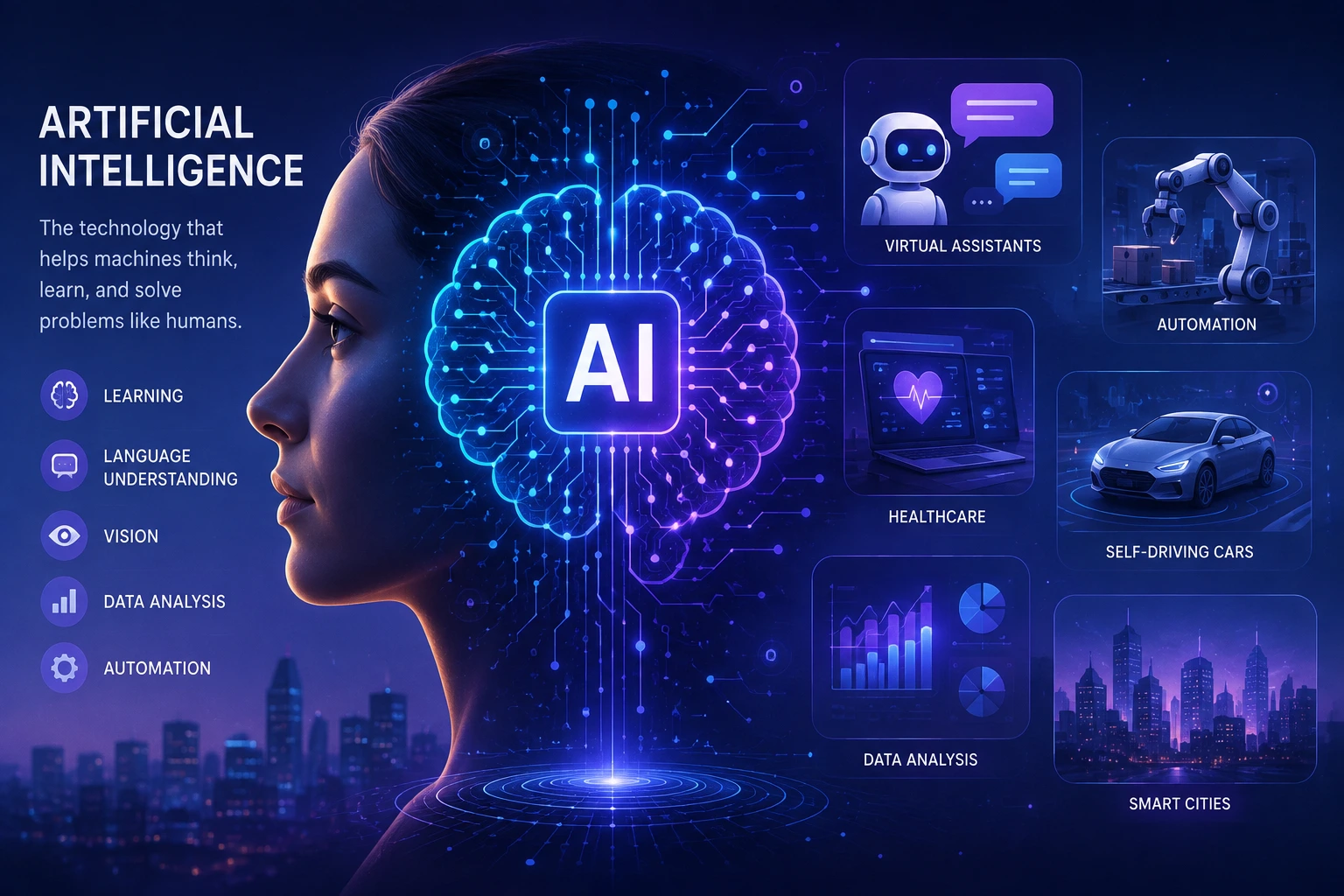

What Is Artificial Intelligence?
Artificial intelligence (AI) is a field of computer science focused on building systems that can perform tasks that normally require capabilities associated with human intelligence. These capabilities can include understanding language, recognizing patterns, analyzing information, making predictions, solving problems, and generating content.
AI is not a single technology or a single type of software. It is a broad field that includes several approaches, including machine learning, neural networks, computer vision, natural language processing, and generative AI.
You interact with AI in many everyday situations, often without noticing it. Search engines can use AI to understand queries, streaming services can recommend content, email applications can identify spam, and modern AI assistants can understand questions and generate responses.
How Does Artificial Intelligence Work?
At a high level, an AI system receives information, processes it using a model or algorithm, and produces an output. The exact process depends on the type of AI system and the task it was designed to perform.
Many modern AI systems learn patterns from data rather than relying entirely on manually written rules. During training, a machine learning model is exposed to examples and adjusts its internal parameters to improve its performance on a particular task.
For example, imagine a system designed to recognize cats in photographs. The system can be trained using many labeled images. During training, the model learns patterns that help distinguish cats from other objects. When a new image is provided, the trained model can estimate whether the image contains a cat.
The quality of an AI system depends on several factors, including the quality and relevance of its training data, the model architecture, the training process, the evaluation method, and how the system is used after deployment.
AI, Machine Learning, Deep Learning, and Generative AI
These terms are often used interchangeably, but they describe different concepts. Understanding the relationship between them makes it easier to understand modern AI technology.
Artificial Intelligence
Artificial intelligence is the broadest term. It describes the field of creating computer systems capable of performing tasks associated with intelligent behavior.
Machine Learning
Machine learning is an approach to AI in which systems learn patterns from data and use those patterns to make predictions, classifications, or decisions.
Deep Learning
Deep learning is a branch of machine learning that uses neural networks with multiple layers. It has become particularly important for tasks involving images, speech, language, and other complex forms of data.
Generative AI
Generative AI refers to systems that can generate new content based on patterns learned during training. Depending on the model, the output can include text, images, audio, video, or computer code.
In simple terms, the relationship can be represented as:
- Artificial intelligence is the broad field.
- Machine learning is one major approach used in AI.
- Deep learning is a type of machine learning.
- Generative AI is a category of AI systems designed to generate content.
What Are the Main Types of AI?
Narrow AI
Narrow AI, also called weak AI, is designed to perform specific tasks or a limited group of related tasks. Almost all practical AI applications available today fall into this category.
Examples include recommendation systems, spam detection, speech recognition, translation systems, image recognition, navigation systems, and AI assistants.
Artificial General Intelligence
Artificial General Intelligence (AGI) generally refers to a hypothetical form of AI capable of performing a broad range of intellectual tasks with a level of flexibility comparable to human intelligence.
AGI remains a subject of research and debate. It should not be treated as synonymous with the specialized AI systems that people commonly use today.
What Is Generative AI?
Generative AI has become one of the most visible areas of artificial intelligence because it can produce content in response to natural-language instructions and other inputs.
For example, a generative AI system can be asked to summarize a document, explain a programming concept, create an image from a description, generate software code, or help brainstorm ideas.
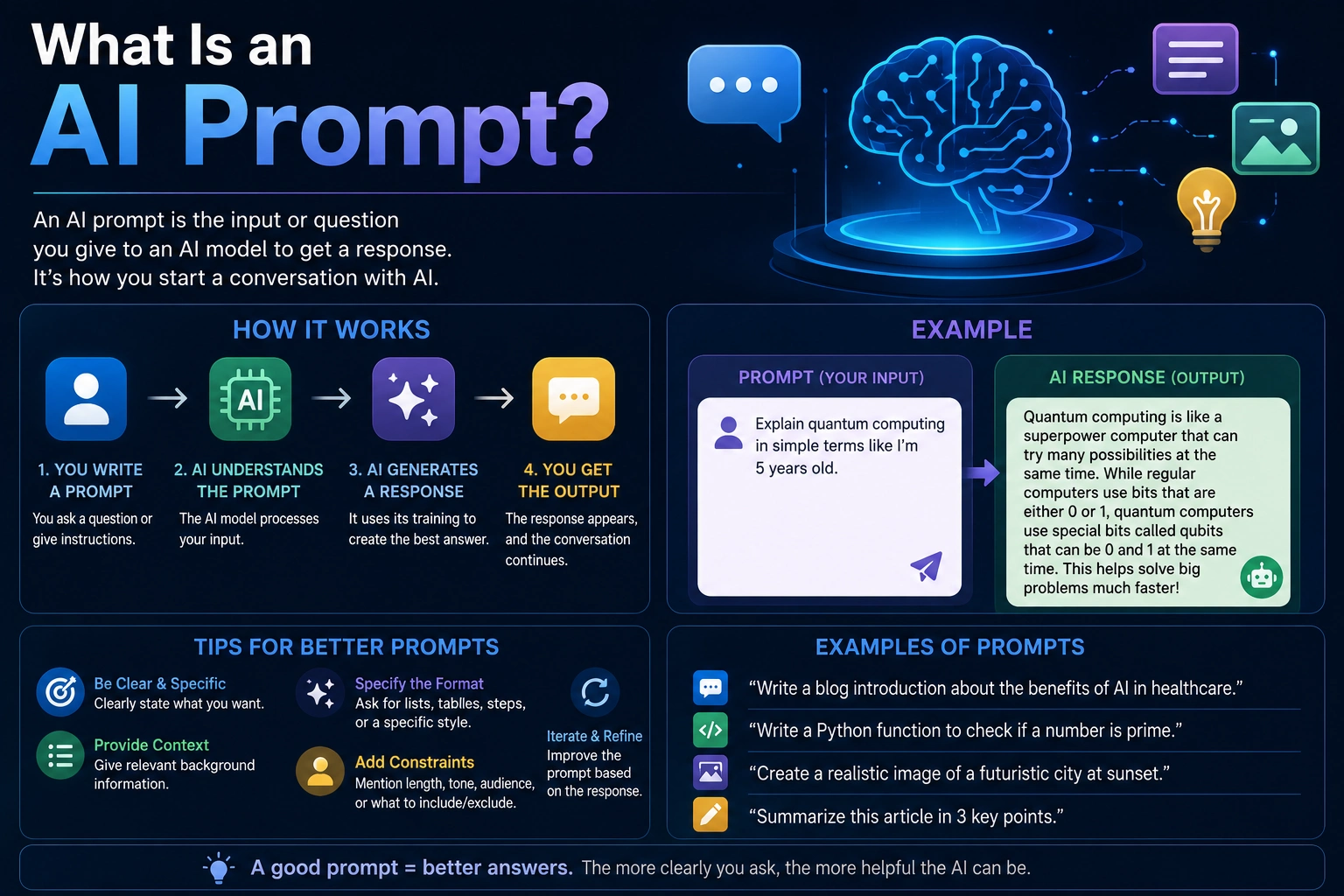
A typical interaction starts with an input such as a prompt. The model processes the input and generates an output based on patterns learned during training and the capabilities built into the system.
However, generated content is not automatically accurate. A response can sound convincing while containing incorrect or incomplete information. For important tasks, users should verify factual claims and review the output before relying on it.
Examples of Artificial Intelligence in Everyday Life
AI is already integrated into many digital products and services. Some common examples include:
- Search: AI can help interpret search queries and determine which information is most relevant.
- Recommendations: Streaming and shopping platforms can analyze user behavior to recommend content or products.
- Email: Machine learning systems can identify spam and suspicious messages.
- Smartphones: AI can support speech recognition, photography features, translation, and image processing.
- Maps and navigation: AI and machine learning can help estimate travel times and identify traffic patterns.
- Translation: AI systems can analyze and translate text between languages.
- Customer service: AI-powered assistants can answer common questions and help users find information.
- Software development: AI coding tools can help developers understand code, generate suggestions, and identify potential problems.
What Can AI Be Used For?
The usefulness of AI depends on the specific system and the task it is designed to perform. Common applications include:
Automation
AI can assist with repetitive tasks such as sorting information, classifying documents, processing requests, and extracting data from large collections of files.
Data Analysis
Machine learning systems can analyze large datasets and identify patterns that may be difficult to detect manually. This can support forecasting, classification, anomaly detection, and other analytical tasks.
Content Creation
Generative AI can assist with drafting text, creating images, generating code, summarizing documents, and producing other forms of digital content.
Personalization
AI can help services tailor recommendations, search results, advertisements, educational content, and other experiences according to user behavior or preferences.
What Are the Limitations of Artificial Intelligence?
AI systems can be extremely useful, but they have important limitations. A model can produce an incorrect answer, misunderstand a user's intent, fail to recognize important context, or generate an output that appears reliable even when it is wrong.
The quality of an AI system is also affected by the data, instructions, evaluation methods, and technical design behind it. A system that performs well on one task may perform poorly on another.
AI can also introduce broader concerns involving privacy, security, copyright, bias, misinformation, and the effect of automation on jobs and organizations.
For these reasons, AI should generally be treated as a tool that can assist human decision-making rather than an infallible source of information.
AI vs. Traditional Software
Traditional software is often built around explicit rules written by programmers. For example, a simple program might be instructed to perform one action when a particular condition is true.
Many machine learning systems work differently. Instead of specifying every rule manually, developers provide data and a learning method that allows the model to identify useful patterns.
This difference does not mean that traditional programming and AI are completely separate. Modern applications often combine conventional software, databases, APIs, and machine learning models in the same system.
What Are the Benefits of AI?
When used appropriately, AI can provide several practical benefits.
- Speed: AI can process and summarize large amounts of information quickly.
- Automation: AI can reduce the amount of manual work required for repetitive tasks.
- Pattern recognition: Machine learning can identify patterns across large datasets.
- Accessibility: AI-powered tools can make activities such as translation, transcription, and information retrieval easier.
- Assistance: AI can help people brainstorm, analyze information, write drafts, and solve certain technical problems.
How Should You Use AI Responsibly?
Using AI effectively requires more than simply asking a system for an answer. The user should consider the quality of the input, evaluate the output, and verify important information.
For example, AI can be useful for creating a first draft of an article or summarizing a long document. However, factual claims, quotations, statistics, legal information, financial information, and other important details should be checked against reliable sources.
A practical approach is to treat AI as an assistant rather than a replacement for human judgment. The person using the system remains responsible for reviewing the final result and deciding whether it is appropriate for its intended purpose.
The Future of Artificial Intelligence
AI is continuing to develop across areas such as language, computer vision, robotics, software development, scientific research, education, and business.
Future progress may lead to systems that can handle more complex tasks, work across multiple types of information, and interact with software and physical environments in increasingly sophisticated ways.
At the same time, technical progress will need to be accompanied by careful attention to reliability, privacy, security, transparency, copyright, safety, and the broader effects of automation.
Frequently Asked Questions About AI
Is AI the same as machine learning?
No. Artificial intelligence is the broader field, while machine learning is one of the main approaches used to build AI systems.
Is ChatGPT an example of AI?
Yes. ChatGPT is an example of a generative AI application that can process natural-language instructions and generate responses.
Can AI make mistakes?
Yes. AI systems can generate incorrect, incomplete, or misleading results. Important information should therefore be checked against reliable sources.
Can AI replace human workers?
The effect of AI varies by job and task. AI can automate some activities, assist workers with others, and create demand for new skills. Whether a particular job is significantly affected depends on the tasks involved and how organizations adopt the technology.
Can a beginner learn AI?
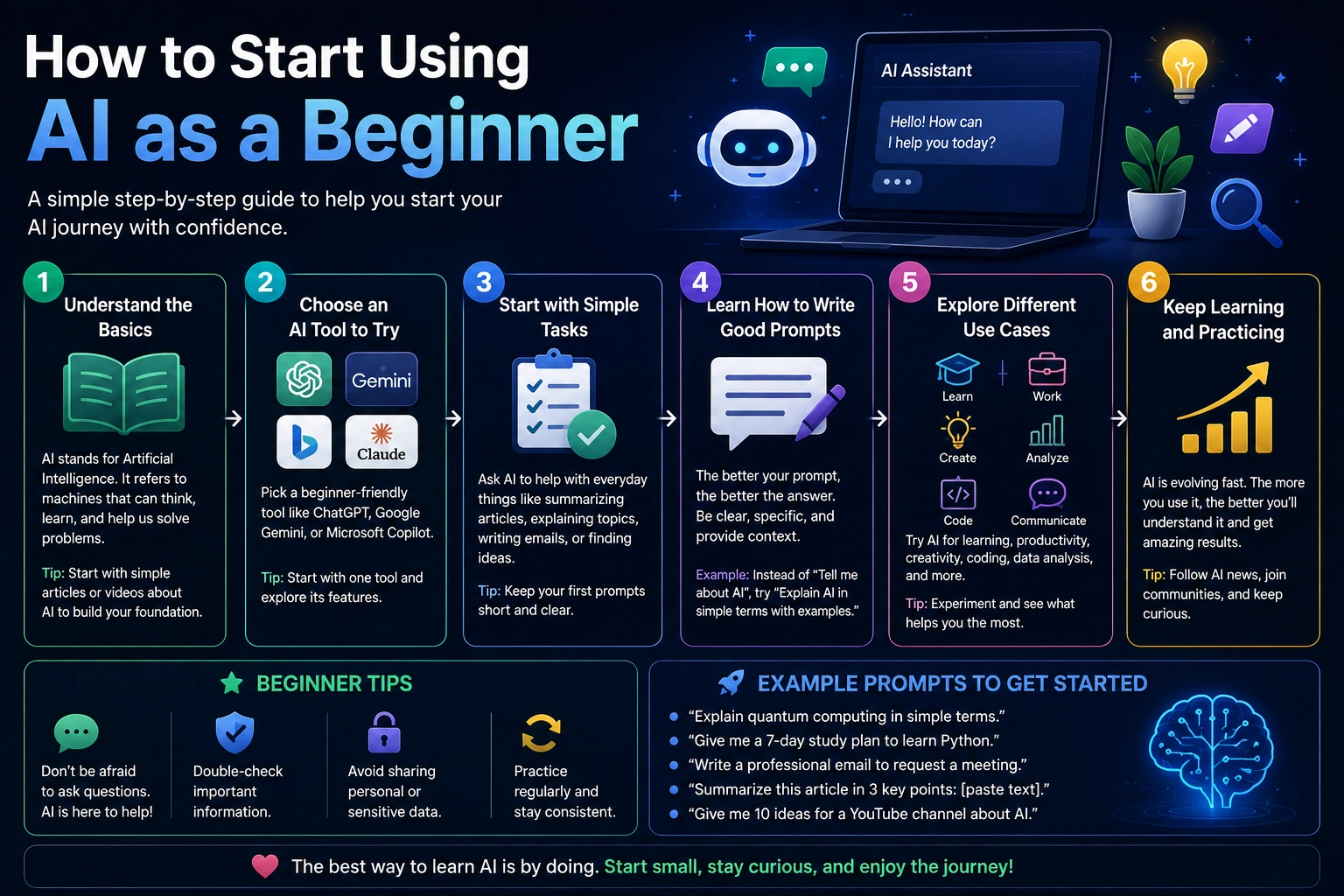
Yes. A beginner can start with fundamental concepts such as artificial intelligence, machine learning, data, algorithms, and neural networks before moving into programming and more advanced AI topics.
Final Thoughts
Artificial intelligence is a broad field rather than a single technology. It includes different techniques and applications that allow computers to recognize patterns, process information, make predictions, understand language, and generate content.
The most useful way to understand AI is to look beyond the terminology and examine how a particular system works, what data or inputs it uses, what task it performs, and where its limitations are.
As AI becomes more common in everyday products and professional workflows, understanding these fundamentals can help users make better decisions about when to use AI, how to evaluate its output, and when human judgment is still essential.