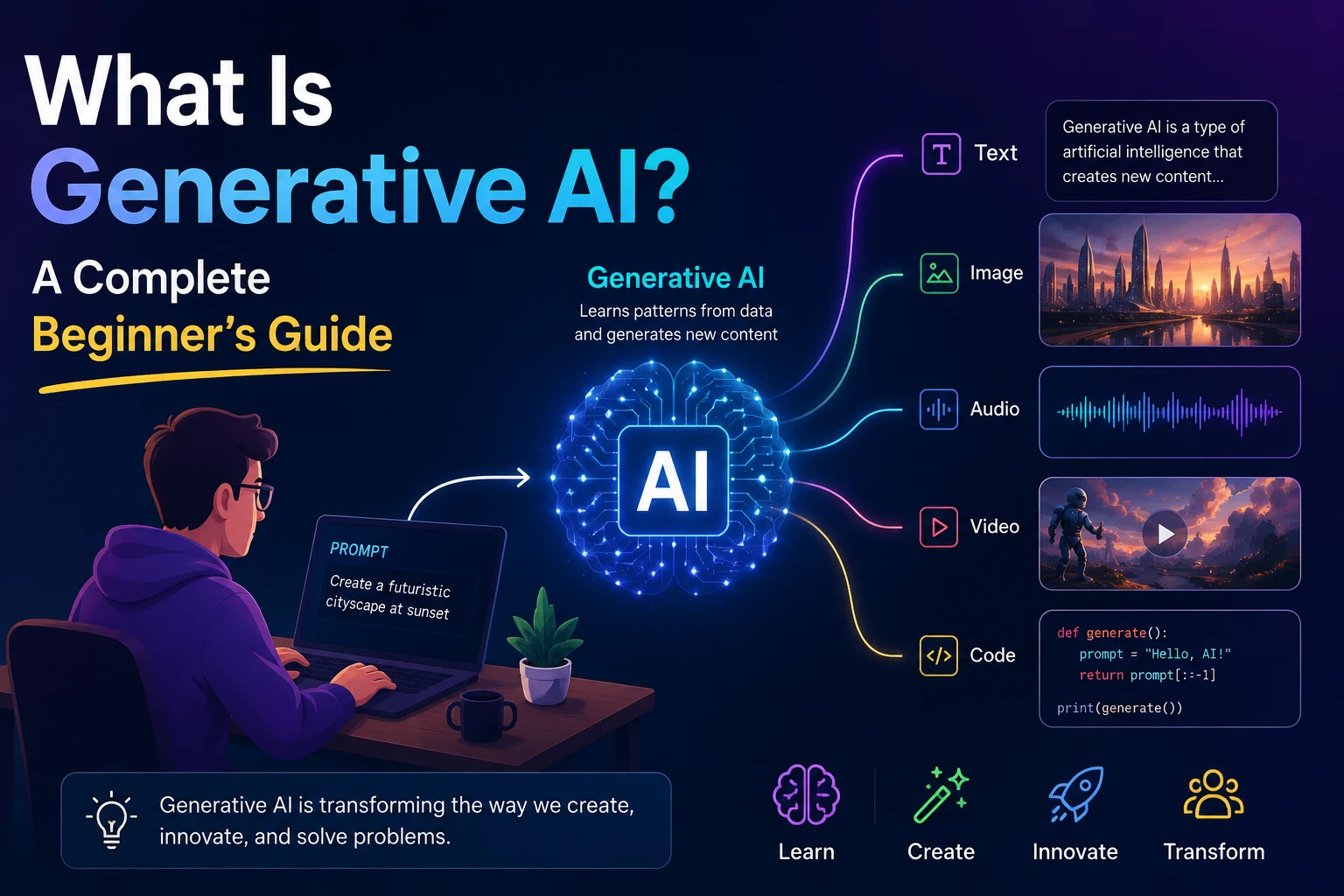

Generative AI has quickly become one of the most important technologies in the world. From writing emails and creating images to generating code and producing videos, generative AI can create content in seconds that previously required hours of human work.
But what exactly is generative AI? How does it work, and how is it different from traditional artificial intelligence?
In this beginner's guide, we'll explain generative AI in simple terms, explore what it can do, look at real-world examples, and discuss its benefits, limitations, and future.
What Is Generative AI?
Generative AI is a type of artificial intelligence designed to create new content based on patterns it has learned from large amounts of data.
Unlike traditional AI systems that are often designed to analyze information, classify objects, make predictions, or follow predefined instructions, generative AI can produce something new.
Depending on the AI model, it can generate:
- Text and articles
- Images and illustrations
- Videos
- Audio and music
- Computer code
- Presentations
- Summaries and translations
- Marketing content
For example, you can give an AI tool a simple instruction such as "Write a short article about renewable energy", and the system can generate an original response based on what it learned during training.
How Does Generative AI Work?
Generative AI systems are trained using very large datasets. These datasets can contain books, websites, images, code, audio, videos, and other forms of information, depending on the purpose of the model.
During training, the model learns patterns and relationships within the data. It does not simply memorize everything like a traditional database. Instead, modern AI models learn statistical patterns that allow them to generate new outputs.
1. Training
The first major stage is training. The AI model processes huge amounts of data and learns relationships between different pieces of information.
2. Learning Patterns
The model learns patterns in language, images, code, sound, or other types of data. For a language model, this can include relationships between words, sentences, concepts, and context.
3. Generating Content
When you provide a prompt, the model uses what it learned to generate an output. The result may be text, an image, code, audio, or another type of content depending on the AI system.
What Is a Generative AI Model?
A generative AI model is the underlying technology that produces new content. Different models are designed for different types of tasks.
Some models specialize in text, while others are designed for images, video, audio, or programming.
Large language models, commonly called LLMs, are among the best-known examples. They are designed to understand and generate human-like text.
What Can Generative AI Create?
Text
Generative AI can create articles, emails, social media posts, summaries, product descriptions, stories, explanations, and many other types of text.
Images
AI image generators can create illustrations, realistic images, concept art, advertisements, product visuals, and other graphics from written prompts.
Video
New AI video systems can generate or transform video content from text, images, or existing footage.
Audio
Generative AI can also create speech, sound effects, music, and other types of audio content.
Code
AI coding tools can generate programming code, explain existing code, suggest improvements, find potential bugs, and help developers build software.
Popular Examples of Generative AI
Generative AI is now available through many popular consumer and professional tools. Some well-known examples include:
- ChatGPT — AI assistant for text, reasoning, coding, and many other tasks.
- Google Gemini — Google's generative AI assistant and model family.
- Claude — AI assistant focused on writing, analysis, coding, and reasoning.
- AI image generators — Tools that create images from text prompts.
- AI video generators — Tools that generate or edit video using AI.
- AI coding assistants — Tools that help developers write and understand code.
Generative AI vs Traditional AI
Traditional AI and generative AI can both use machine learning, but they are often designed for different purposes.
| Traditional AI | Generative AI |
|---|---|
| Often analyzes existing information | Creates new content |
| Often performs specific tasks | Can handle many creative tasks |
| Commonly predicts or classifies | Generates text, images, code, audio, and more |
Benefits of Generative AI
1. Saves Time
Generative AI can complete many repetitive tasks in seconds. This can help individuals and businesses spend more time on higher-value work.
2. Improves Productivity
AI assistants can help with brainstorming, research, writing, summarization, coding, planning, and organization.
3. Helps With Creativity
Generative AI can provide ideas, variations, drafts, visual concepts, and creative starting points.
4. Makes Technology More Accessible
People without advanced technical skills can use natural language to interact with powerful AI systems.
5. Supports Businesses
Businesses can use generative AI for customer support, marketing, content creation, software development, data analysis, and internal productivity.
Limitations of Generative AI
Although generative AI is powerful, it is not perfect. Users should understand its limitations before relying on AI-generated information.
AI Can Make Mistakes
Generative AI can sometimes produce incorrect information or confidently present an inaccurate answer. This is sometimes referred to as an AI hallucination.
Information May Be Incomplete
Depending on the model and whether it has access to current information, its knowledge may not always reflect the latest events.
Human Review Is Important
AI-generated content should be reviewed, especially when it involves important decisions, technical information, financial matters, legal topics, or other situations where accuracy is critical.
Privacy Matters
Users should be careful about entering confidential, private, or sensitive information into AI services. Always understand how a service handles submitted data.
How Can Beginners Use Generative AI?
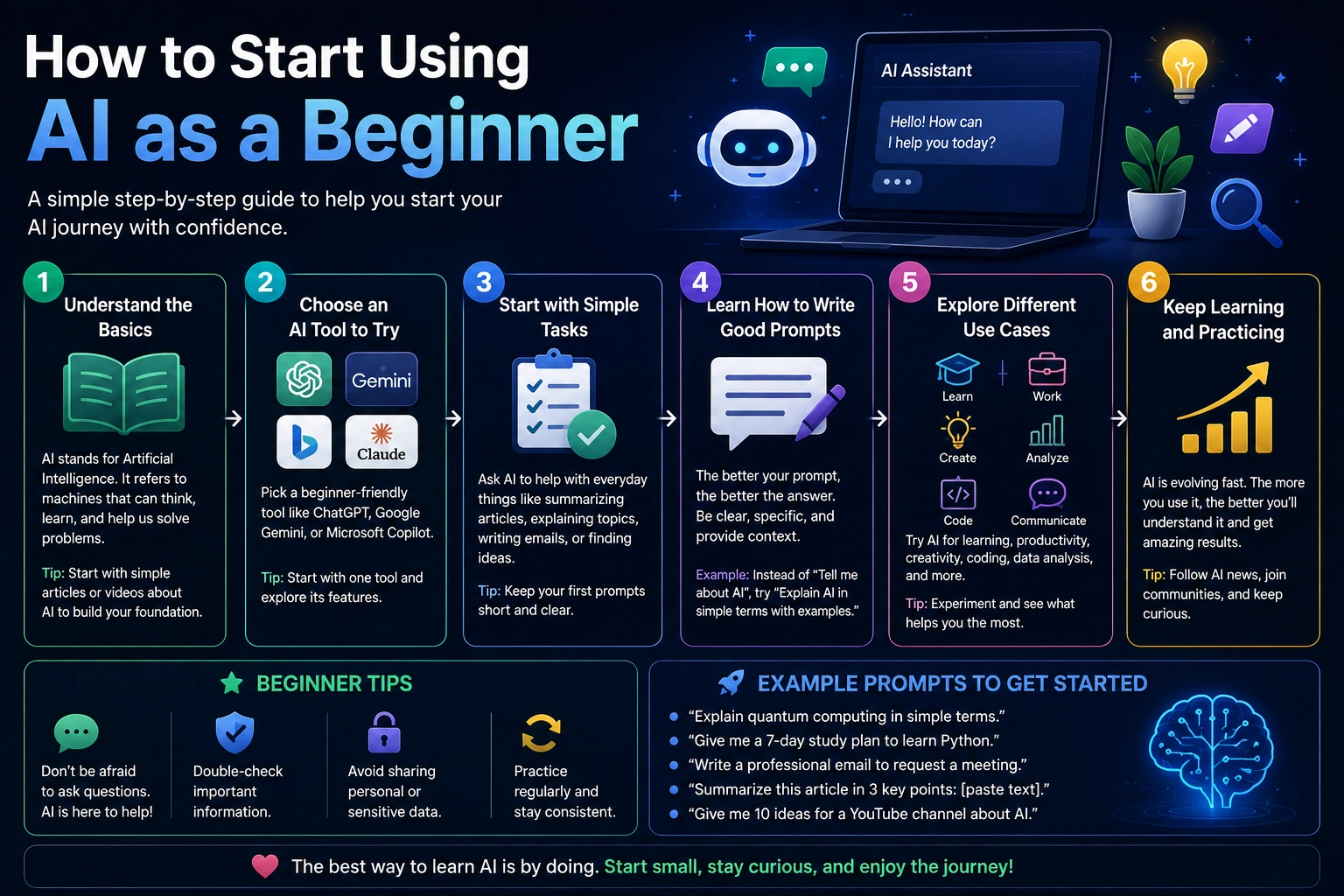
You don't need to be a programmer to start using generative AI. A simple way to begin is to choose an AI assistant and describe what you want it to do.
For example, you could ask an AI tool to:
- Explain a difficult topic in simple language.
- Summarize a long document.
- Help brainstorm ideas for a project.
- Write a first draft of an email.
- Create a study plan.
- Generate programming examples.
- Create an image from a description.
- Translate or improve a piece of writing.
What Is a Prompt?
A prompt is the instruction or question you give to a generative AI system. The quality and clarity of your prompt can have a significant effect on the output.
Instead of asking: "Tell me about AI."
You could provide more context: "Explain generative AI to a complete beginner using simple language and three real-world examples."
The second prompt gives the AI more information about the desired audience, topic, style, and output.
Is Generative AI the Same as ChatGPT?
No. ChatGPT is an AI application that uses generative AI models. Generative AI is the broader technology category.
Think of generative AI as a technology family and ChatGPT as one product built using that technology.
Will Generative AI Replace Humans?
Generative AI is changing how people work, but the idea that it will simply replace every human job is much more complicated.
AI can automate certain tasks and change the skills required for some jobs. At the same time, people are still needed for judgment, creativity, communication, leadership, responsibility, and decisions that require real-world context.
In many situations, the most useful approach is not humans versus AI, but humans working with AI.
The Future of Generative AI
Generative AI is continuing to develop rapidly. AI systems are becoming more capable of working across multiple types of information, including text, images, audio, video, and code.
We can expect AI assistants to become increasingly integrated into software, search engines, productivity applications, creative tools, education, and business workflows.
As the technology develops, understanding how to use AI effectively will become an increasingly valuable digital skill.
Frequently Asked Questions
What is generative AI in simple terms?
Generative AI is technology that can create new content such as text, images, audio, video, and code based on instructions provided by a user.
Is ChatGPT generative AI?
ChatGPT is a generative AI application that can generate text and perform many other tasks depending on the models and features available.
Is generative AI free?
Some generative AI services offer free plans, while others require subscriptions or charge for additional usage and advanced features.
Do I need programming skills to use generative AI?
No. Many generative AI tools are designed to be used with natural-language instructions, so beginners can use them without programming knowledge.
Can generative AI create images?
Yes. Specialized generative AI models can create images from text descriptions and can also edit or transform existing images.
Final Thoughts
Generative AI is one of the most significant developments in modern technology. It allows computers to generate new content rather than simply analyze existing information.
Whether you are a student, professional, creator, developer, or complete beginner, learning how to use generative AI can help you save time, explore ideas, and become more productive.
The best way to understand generative AI is to start experimenting with it. Try simple prompts, check the results carefully, and gradually learn how to give the AI better instructions.