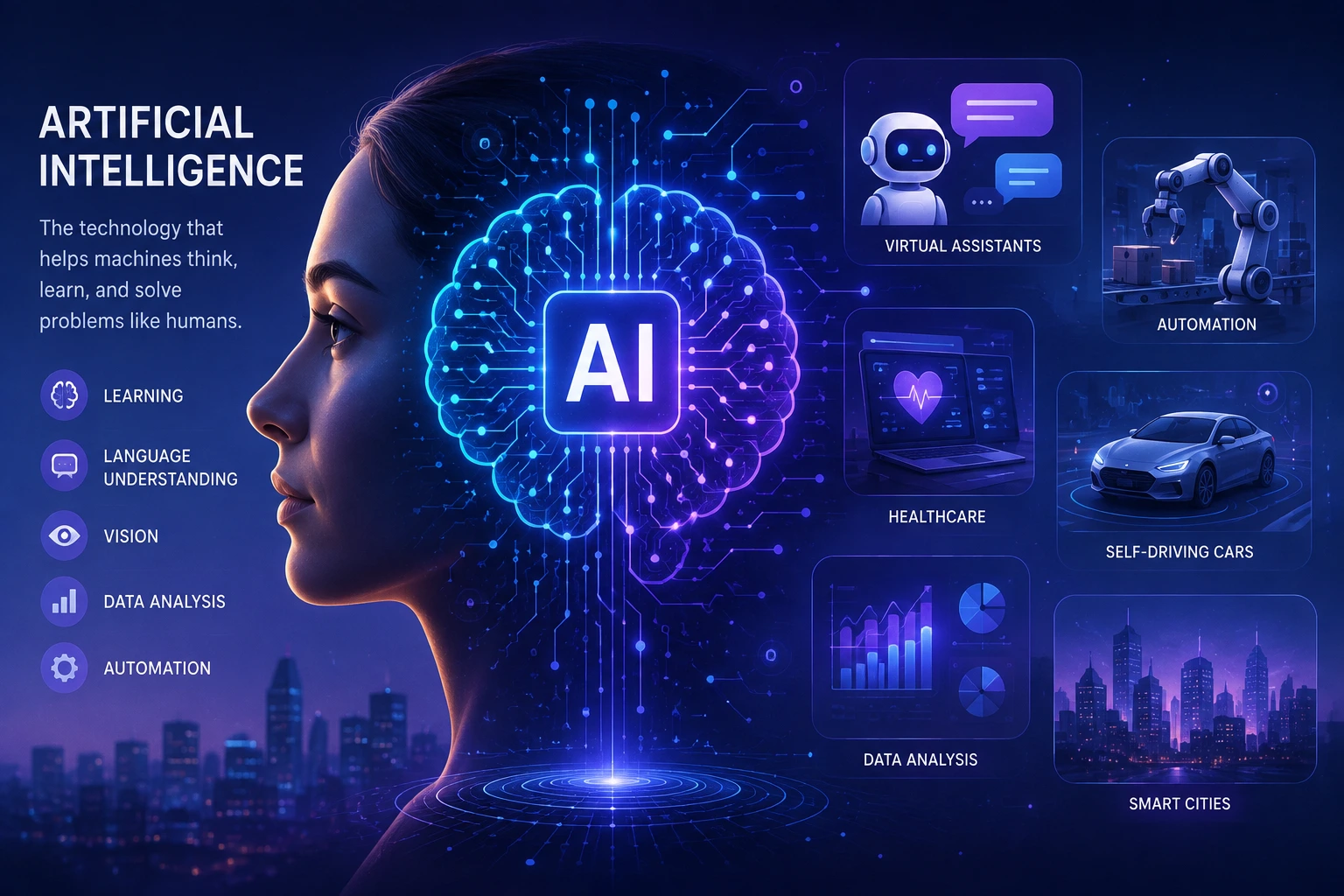
An AI model is a computer system that has been trained to recognize patterns in data and use those patterns to make predictions, generate content, classify information, or perform other tasks.
AI models are behind many of the artificial intelligence tools people use every day. They can power chatbots, search systems, recommendation engines, image generators, coding assistants, speech recognition systems, fraud detection tools, and many other applications.
When you ask an AI assistant a question and receive an answer, an AI model is responsible for processing your input and generating the result.
But what exactly is an AI model, how does it learn, and how is it different from an AI application?
In this beginner-friendly guide, we'll explain what an AI model is, how AI models are trained, the main types of AI models, how generative AI models work, and how models are used in tools such as ChatGPT and other AI applications.
What Is an AI Model?
An AI model is a mathematical and computational system that learns patterns from data and uses those patterns to perform a specific task or group of tasks.
Instead of being explicitly programmed with every possible answer, many modern AI models learn from examples during a training process.
For example, an image-recognition model can be trained using thousands or millions of images. During training, the model learns patterns associated with different objects.
After training, the model can analyze a new image and estimate what it contains.
A language model works in a different domain but follows a similar general idea. It learns statistical patterns in text and can use those patterns to predict and generate language.
In simple terms:
An AI model is a trained system that learns patterns from data and uses those patterns to produce useful outputs.
How Does an AI Model Work?
Most AI models follow a general process involving data, training, parameters, and inference.
The basic process looks like this:
- Collect data: The model is provided with relevant training data.
- Train the model: Algorithms adjust the model based on patterns in the data.
- Learn parameters: The model develops internal numerical values that represent what it learned.
- Evaluate the model: Developers test how well the model performs.
- Deploy the model: The trained model is made available for applications.
- Run inference: The model processes new inputs and produces outputs.
The exact process varies considerably depending on the type of AI model and what it is designed to do.
What Is AI Model Training?
AI model training is the process of teaching a model to recognize patterns in data.
During training, the model receives examples and produces predictions. An optimization process then adjusts its internal parameters to reduce errors or improve the desired objective.
This process can be repeated many times using large amounts of data.
For example, imagine training a model to recognize cats and dogs.
The training data could contain images labeled as either "cat" or "dog." The model analyzes these examples and gradually adjusts its parameters so that it becomes better at distinguishing between the two categories.
After training, developers can evaluate the model using images it has not previously seen.
The goal is not simply to memorize the training examples. The model should learn patterns that allow it to perform well on new data.
What Are AI Model Parameters?
Parameters are numerical values inside an AI model that are adjusted during training.
They help the model represent patterns learned from its training data.
Modern neural networks can contain millions, billions, or even more parameters. The number of parameters is one way to describe the size of a model, although parameter count alone does not determine how capable a model is.
A larger model can potentially represent more complex patterns, but training data, architecture, optimization, and other factors also have a major effect on performance.
What Is AI Model Inference?
Inference is the process of using a trained AI model to produce an output from new input.
For example, when you enter a question into an AI chatbot, the model processes your input and generates a response. This is an example of inference.
Other examples include:
- An image model generating an image from a text prompt
- A speech model converting audio into text
- A recommendation model predicting products you may like
- A fraud detection model identifying suspicious transactions
- A vision model identifying objects in an image
Training and inference are therefore different stages. Training is when the model learns its parameters, while inference is when the trained model is used.
AI Model vs AI System
An AI model is not necessarily the same thing as a complete AI product or system.
An AI application can contain a model along with many other components.
For example, an AI-powered application may include:
- An AI model
- User interface
- Databases
- Search systems
- Authentication
- APIs
- Safety systems
- Monitoring infrastructure
- Other software services
The model provides the core AI capability, while the surrounding software turns that capability into a usable product.
Types of AI Models
There are many different types of AI models. They are often categorized according to the tasks they perform, the way they learn, or the architecture they use.
Some important categories include:
- Supervised learning models
- Unsupervised learning models
- Reinforcement learning models
- Neural networks
- Language models
- Computer vision models
- Generative AI models
- Multimodal models
1. Supervised Learning Models
Supervised learning models are trained using examples that include known answers or labels.
For example, a dataset might contain customer transactions labeled as either legitimate or fraudulent.
The model learns patterns associated with those labels and can later classify new transactions.
Supervised learning is commonly used for tasks such as:
- Classification
- Prediction
- Spam detection
- Fraud detection
- Image classification
- Demand forecasting
2. Unsupervised Learning Models
Unsupervised learning involves finding patterns or structures in data without relying on predefined labels for every example.
For example, a model could analyze customer behavior and group customers with similar characteristics.
Common applications include:
- Customer segmentation
- Clustering
- Anomaly detection
- Pattern discovery
- Data exploration
3. Reinforcement Learning Models
Reinforcement learning involves an agent learning how to make decisions by interacting with an environment and receiving feedback.
The system can receive rewards for desirable actions and negative feedback for undesirable actions.
Over time, it learns strategies that can improve its performance.
Reinforcement learning has been used in areas such as robotics, games, optimization, and decision-making systems.
4. Neural Network Models
Neural networks are a family of machine learning models inspired loosely by the structure of biological nervous systems.
They contain interconnected computational units organized into layers.
Neural networks can learn complex relationships from data and are widely used in modern AI.
They power many applications involving:
- Images
- Text
- Speech
- Video
- Recommendations
- Prediction
5. Large Language Models
A large language model, or LLM, is an AI model designed to process and generate human language.
Modern LLMs are trained on large collections of text and other data. They learn patterns that allow them to predict and generate sequences of language.
LLMs can be used for:
- Answering questions
- Writing text
- Summarizing documents
- Translating languages
- Generating code
- Analyzing text
- Brainstorming ideas
Chatbots are often applications built around language models rather than being the models themselves.
6. Computer Vision Models
Computer vision models are designed to process and understand visual information.
They can analyze images and video and perform tasks such as:
- Object detection
- Image classification
- Image segmentation
- Face detection
- Optical character recognition
- Image generation
Computer vision is used in areas such as manufacturing, healthcare, security, autonomous systems, retail, and content creation.
7. Generative AI Models
Generative AI models are designed to create new content based on patterns learned during training.
Depending on the model, the generated content can include:
- Text
- Images
- Audio
- Video
- Code
For example, a text generation model can produce an article from a prompt, while an image generation model can create an image from a written description.
8. Multimodal AI Models
Multimodal AI models can work with more than one type of information, such as text, images, audio, or video.
For example, a multimodal model may receive an image and a text question and generate a text response based on the visual information.
Multimodal AI can make it possible to build applications that understand and generate different forms of content within a single workflow.
How Do AI Models Learn?
AI models learn by adjusting their internal parameters during training.
A simplified training process looks like this:
- The model receives training data.
- The model produces a prediction.
- The prediction is compared with the desired result or training objective.
- An error or loss value is calculated.
- An optimization algorithm adjusts model parameters.
- The process is repeated many times.
Over many training iterations, the model can become better at the task it was designed to perform.
Modern deep learning models may require enormous amounts of computing power, specialized hardware, and large datasets during training.
What Data Do AI Models Use?
The type of data used to train an AI model depends on what the model is designed to do.
Examples include:
- Text
- Images
- Audio
- Video
- Code
- Sensor data
- Business records
- Scientific data
A language model requires large amounts of language-related training data, while an image-recognition model needs relevant visual data.
The quality, diversity, relevance, and preparation of training data can significantly affect model performance.
What Is a Neural Network?
A neural network is a machine learning architecture made up of interconnected computational units that process information through multiple layers.
During training, the network adjusts its parameters so that its outputs become more useful for the task it is learning.
Deep learning refers to machine learning approaches that use neural networks with multiple layers.
Neural networks are an important foundation of many modern AI systems, including models used for language, vision, speech, and generative AI.
What Is a Foundation Model?
A foundation model is a large, broadly trained AI model that can be adapted or used for many different tasks.
Instead of training a completely separate model for every individual application, developers can start with a foundation model and adapt it to specific requirements.
Foundation models can support applications such as:
- Chatbots
- Writing assistants
- Coding assistants
- Document analysis
- Image generation
- Search and information systems
AI Model vs Machine Learning Model
The terms AI model and machine learning model are often used interchangeably, but they are not always identical.
Artificial intelligence is the broader field of creating systems that perform tasks associated with intelligent behavior.
Machine learning is a major approach within AI where systems learn patterns from data.
Therefore, a machine learning model is a type of AI model.
In modern discussions, however, the term AI model is frequently used to describe machine learning and deep learning models.
AI Model vs AI Tool
| AI Model | AI Tool |
|---|---|
| The underlying trained system | The application users interact with |
| Learns patterns from data | Uses models to provide features |
| Produces predictions or generated outputs | Provides a user interface and workflow |
| Can be accessed through an API | Can combine models with other software |
For example, an AI writing application might use a language model behind the scenes while adding its own interface, templates, editing tools, and document-management features.
How AI Models Generate Text
Language models generate text by processing the input and predicting what should come next based on patterns learned during training.
A simplified example would be:
The weather today is...
The model considers the preceding text and estimates possible next tokens. It then selects an output according to its generation process and continues until it produces a complete response.
Modern language models use sophisticated architectures and mechanisms that allow them to process much more context than simple word-prediction systems.
What Is a Token in an AI Model?
A token is a unit of information that a language model processes.
A token may represent a complete word, part of a word, punctuation, or another piece of text.
AI models process text as sequences of tokens rather than simply reading text exactly as humans do.
The number of tokens an AI model can process is related to its context window.
What Is an AI Model's Context Window?
A context window refers to the amount of information a model can process as context during a particular interaction.
A larger context window can allow an AI application to work with longer conversations, documents, codebases, or other inputs.
However, context-window size is only one factor in determining how useful a model is. Model architecture, training, reasoning capabilities, and the quality of the provided information also matter.
How Are AI Models Used in Everyday Life?
AI models are already used in many products and services.
Common examples include:
- Search engines
- Voice assistants
- Recommendation systems
- Translation tools
- Spam filters
- Fraud detection
- Navigation systems
- Chatbots
- Image generators
- Coding assistants
In many cases, users interact with an application without ever seeing the underlying AI model.
How Are AI Models Used in Business?
Businesses can use AI models to automate repetitive tasks, analyze information, assist employees, and build new products.
Common business applications include:
- Customer support
- Document processing
- Marketing content generation
- Sales assistance
- Data analysis
- Fraud detection
- Demand forecasting
- Software development
- Search and recommendation
Can Anyone Build an AI Model?
Yes, although the difficulty depends on the type and size of the model.
A developer can build a relatively simple machine learning model using existing libraries and datasets.
Training a large foundation model from scratch is much more difficult. It can require enormous datasets, specialized hardware, significant engineering expertise, and substantial financial resources.
Many developers therefore use existing models through APIs, downloadable model weights, or machine learning frameworks instead of training large models from scratch.
How Do Developers Use AI Models?
Developers can integrate AI models into applications in several ways.
Using an AI API
An application can send user input to a hosted AI model through an API and receive the generated result.
Using a Pretrained Model
Developers can sometimes download or access pretrained models and run them using their own infrastructure or compatible platforms.
Fine-Tuning a Model
Fine-tuning involves further training a pretrained model on a more specific dataset or task.
This can help adapt a model to particular requirements, although fine-tuning is not always necessary.
What Is Fine-Tuning?
Fine-tuning is a process in which an existing pretrained model is trained further using a specialized dataset.
For example, a general language model could potentially be adapted for a specialized business task using appropriate training data.
Fine-tuning can be useful when a model needs to behave consistently for a particular type of task or domain.
However, developers should first determine whether prompting, retrieval, or other techniques can solve the problem before choosing fine-tuning.
What Are AI Model Limitations?
AI models can be extremely capable, but they are not perfect.
Potential limitations include:
- Incorrect information
- Biased outputs
- Outdated knowledge
- Hallucinated information
- Security vulnerabilities
- Difficulty with unusual inputs
- Limited understanding of real-world context
- Dependence on training and evaluation data
A model can produce a confident answer that is incorrect. For important decisions, AI-generated information should therefore be independently verified.
Why Do AI Models Make Mistakes?
AI models learn statistical patterns rather than possessing human-like understanding of the world.
Errors can occur because of limitations in training data, model architecture, incomplete context, ambiguous instructions, or the inherent uncertainty of a prediction.
Generative models can also produce plausible-sounding information that is not supported by reliable evidence.
This is why human review remains important, particularly in areas such as medicine, law, finance, science, and security.
What Makes an AI Model Good?
There is no single measurement that determines whether an AI model is good.
Important factors can include:
- Accuracy
- Reliability
- Reasoning performance
- Language quality
- Context handling
- Speed
- Cost
- Safety
- Privacy
- Performance on the intended task
The best model for one task may not be the best model for another.
AI Model Size vs AI Model Performance
A common misconception is that a model with more parameters must always be better.
Model size can be important, but performance also depends on training data, architecture, optimization, inference techniques, and the specific task being evaluated.
A smaller model can sometimes be preferable when speed, cost, privacy, or local deployment are more important than maximum capability.
Large AI Models vs Small AI Models
| Large AI Models | Small AI Models |
|---|---|
| Often require more computing resources | Usually require fewer resources |
| Can handle complex tasks | Can be optimized for specific tasks |
| May have higher operating costs | Can be cheaper to run |
| Often used for broad capabilities | Can be useful for specialized applications |
| May require powerful infrastructure | Can sometimes run on local devices |
What Is an AI Model API?
An AI model API allows developers to communicate with an AI model from their applications.
For example, a developer can create a website where a user enters a question. The website sends that question to an AI model through an API and then displays the model's response.
This allows developers to add AI capabilities without building and training a large model themselves.
AI Models and Generative AI
Generative AI is one of the most visible applications of modern AI models.
Generative models can create new content based on user instructions and learned patterns.
Examples include:
- Text generation
- Image generation
- Video generation
- Audio generation
- Code generation
The quality of generated content depends on the model, its training, the input provided by the user, and the application surrounding the model.
How to Choose an AI Model
Developers and businesses should choose a model based on the actual requirements of their application rather than simply choosing the largest available model.
Consider:
- What task the model needs to perform
- Required accuracy
- Response speed
- Operating cost
- Context requirements
- Privacy requirements
- Deployment options
- Integration requirements
- Safety requirements
- Expected number of users
A Simple Example of an AI Model
Imagine you want to build an application that predicts whether an email is spam.
You could collect thousands of emails labeled as either spam or legitimate.
A machine learning model could analyze patterns in those examples and learn relationships between characteristics of emails and their labels.
When a new email arrives, the trained model processes it and predicts whether it is likely to be spam.
The application then uses that prediction to decide what action to take.
This example demonstrates the basic relationship between data, an AI model, and an AI-powered application.
A Practical AI Model Workflow
- Define the problem: Decide what you want the AI system to accomplish.
- Collect data: Gather relevant and appropriate training or evaluation data.
- Prepare the data: Clean, organize, and process the data.
- Select a model: Choose an architecture or pretrained model appropriate for the task.
- Train or adapt: Train the model or customize an existing model when necessary.
- Evaluate: Measure performance using appropriate tests.
- Deploy: Integrate the model into an application.
- Monitor: Track performance, errors, cost, and safety after deployment.
- Improve: Update the system as requirements and data change.
AI Models Are the Foundation of Modern AI
AI models are the underlying technology that makes many modern artificial intelligence applications possible.
From language models that generate text to computer vision models that analyze images, different models are designed to recognize patterns and produce useful outputs from new information.
Understanding the difference between a model and an application is important because an AI product is usually much more than the underlying model. It can combine one or more models with search, databases, APIs, software interfaces, safety systems, and other technologies.
Final Verdict
An AI model is a trained computational system that learns patterns from data and uses those patterns to produce predictions, classifications, recommendations, or generated content.
AI models can be designed for many different tasks, including understanding text, analyzing images, recognizing speech, predicting outcomes, and generating new content.
Modern generative AI systems have made AI models much more visible to everyday users. Tools for writing, coding, image generation, research, and productivity all rely on models behind the scenes.
The most important thing to understand is that an AI model is the underlying intelligence or prediction engine, while an AI application combines that model with software and other systems to provide a useful experience.
As AI continues to develop, understanding models, training, inference, parameters, and different model types will make it easier to understand how modern AI tools actually work.
Frequently Asked Questions
What is an AI model in simple terms?
An AI model is a computer system that has learned patterns from data and can use those patterns to produce an output. Depending on the model, that output could be a prediction, classification, recommendation, or generated content.
How does an AI model learn?
An AI model learns by processing training data and adjusting its internal parameters to improve its performance according to a specific training objective.
What is the difference between AI and an AI model?
Artificial intelligence is the broader field of creating systems capable of performing tasks associated with intelligent behavior. An AI model is a trained computational system used to perform specific AI-related tasks.
What is a machine learning model?
A machine learning model is a type of AI model that learns patterns from data rather than relying entirely on manually programmed rules.
What is a large language model?
A large language model, or LLM, is an AI model trained to process and generate language. LLMs can be used for tasks such as answering questions, summarizing text, writing, translation, and code generation.
What is a generative AI model?
A generative AI model is designed to create new content based on patterns learned during training. Depending on the model, it can generate text, images, audio, video, or code.
Are ChatGPT and an AI model the same thing?
Not exactly. ChatGPT is an AI application that uses AI models to generate responses and provide other features. The model is the underlying technology that processes the input and generates outputs.
Can AI models learn after they are deployed?
A deployed model does not necessarily learn continuously from every interaction. Whether a model is updated, retrained, fine-tuned, or otherwise adapted depends on how the AI system is designed.
Can AI models make mistakes?
Yes. AI models can produce incorrect, incomplete, biased, or misleading outputs. Important information should be independently verified, particularly for high-stakes decisions.
What is AI model training?
AI model training is the process of using data and optimization algorithms to adjust a model's internal parameters so that it performs better on a particular task or objective.
What is AI model inference?
Inference is the process of using a trained AI model to process new input and produce an output.
What are AI model parameters?
Parameters are numerical values learned during model training. They allow the model to represent patterns in its training data and use those patterns when processing new inputs.
Can beginners build an AI model?
Yes. Beginners can build simple machine learning models using existing datasets and software libraries. Building a large modern foundation model from scratch, however, requires considerably more data, computing resources, and specialized expertise.