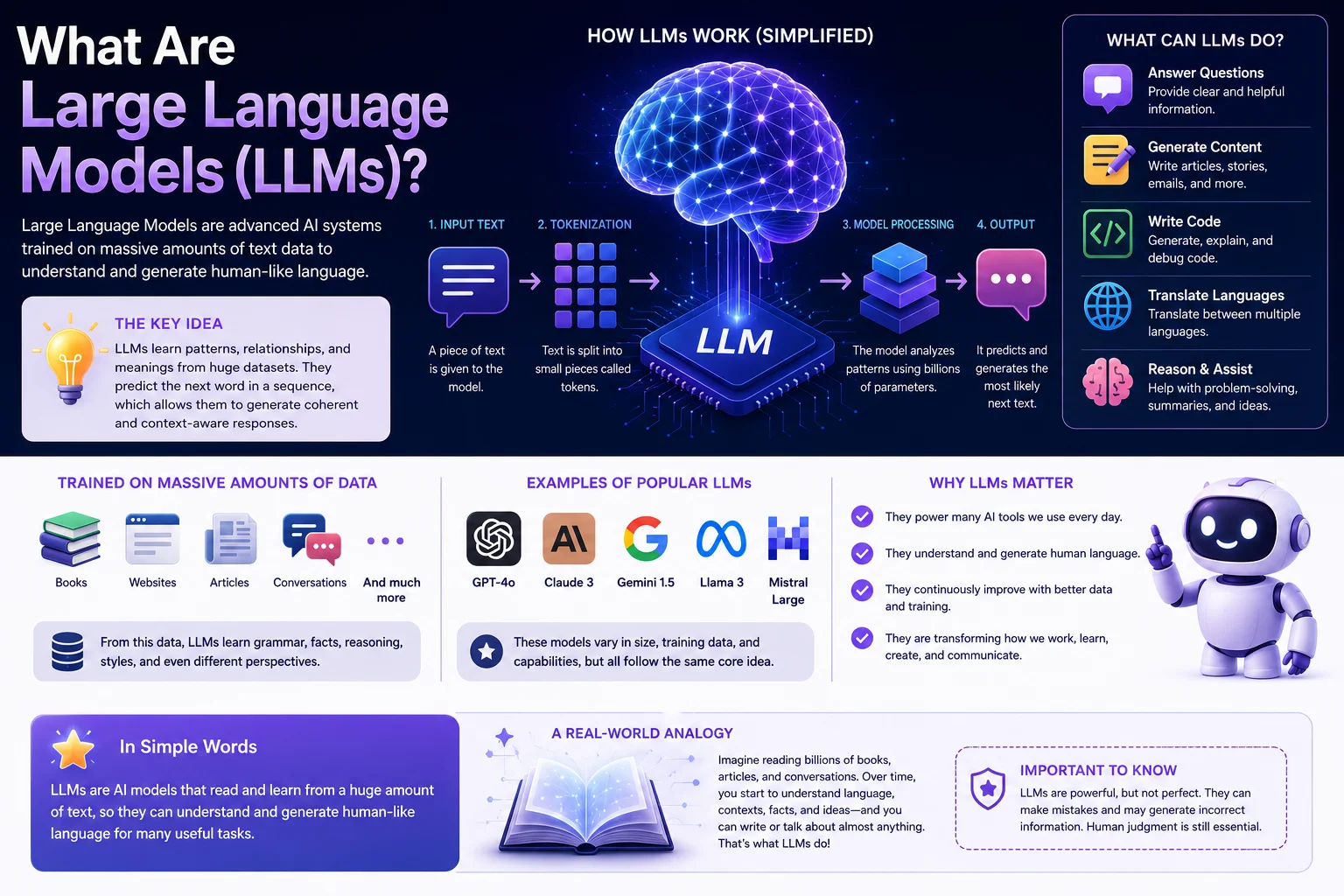

Large language models (LLMs) are advanced artificial intelligence systems designed to understand and generate human language.
They are the technology behind many modern AI applications, including chatbots, writing assistants, coding assistants, search tools, translation systems, and AI-powered productivity applications.
If you've used tools such as ChatGPT, Google Gemini, Claude, or other modern AI assistants, you've already interacted with technology based on large language models.
But what exactly is an LLM, how does it work, and why are these models so powerful?
Let's explain it in simple terms.
What Is a Large Language Model?
A large language model is a type of AI model trained on very large amounts of text and other data so that it can learn patterns in language.
After training, the model can use those learned patterns to generate text, answer questions, summarize information, translate languages, explain concepts, write code, and perform many other language-related tasks.
The word large refers to several things, including the huge amounts of training data and the large number of parameters used by modern models.
The word language refers to the model's primary ability to process and generate language.
And model means a mathematical system that has learned patterns from data.
In simple terms:
An LLM is an AI system that learns patterns in language from large amounts of data and uses those patterns to generate useful responses.
How Do Large Language Models Work?
At a high level, an LLM receives an input and predicts what text should come next based on patterns learned during training.
For example, if you write:
"The capital of France is..."
The model has learned from enormous amounts of text that a likely continuation is "Paris."
Modern LLMs are much more sophisticated than simple autocomplete systems. They can process long sequences of information, identify relationships between words and concepts, and generate coherent responses based on the context of a conversation.
A simplified workflow looks like this:
| Step | What Happens |
|---|---|
| 1. Input | You provide a prompt or question. |
| 2. Tokenization | The text is converted into smaller units called tokens. |
| 3. Processing | The model analyzes relationships between the tokens. |
| 4. Prediction | The model predicts likely next tokens. |
| 5. Generation | The predicted tokens are generated into a response. |
What Are Tokens?
LLMs don't usually process text exactly the way humans do.
Instead, text is broken into smaller pieces called tokens.
A token might represent:
- A complete word
- Part of a word
- A punctuation mark
- A number
- Another small piece of text
For example, a long word may be divided into multiple tokens rather than being treated as one indivisible unit.
Tokens allow AI models to efficiently process and generate large amounts of text.
What Is a Transformer?
Most modern large language models are based on a neural-network architecture called the Transformer.
Transformers became extremely important for language AI because they can efficiently process relationships between different parts of a sequence.
One of the key ideas behind Transformers is attention.
Attention allows the model to determine which parts of the input are particularly relevant when processing a particular token.
For example, consider the sentence:
"The dog chased the ball because it was excited."
Understanding what "it" refers to requires considering the surrounding context. Attention mechanisms help models capture these kinds of relationships.
What Is Attention in AI?
Attention is a mechanism that helps a neural network determine which parts of an input are important when processing information.
Instead of treating every word as equally important, the model can assign different levels of importance to different parts of the context.
This is one reason Transformer-based models can work effectively with complex language.
Attention mechanisms are fundamental to many modern language models.
How Are LLMs Trained?
Training a large language model is a complex process that requires large datasets, powerful computing infrastructure, and sophisticated algorithms.
A simplified training process looks like this:
1. Collect Training Data
Developers assemble large datasets containing text and, depending on the model, other types of information.
The data can come from many different sources, subject to the model developer's data policies and applicable laws.
2. Prepare the Data
The data is processed and prepared for training. This can involve cleaning, filtering, deduplication, formatting, and other preprocessing steps.
3. Train the Model
The model processes enormous numbers of examples and adjusts its parameters to become better at predicting tokens.
4. Evaluate the Model
Developers evaluate how well the model performs on different tasks and look for problems such as factual errors, unsafe behavior, or poor reasoning performance.
5. Fine-Tune the Model
Additional training techniques can be used to make the model more useful for following instructions and interacting with people.
6. Deploy the Model
After testing and optimization, the model can be integrated into an AI application or service.
What Is Pretraining?
Pretraining is the initial large-scale training stage where a language model learns general patterns from a huge dataset.
During this stage, the model learns relationships involving:
- Words
- Grammar
- Language structure
- Facts and concepts
- Writing styles
- Relationships between concepts
- Patterns in code and other structured information
The model doesn't simply store a giant collection of sentences. Instead, training adjusts its parameters so that it develops statistical representations of patterns in its training data.
What Is Fine-Tuning?
Fine-tuning is an additional training stage used to adapt a pretrained model for particular behaviors, tasks, or domains.
Fine-tuning can help a model become better at:
- Following instructions
- Answering questions
- Writing in particular formats
- Following specific behavioral requirements
- Working with specialized tasks
Modern AI systems can use multiple techniques beyond traditional fine-tuning to improve their behavior and usefulness.
What Are Parameters?
Parameters are numerical values learned by a neural network during training.
They influence how the model processes information and generates outputs.
Large language models can contain billions or more parameters, although parameter count alone does not determine how capable a model is.
Two models with different architectures, training methods, data, and parameter counts can have very different performance.
What Can Large Language Models Do?
Modern LLMs can perform a wide range of tasks.
| Task | Example |
|---|---|
| Writing | Create articles, emails, and stories. |
| Summarization | Turn long documents into concise summaries. |
| Translation | Translate text between languages. |
| Question Answering | Explain concepts and answer questions. |
| Coding | Generate, explain, and debug code. |
| Brainstorming | Generate ideas and possible solutions. |
| Classification | Organize or categorize text. |
| Extraction | Extract specific information from text. |
Some newer models can also work with multiple types of information, such as text, images, audio, and video. These are often called multimodal AI models.
Examples of Large Language Models
Several major AI companies have developed large language models or families of models.
| AI Model Family | Company | Common Applications |
|---|---|---|
| GPT | OpenAI | Chatbots, writing, coding, AI applications |
| Gemini | AI assistants, search, productivity | |
| Claude | Anthropic | Writing, analysis, coding, assistants |
| Llama | Meta | Research, applications, open model ecosystem |
| Mistral models | Mistral AI | Enterprise and developer applications |
The capabilities, availability, licensing, and features of these models vary and can change over time.
Are ChatGPT and an LLM the Same Thing?
Not exactly.
An LLM is the underlying AI model, while ChatGPT is an AI product that uses language models as part of its technology.
A useful analogy is:
Engine → Car
An engine is an important component of a car, but a car is more than just its engine.
Similarly, an LLM is an important component of an AI application, but the complete application can include interfaces, tools, memory, safety systems, retrieval systems, and other technologies.
LLMs vs Traditional Chatbots
Traditional chatbots often rely heavily on predefined rules, scripts, or decision trees.
LLM-based assistants can generate responses dynamically based on the context of the conversation.
| Traditional Chatbot | LLM-Based Assistant |
|---|---|
| Often rule-based | Uses learned language patterns |
| Limited predefined responses | Generates dynamic responses |
| Usually narrow in scope | Can handle many different tasks |
| Requires explicit conversation flows | Can interpret natural-language instructions |
Why Are LLMs So Powerful?
Large language models are powerful because they combine several capabilities:
- Large-scale training
- Transformer architectures
- Huge numbers of learned parameters
- Large context windows in modern systems
- Powerful computing infrastructure
- Advanced training and alignment techniques
One particularly important capability is generalization.
A model trained on many different examples can sometimes apply what it learned to tasks that weren't explicitly demonstrated in exactly the same form.
This allows one model to perform many different tasks through natural-language instructions.
What Is a Context Window?
A context window is the amount of information an AI model can consider as part of a particular interaction.
This can include:
- Your current prompt
- Previous messages
- Documents
- Code
- Other information provided to the model
Larger context windows allow models to work with longer documents and more extensive conversations, although having a larger context window does not automatically mean a model will understand every piece of information perfectly.
Do LLMs Understand Language Like Humans?
This is an important question.
LLMs can process language extremely effectively, but their operation is fundamentally different from human understanding.
A model learns statistical and representational patterns from its training process and uses them to generate outputs.
It does not necessarily possess human experiences, emotions, beliefs, or consciousness.
This distinction is important when evaluating AI-generated information.
What Are AI Hallucinations?
An AI hallucination occurs when a model produces information that sounds plausible but is incorrect, unsupported, or invented.
For example, an LLM might:
- Invent a citation
- Give an incorrect fact
- Confidently describe a nonexistent event
- Generate code containing errors
- Misinterpret a question
This happens because language models are designed to generate likely outputs, not to guarantee that every statement is factually correct.
For important information, you should verify AI-generated answers using reliable sources.
What Are the Limitations of LLMs?
Despite their impressive capabilities, large language models have important limitations.
1. They Can Make Mistakes
LLMs can generate incorrect information even when the response sounds confident.
2. They Can Reflect Biases
Models can reproduce unwanted biases found in data or introduced during development.
3. They Don't Automatically Know Everything
A model's knowledge depends on its training, system design, available tools, and whether it can access current information.
4. They Can Struggle With Complex Reasoning
Although modern models can perform sophisticated reasoning tasks, they can still make logical or mathematical mistakes.
5. They Require Significant Resources
Training and operating advanced models can require substantial computing power and infrastructure.
LLMs and Generative AI
Large language models are an important part of generative AI.
Generative AI refers to systems that can create new content based on patterns learned from data.
Examples include:
- Text generation
- Image generation
- Audio generation
- Video generation
- Code generation
LLMs specialize primarily in language and language-related tasks, while generative AI is a broader category that includes many different types of models.
How LLMs Are Used in Everyday Life
You may already be using LLM technology without thinking about it as an AI model.
AI can draft replies, summarize messages, and improve the tone of communication.
Education
Students can use AI assistants to explain difficult concepts, create study questions, and summarize learning material.
Programming
LLMs can generate code, explain programming concepts, find potential bugs, and help developers work with unfamiliar codebases.
Customer Support
Businesses can use language models to help answer customer questions and assist human support agents.
Content Creation
Writers and marketers can use LLMs to brainstorm ideas, create outlines, rewrite content, and generate first drafts.
LLMs and Coding
One of the most significant uses of large language models is software development.
Because programming languages have structured syntax and large amounts of publicly available code and documentation, language models can be useful for coding tasks.
Developers can ask an LLM to:
- Generate functions
- Explain code
- Debug errors
- Write tests
- Convert code between languages
- Create documentation
- Suggest improvements
However, developers should always test AI-generated code rather than assuming it is correct.
What Is Retrieval-Augmented Generation?
Retrieval-Augmented Generation (RAG) is a technique that combines an LLM with an external information-retrieval system.
Instead of relying only on information stored in the model's learned parameters, a RAG system can retrieve relevant documents or information and provide them to the model as context.
This can be useful for:
- Company knowledge bases
- Customer support
- Document question answering
- Research
- Internal business information
RAG can help an AI application work with specific and up-to-date information without requiring the underlying model to be retrained every time a document changes.
What Is an LLM API?
An LLM API allows developers to connect an AI language model to their own applications.
For example, a developer could build:
- An AI customer support assistant
- An AI writing application
- A coding assistant
- A document summarizer
- An educational chatbot
- An AI search application
The application sends information to the model through an API and receives the generated output.
Why Do LLMs Need So Much Computing Power?
Training advanced language models involves processing enormous amounts of data and performing huge numbers of mathematical operations.
Specialized hardware, including GPUs and other AI accelerators, is commonly used to make this computation practical.
Training is only part of the cost. Serving a model to millions of users also requires substantial infrastructure.
This is one reason AI companies invest heavily in data centers, specialized chips, networking, and model optimization.
Are Larger LLMs Always Better?
No.
Model size can be important, but it is only one factor that affects performance.
Other factors include:
- Training data quality
- Training techniques
- Model architecture
- Post-training methods
- Reasoning capabilities
- Inference optimization
- Tool use
- Context length
A smaller, specialized model can sometimes be more efficient or better suited to a particular task than a much larger general-purpose model.
The Future of Large Language Models
LLMs are likely to remain one of the central technologies in AI development.
Future AI systems are expected to become increasingly capable of working with multiple types of information and interacting with external tools.
Important areas of development include:
- Better reasoning
- More efficient models
- Longer context windows
- Improved multimodal capabilities
- Better tool use
- More reliable AI agents
- Smaller models that can run locally
- More specialized models
Instead of simply generating text, future AI applications may increasingly use language models as reasoning and coordination engines that interact with software, databases, websites, and other tools.
Our Simple Definition
If you remember one thing from this article, remember this:
A large language model is an AI system trained on large amounts of data to learn patterns in language and generate useful text-based responses.
LLMs are one of the key technologies behind today's generative AI revolution. They power chatbots, writing assistants, coding tools, research applications, and many other AI products.
Understanding how LLMs work gives you a better foundation for understanding the rapidly changing world of artificial intelligence.
Frequently Asked Questions
What does LLM stand for?
LLM stands for Large Language Model.
What is an LLM in simple terms?
An LLM is an AI model trained on large amounts of data to recognize patterns in language and generate responses based on those patterns.
Is ChatGPT an LLM?
ChatGPT is an AI application that uses large language models as part of its underlying technology. The product itself includes more than just the model.
Are LLMs the same as generative AI?
No. LLMs are primarily language models, while generative AI is a broader category that includes models capable of generating text, images, audio, video, code, and other content.
How are LLMs trained?
LLMs are trained using large datasets and powerful computing systems. During training, their parameters are adjusted so they become better at predicting and generating sequences of tokens.
Can LLMs think like humans?
LLMs can perform sophisticated reasoning-like tasks, but they do not necessarily think or experience the world in the same way humans do.
Can LLMs make mistakes?
Yes. LLMs can produce inaccurate information, sometimes with high confidence. Important information should therefore be independently verified.
What is the difference between AI and an LLM?
AI is the broad field of artificial intelligence. An LLM is a specific type of AI model designed primarily to process and generate language.
What are LLMs used for?
LLMs are used for writing, summarization, translation, coding, question answering, research assistance, customer support, content creation, and many other language-related tasks.