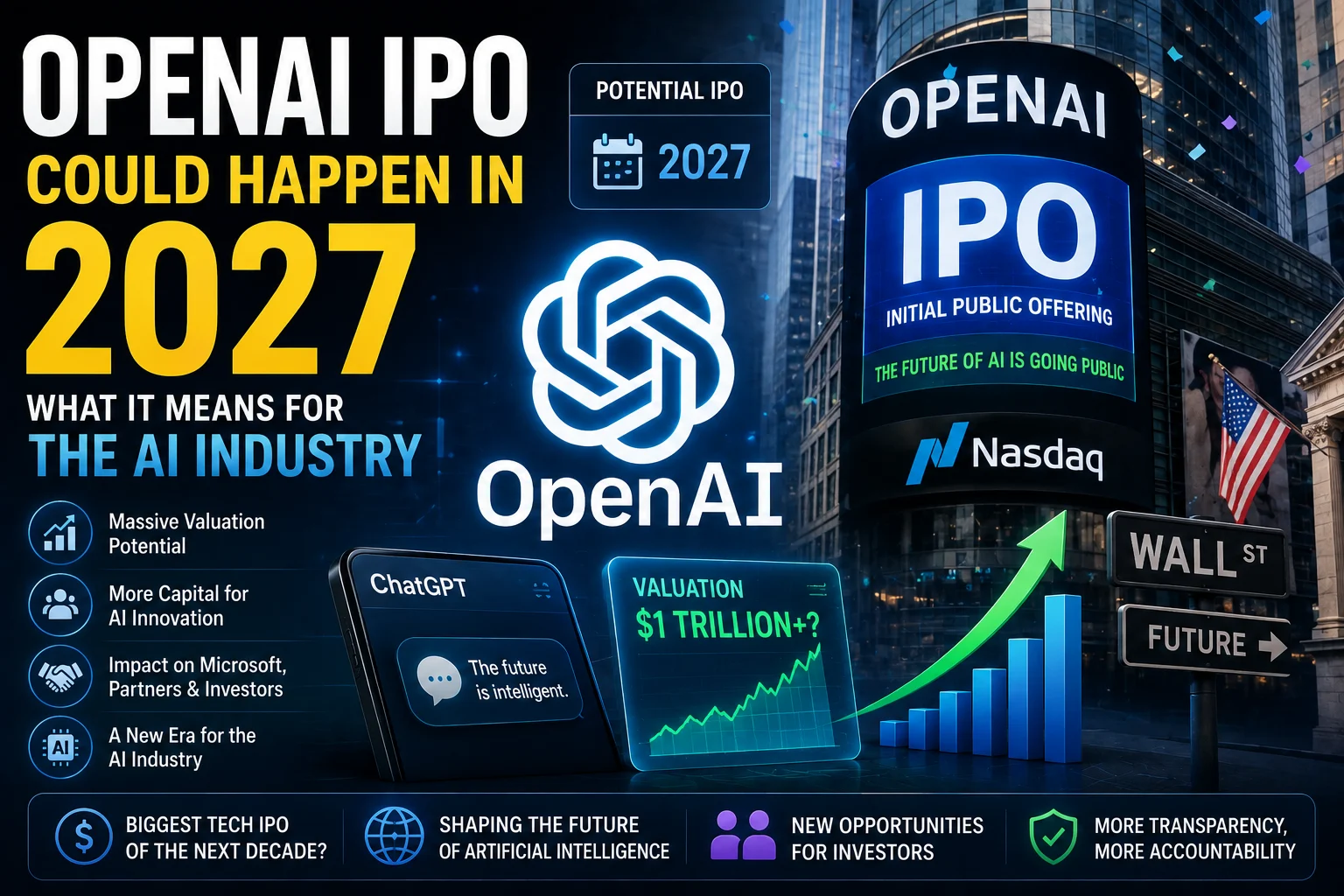

OpenAI could be heading toward one of the biggest technology IPOs in history, but the company's public debut may not happen until 2027.
The company behind ChatGPT has been preparing for the possibility of becoming a publicly traded company, while recent reports indicate that OpenAI has been considering delaying its IPO timeline. The exact date has not been finalized, meaning a 2027 listing remains a possibility rather than a confirmed event.
If OpenAI does eventually go public, the impact could extend far beyond the company itself. An IPO would give investors a new way to participate in the AI boom while forcing one of the world's most important AI companies to provide much greater financial transparency.
It could also affect competitors such as Anthropic and Google, major technology partners, AI infrastructure companies, venture capital markets, and the broader debate over how much the artificial intelligence industry is really worth.
In this guide, we'll explain what is currently known about a potential OpenAI IPO, why 2027 is being discussed, what OpenAI could be worth, and what a public listing could mean for the AI industry.
Could OpenAI Go Public in 2027?
Yes, OpenAI could potentially go public in 2027, but there is currently no confirmed IPO date.
OpenAI has been preparing for a potential public listing and confidentially submitted a draft registration statement to U.S. securities regulators in 2026. A confidential filing is an important step toward an IPO, but it does not guarantee that a company will complete the offering.
Earlier plans had pointed toward a possible 2026 listing, but reports later indicated that OpenAI was leaning toward delaying the IPO until 2027.
That means investors should distinguish between three different things:
- OpenAI preparing for a potential IPO
- OpenAI potentially targeting 2027
- OpenAI having a confirmed IPO date
The first two have been reported, while the third has not been officially confirmed.
Why Is OpenAI Considering an IPO?
An IPO could provide OpenAI with access to enormous amounts of capital at a time when developing and operating advanced AI systems requires significant computing infrastructure.
Training and running large AI models requires expensive data centers, specialized chips, networking equipment, energy, and engineering talent.
OpenAI is also competing in a rapidly changing market against companies including Anthropic, Google, Meta, and other AI developers.
Going public could give OpenAI another major source of capital to fund:
- AI model development
- Data center infrastructure
- GPU and computing capacity
- Enterprise AI products
- ChatGPT development
- AI agents
- Research and safety work
- Global expansion
A public listing could therefore become an important part of OpenAI's long-term strategy.
How Much Could OpenAI Be Worth?
OpenAI has already reached a valuation that would make it one of the world's most valuable private technology companies.
Recent private transactions have valued the company at around $852 billion, while reports have discussed the possibility of an IPO valuation approaching or exceeding $1 trillion. :contentReference[oaicite:1]{index=1}
However, a private-company valuation should not automatically be treated as the price investors would pay in a public market.
The final IPO valuation would depend on factors such as:
- OpenAI's revenue growth
- Profitability and cash flow
- AI infrastructure costs
- Investor demand
- Interest rates
- Competition from other AI companies
- Market conditions
- Future growth expectations
If OpenAI were valued at $1 trillion or more, the IPO would rank among the largest technology listings ever.
Why Could the OpenAI IPO Be Delayed Until 2027?
There are several reasons why OpenAI might prefer to wait rather than rush into the public markets.
1. Market Conditions
Technology IPOs depend heavily on investor sentiment.
Even a rapidly growing company can struggle to achieve its desired valuation if investors become more cautious about technology stocks or AI spending.
A delay could give OpenAI more time to wait for a market environment that supports a large technology IPO.
2. AI Competition Is Increasing
OpenAI no longer operates in a market where it has few serious competitors.
Anthropic has become a major competitor, while Google, Meta, xAI, and other companies continue to invest heavily in AI models and products.
The stronger the competition becomes, the more important revenue growth, product adoption, and profitability will become for public-market investors.
3. Massive AI Infrastructure Costs
AI companies require enormous amounts of computing power.
The cost of GPUs, data centers, electricity, networking infrastructure, and model development creates a major difference between AI companies and traditional software businesses.
Public investors are likely to pay close attention to whether OpenAI can convert its rapid AI adoption into sustainable economics.
4. OpenAI Is Still Evolving
OpenAI has undergone significant organizational and strategic changes as it has expanded from an AI research organization into a large technology company.
The company continues to develop consumer products, enterprise services, coding tools, AI agents, and increasingly capable models.
Waiting until 2027 could give OpenAI additional time to demonstrate the strength of these businesses.
What Would an OpenAI IPO Mean for Investors?
An OpenAI IPO would give public-market investors direct exposure to one of the most important companies in the artificial intelligence industry.
For investors, the attraction would be obvious: OpenAI operates ChatGPT and has become one of the central companies driving generative AI adoption.
But the risks would also be significant.
Investors would need to consider:
- High AI infrastructure costs
- Intense competition
- Potentially extreme valuation expectations
- Regulatory uncertainty
- Rapid changes in AI technology
- Dependence on computing infrastructure
- Potential changes in consumer AI demand
- Long-term profitability
The IPO could therefore become one of the most closely watched technology investment events of the decade.
What Would an OpenAI IPO Mean for the AI Industry?
The impact would likely extend well beyond OpenAI.
More Transparency
As a public company, OpenAI would be expected to provide investors with significantly more information about its financial performance, risks, business operations, and corporate governance.
This could help the market better understand how much revenue AI companies are actually generating and how much they spend to produce that revenue.
More Pressure on AI Companies
Public ownership can introduce pressure to deliver predictable financial results.
That could change how OpenAI approaches product launches, infrastructure spending, research investments, and long-term projects.
A New Benchmark for AI Valuations
One of the most important consequences could be the creation of a public-market benchmark for AI companies.
If OpenAI receives a very high valuation, other AI companies could use that valuation as evidence supporting their own market expectations.
If investors instead value OpenAI more conservatively, it could force the entire AI startup ecosystem to reconsider some of the extremely high private valuations seen in recent years.
What Could an OpenAI IPO Mean for Anthropic?
OpenAI would not be the only major AI company attracting attention from investors.
Anthropic has also emerged as one of the most important companies in the generative AI market, and recent reporting has suggested that it could move toward a public listing before OpenAI.
That creates an interesting possibility: investors could soon have public-market comparisons between two of the largest AI model companies.
Such a comparison could help investors evaluate:
- Revenue growth
- Enterprise adoption
- AI model performance
- Infrastructure costs
- Customer acquisition
- Profitability
- Long-term business models
The first major AI laboratory to successfully enter the public markets could therefore have an important influence on how investors value the entire sector.
What Would an OpenAI IPO Mean for Microsoft?
Microsoft is one of OpenAI's most important strategic partners, making an OpenAI IPO particularly significant for Microsoft as well.
Microsoft has invested heavily in OpenAI and has integrated OpenAI technology into products and services across its ecosystem.
A public listing could make OpenAI's financial performance easier for investors to evaluate and could bring greater attention to the economic relationship between the two companies.
Investors would likely pay close attention to:
- Microsoft's relationship with OpenAI
- Cloud infrastructure commitments
- Revenue-sharing arrangements
- AI product integration
- Microsoft's own AI strategy
Could OpenAI Become the Biggest AI IPO Ever?
It is possible.
If OpenAI eventually lists at a valuation around $1 trillion or higher, it would rank among the largest technology IPOs ever.
The company has grown from an AI research organization into a global technology platform used by consumers, developers, businesses, and organizations around the world.
The size of the potential listing reflects the enormous expectations surrounding artificial intelligence.
However, a huge valuation would also create huge expectations.
Public investors would expect OpenAI to demonstrate that its growth can eventually translate into a sustainable and highly valuable business.
What Investors Should Watch Before an OpenAI IPO
If OpenAI continues toward a 2027 IPO, several indicators will be particularly important.
Revenue Growth
Investors will want to know how quickly OpenAI's revenue is increasing and whether growth is coming from consumer subscriptions, enterprise customers, APIs, or other products.
Profitability
Revenue alone does not determine whether an AI company is financially sustainable.
Investors will also need to understand how much OpenAI spends on computing, employees, infrastructure, research, and other operating costs.
Enterprise Adoption
Enterprise AI could become an increasingly important source of revenue.
The number of businesses using OpenAI products and the amount they spend could therefore become an important indicator of long-term growth.
AI Infrastructure
OpenAI's relationship with cloud providers, chip companies, and data-center operators will remain important because advanced AI requires enormous computing resources.
Competition
OpenAI's position relative to Anthropic, Google, Meta, and other AI developers could have a major influence on investor expectations.
What Could Go Wrong With an OpenAI IPO?
A successful IPO is not guaranteed simply because a company is popular.
OpenAI could face several major risks.
- High valuation risk: A very high IPO valuation could make future growth expectations difficult to meet.
- Competition: Rival AI companies could reduce OpenAI's market share.
- Infrastructure costs: AI development requires enormous capital and computing resources.
- Regulation: Governments could introduce rules affecting AI development and deployment.
- Technology changes: New AI architectures or competitors could change the market quickly.
- Profitability: Rapid revenue growth does not automatically mean sustainable profits.
These risks would become especially important if OpenAI enters the public markets at an extremely high valuation.
Will OpenAI Stock Be Available to Everyone?
If OpenAI completes an IPO, its shares would eventually become publicly tradable through the stock market.
However, investors should not assume that a ticker symbol, exchange, offering price, or exact share structure has already been finalized.
Those details would normally become clearer through official regulatory filings and IPO announcements closer to the offering.
Until then, claims about a specific OpenAI stock price or guaranteed IPO date should be treated cautiously.
How an OpenAI IPO Could Change AI Startups
The public listing of OpenAI could change how investors evaluate AI startups.
For years, private AI companies have been valued largely through venture-capital funding rounds and private transactions.
A public OpenAI would introduce a continuously updated market valuation.
That could influence how venture capital firms price emerging AI companies and how founders negotiate future funding rounds.
It could also make investors more selective.
Instead of valuing AI companies primarily based on technological potential, investors may increasingly compare startups against public companies using measurable metrics such as revenue, growth, margins, customer retention, and infrastructure costs.
OpenAI IPO vs Traditional Technology IPOs
| Factor | Traditional Software IPO | Potential OpenAI IPO |
|---|---|---|
| Infrastructure costs | Often relatively low | Extremely high |
| Growth expectations | High | Potentially extreme |
| Technology cycle | Relatively predictable | Rapidly changing |
| Competition | Industry dependent | Global and intense |
| Investor attention | High | Potentially unprecedented |
| Regulatory attention | Industry dependent | Very high |
What an OpenAI IPO Could Mean for the Future of AI
An OpenAI IPO would represent more than another technology company entering the stock market.
It would be a major test of whether the enormous private-market valuations surrounding artificial intelligence can translate into sustainable public-company valuations.
If investors strongly support the offering, it could encourage even more capital to flow into AI infrastructure, models, applications, and startups.
If investors are more cautious, it could signal that the AI market needs to focus more heavily on profitability and sustainable business models.
Either outcome would be important for the future of the industry.
OpenAI IPO 2027: What We Know So Far
| Question | Current Situation |
|---|---|
| Will OpenAI go public? | A potential IPO is being prepared, but completion is not guaranteed. |
| Could the IPO happen in 2027? | Yes, recent reports indicate 2027 is a possible timeline. |
| Is the IPO date confirmed? | No. |
| Could OpenAI be valued at $1 trillion? | Reports have discussed a potential valuation around or above $1 trillion. |
| Has OpenAI taken steps toward an IPO? | Yes, including a confidential regulatory filing. |
| Would it be a major AI IPO? | Yes, potentially one of the largest technology listings ever. |
Final Verdict
An OpenAI IPO in 2027 could become one of the most important events in the technology industry, but investors should remember that the timeline is not guaranteed.
OpenAI has already taken meaningful steps toward a potential public listing, while recent reports indicate that the company may now be targeting 2027 rather than rushing to market in 2026. :contentReference[oaicite:2]{index=2}
The potential size of the offering is what makes the story particularly important. OpenAI's latest private valuation has been reported at around $852 billion, while a future IPO valuation of $1 trillion or more has been discussed. :contentReference[oaicite:3]{index=3}
If OpenAI goes public at that scale, the IPO could influence how investors value artificial intelligence companies across the entire industry.
It could also provide the public with a much clearer view of the economics behind generative AI, including revenue growth, infrastructure spending, operating costs, and the path toward profitability.
For AI investors, startups, competitors, and technology companies, the OpenAI IPO could therefore become much more than a single company's stock-market debut. It could become a major test of the entire AI investment boom.
Frequently Asked Questions
When will OpenAI go public?
OpenAI has not announced a confirmed IPO date. Recent reports have indicated that the company could delay its public debut until 2027.
Could OpenAI IPO in 2027?
Yes. A 2027 IPO is currently a possibility, although the exact timing could change depending on market conditions, company performance, and regulatory preparations.
How much could OpenAI be worth at an IPO?
Reports have discussed a potential valuation of around $1 trillion or more. OpenAI was recently valued at approximately $852 billion in a private transaction, but the eventual public-market valuation could be different.
Does OpenAI have a stock ticker?
OpenAI does not currently have a publicly traded stock ticker. If the company completes an IPO, its ticker and exchange would be disclosed as part of the public offering process.
Can I buy OpenAI stock now?
OpenAI is not currently a publicly traded company, so ordinary investors cannot purchase its shares through a standard public stock exchange.
Why is OpenAI considering an IPO?
An IPO could provide OpenAI with access to substantial capital that could be used for AI research, computing infrastructure, data centers, product development, and global expansion.
Would an OpenAI IPO affect other AI companies?
Yes. A large OpenAI IPO could influence how investors value companies such as Anthropic and other AI startups. It could also affect venture-capital valuations and investment in AI infrastructure.
Would an OpenAI IPO be the biggest AI IPO?
It could become one of the largest technology and AI-related IPOs ever if OpenAI reaches a valuation around $1 trillion or higher.
Is the OpenAI IPO guaranteed?
No. Preparing for an IPO does not guarantee that a company will complete the offering. The timing and structure can change based on market conditions, business performance, regulatory requirements, and other factors.