
Choosing the right hosting is one of the most important decisions when building an AI website. Whether you're creating an AI-focused blog, an AI tools directory, a SaaS application, an AI-powered web app, or a website that connects to external AI APIs, your hosting provider affects performance, reliability, security, scalability, and cost.
The good news is that you don't always need expensive cloud infrastructure to launch an AI website. For many websites, a reliable managed hosting provider can provide everything needed to get started without the complexity of managing servers yourself.
In this guide, we'll look at the best hosting options for AI websites in 2026 and explain which hosting provider is best for different types of AI projects.
Best Hosting for AI Websites in 2026
Different AI websites have different hosting requirements. A content website publishing AI news and tutorials doesn't need the same infrastructure as an AI SaaS application running backend services and API requests.
For most beginners, bloggers, affiliate website owners, and small businesses, Hostinger is one of the best places to start because it combines affordable hosting, an easy control panel, website-building tools, and a relatively simple setup process.
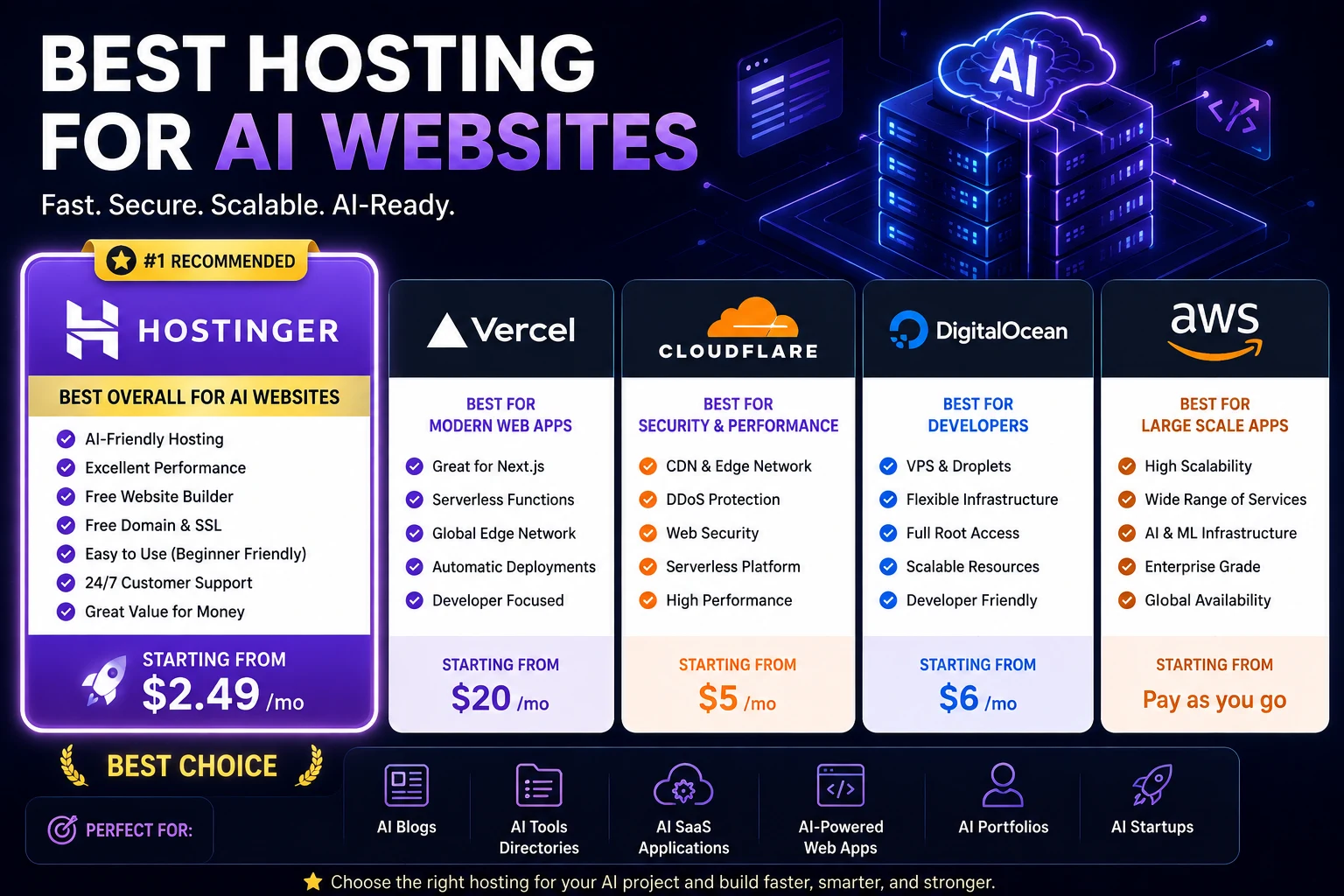
- Hostinger — Best overall hosting for most AI websites
- Vercel — Best for modern Next.js and frontend applications
- Cloudflare — Best for edge performance and serverless applications
- DigitalOcean — Best for developers who want more server control
- AWS — Best for large-scale AI applications and enterprise infrastructure
1. Hostinger
Hostinger is our top choice for most AI websites in 2026.
For many AI-focused websites, especially content sites, blogs, affiliate websites, directories, portfolios, and small web applications, you don't need to start with complicated cloud infrastructure.
Hostinger provides a relatively beginner-friendly environment that makes it easier to launch and manage a website without spending a significant amount of time configuring servers.
Why Hostinger is a good choice for AI websites
- Affordable hosting plans
- Easy website management
- Simple control panel
- Domain and hosting management in one place
- SSL support
- PHP and MySQL support
- Suitable for WordPress and custom websites
- Useful for AI blogs and content websites
- Can support websites that connect to external AI APIs
- Beginner-friendly setup
Hostinger is particularly attractive if your AI website doesn't actually run an AI model on the server.
For example, imagine you're building an AI tools website using PHP and MySQL. Your website could send requests to an external AI API rather than running a large language model directly on your hosting server.
In that situation, your hosting provider mainly needs to handle your website, database, authentication, API requests, images, and other web application functionality.
That makes traditional web hosting a practical and cost-effective option.
What types of AI websites can use Hostinger?
- AI blogs
- AI news websites
- AI tool directories
- AI affiliate websites
- AI tutorials and educational websites
- AI-focused WordPress websites
- PHP and MySQL AI applications
- Landing pages for AI startups
- AI portfolios
- Websites connected to external AI APIs
Best for: Beginners, bloggers, content publishers, affiliate websites, small businesses, and developers who want affordable and straightforward hosting.
2. Vercel
Vercel is a popular choice for developers building modern frontend applications, particularly websites and applications based on Next.js.
It is designed around modern web development workflows and can be especially convenient for applications deployed directly from Git repositories.
Why use Vercel?
- Excellent support for modern frontend frameworks
- Strong Next.js integration
- Git-based deployments
- Serverless and edge capabilities
- Automatic deployments
- Developer-focused workflow
- Useful for AI web applications
Vercel can be particularly attractive when your AI application has a modern JavaScript or TypeScript stack and requires serverless functions to communicate with AI APIs.
Best for: Developers building Next.js applications, AI SaaS products, and modern JavaScript web applications.
3. Cloudflare
Cloudflare provides a broad collection of web infrastructure services, including CDN, DNS, security, edge computing, and serverless application capabilities.
For AI websites, Cloudflare can be useful for improving performance, protecting applications, and running certain workloads closer to users through its edge network.
Why use Cloudflare?
- Global edge network
- CDN capabilities
- DDoS protection
- DNS management
- Serverless application options
- Edge computing
- Security features
Cloudflare is especially interesting for developers building applications that need globally distributed infrastructure.
Best for: Developers who want edge infrastructure, performance optimization, security, and serverless capabilities.
4. DigitalOcean
DigitalOcean is designed for developers who want more control over their infrastructure without necessarily dealing with the complexity of a massive enterprise cloud platform.
You can use virtual machines and other infrastructure services to run custom backend applications, APIs, databases, and other components of an AI application.
Why use DigitalOcean?
- Virtual servers
- Developer-friendly infrastructure
- Custom backend environments
- Database services
- Container support
- Scalable infrastructure
- More server control
The trade-off is that you generally need more technical knowledge than with managed shared hosting.
Best for: Developers who need more control over their servers and application environment.
5. Amazon Web Services
Amazon Web Services provides one of the broadest collections of cloud infrastructure services available to developers.
An AI application running at significant scale may use multiple AWS services for compute, storage, databases, networking, authentication, monitoring, and AI workloads.
Why use AWS?
- Highly scalable infrastructure
- Large selection of cloud services
- Advanced networking
- Object storage
- Databases
- Serverless computing
- AI and machine-learning infrastructure
- Enterprise capabilities
AWS is powerful, but it can also be significantly more complicated than traditional hosting.
For a small AI blog, launching a complete AWS architecture may be unnecessary. For a growing AI SaaS platform with complex infrastructure requirements, however, AWS can become much more attractive.
Best for: Large AI applications, startups with experienced engineering teams, and enterprise workloads.
Hostinger vs Vercel vs Cloudflare vs DigitalOcean vs AWS
| Hosting | Best For | Ease of Use | Control |
|---|---|---|---|
| Hostinger | Most AI websites | Very easy | Moderate |
| Vercel | Next.js and modern web apps | Easy for developers | Moderate |
| Cloudflare | Edge and serverless applications | Moderate | High |
| DigitalOcean | Custom applications | Moderate | High |
| AWS | Large-scale applications | More complex | Very high |
Does an AI Website Need Special Hosting?
Not necessarily.
The term "AI website" can describe many different types of projects. A website about artificial intelligence is very different from a website that actually runs an AI model.
For example, an AI news website might simply contain articles, images, a database, search functionality, and advertising.
An AI-powered application might instead send user requests to an external API such as a large language model API.
A machine-learning application that actually runs inference on its own servers has very different infrastructure requirements.
Therefore, you should choose hosting based on what your application actually does rather than simply because it is described as an "AI website."
Hosting an AI Website That Uses an API
Many AI websites don't run artificial intelligence models themselves. Instead, they communicate with an external AI service through an API.
For example, a web application could work like this:
- The user enters a question.
- Your website sends the request to your backend.
- Your backend securely communicates with an AI API.
- The AI service processes the request.
- Your backend receives the response.
- Your website displays the result to the user.
In this architecture, your hosting server doesn't need to run the AI model itself.
This is one reason affordable hosting can be enough for many AI websites.
Can You Host an AI Website on Shared Hosting?
Yes, depending on the application.
Shared hosting can work well for websites built with technologies such as PHP and MySQL, particularly when AI functionality is provided through external APIs.
For example, an AI content website might use:
- PHP for the backend
- MySQL for the database
- HTML and CSS for the frontend
- JavaScript for interactive features
- An external AI API for AI functionality
This type of architecture doesn't necessarily require a dedicated GPU server.
When Do You Need More Powerful Hosting?
You may need more advanced infrastructure when your application has significantly higher technical requirements.
Examples include:
- Running your own AI models
- GPU-based inference
- Large-scale machine-learning workloads
- High-volume API processing
- Real-time AI applications
- Large databases
- Millions of users
- Complex microservice architectures
At that point, cloud infrastructure or specialized GPU hosting may be more appropriate than traditional shared hosting.
What Should You Look for in AI Website Hosting?
1. Performance
Fast page loading is important for both users and search engines. Look for hosting with reliable server performance, caching options, CDN support, and efficient infrastructure.
2. Reliability
Your website should remain available when users visit it. Hosting reliability becomes especially important once your website begins receiving significant traffic.
3. Security
AI websites can process user accounts, API requests, payments, and other sensitive information. Security features such as SSL, firewalls, backups, and account protection are important.
4. Scalability
Your hosting should give you a reasonable path to upgrade as your traffic grows.
5. Developer Support
If you are building a custom AI application, make sure the hosting environment supports the programming languages, databases, frameworks, and APIs your project requires.
6. Cost
Don't pay for infrastructure you don't need.
A small AI blog doesn't need the same infrastructure as a large AI SaaS platform. Starting with a simpler hosting environment can reduce unnecessary costs while you validate your project.
Best Hosting for an AI Blog
If you're creating an AI blog, news website, tutorial website, or affiliate site, Hostinger is our top recommendation.
These websites typically need reliable web hosting, a database, image storage, SSL, caching, backups, and a straightforward management interface rather than expensive AI infrastructure.
For an AI content website, investing in high-quality content, SEO, fast images, Core Web Vitals, and a good user experience can often be more important than choosing an unnecessarily complicated cloud architecture.
Best choice: Hostinger.
Best Hosting for an AI SaaS Application
AI SaaS applications can have more complicated requirements.
If you're building a JavaScript or Next.js application, Vercel can be a convenient option. Developers who need more control may prefer DigitalOcean, Cloudflare, or AWS depending on the architecture.
For a small SaaS application, however, you don't necessarily need a massive cloud infrastructure from day one.
Start with the simplest architecture that can reliably serve your users, then scale when the application actually requires it.
Best Hosting for a WordPress AI Website
WordPress websites about AI can be hosted on traditional managed hosting platforms.
Hostinger is particularly suitable for this type of project because WordPress can be deployed without requiring developers to manage a complex server environment.
This can make it a practical option for AI blogs, affiliate sites, educational websites, and publishers.
Best Hosting for an AI API
If you're building an API that connects your application to an external AI provider, your requirements will depend heavily on traffic and backend architecture.
For a small application, traditional hosting may be enough.
As traffic increases, you may want to move the API to a more scalable environment such as Vercel, Cloudflare, DigitalOcean, or AWS.
Should You Run an AI Model on Your Hosting Server?
Usually not for a typical website.
Large AI models can require substantial CPU, RAM, storage, or GPU resources. Running these models yourself can also introduce significant infrastructure and maintenance requirements.
For many websites, using an external AI API is considerably simpler.
Your application handles the user interface and business logic while the AI provider handles model inference.
How to Choose Hosting for Your AI Website
- Identify your website type: Determine whether you're building a blog, directory, SaaS application, API, or AI model.
- Choose your technology: Identify whether you're using PHP, WordPress, Node.js, Next.js, Python, or another stack.
- Estimate traffic: Start with realistic traffic expectations rather than planning for millions of visitors immediately.
- Determine AI requirements: Decide whether you'll use an external AI API or run your own model.
- Compare hosting: Look at performance, security, scalability, support, and cost.
- Start simple: Use the least complicated infrastructure that meets your requirements.
- Scale later: Upgrade your infrastructure when your traffic and application requirements justify it.
Our Recommendation
For most people starting an AI website in 2026, Hostinger is the best overall hosting option.
It provides a straightforward way to launch websites without requiring you to become a cloud infrastructure expert. This is especially valuable for AI blogs, content websites, affiliate sites, directories, WordPress projects, and small applications that use external AI APIs.
If you're building a modern Next.js AI application, Vercel may be a better fit. If you need edge infrastructure, Cloudflare is worth considering. If you want greater server control, DigitalOcean is a strong option. And if you're building a large enterprise application, AWS provides much more extensive infrastructure.
The key is to match the hosting platform to the actual requirements of your project.
Final Verdict
The best hosting for an AI website depends on what you're building, how much traffic you expect, and whether you're running AI models yourself or simply connecting your website to external AI APIs.
For most beginners, publishers, bloggers, affiliate marketers, and small businesses, Hostinger is our top choice. It offers a simple starting point without forcing you to manage complicated cloud infrastructure.
For modern JavaScript and Next.js applications, Vercel is an excellent developer-focused alternative. Cloudflare is useful for edge and serverless workloads, while DigitalOcean provides more control over custom servers. AWS is better suited to large-scale and enterprise applications.
You don't need the most powerful hosting available to build a successful AI website. Start with infrastructure that fits your current needs, focus on building a fast and useful product, and upgrade as your application grows.
Frequently Asked Questions
What is the best hosting for AI websites?
For most AI websites, Hostinger is our top overall recommendation because it provides an affordable and beginner-friendly environment for blogs, content websites, WordPress sites, directories, and applications that use external AI APIs.
Is Hostinger good for AI websites?
Yes. Hostinger can be a good choice for many AI websites, particularly AI blogs, affiliate websites, directories, WordPress websites, and PHP applications that communicate with external AI APIs.
Can I run an AI website on shared hosting?
Yes. If your website uses an external AI API instead of running an AI model directly on the server, shared hosting can be sufficient for many projects.
Do AI websites need GPU hosting?
Not necessarily. GPU hosting is generally needed when you plan to run computationally demanding AI or machine-learning models yourself. Websites that use external AI APIs typically don't need their own GPU server.
Is Hostinger good for an AI blog?
Yes. Hostinger is particularly suitable for AI blogs, AI news websites, tutorials, affiliate websites, and other content-focused projects where you need reliable web hosting rather than dedicated AI infrastructure.
Is Vercel good for AI applications?
Yes. Vercel can be a strong choice for modern JavaScript and Next.js AI applications, particularly when the application communicates with external AI APIs and uses serverless or edge-based functionality.
What is the best hosting for an AI SaaS?
There is no single answer. Vercel can be convenient for Next.js applications, while DigitalOcean, Cloudflare, and AWS can provide more infrastructure control as an application becomes more complex.
Can I use Hostinger with an AI API?
Yes. A web application hosted on a compatible Hostinger environment can communicate with external APIs using its supported programming environment. API credentials should always be stored securely and never exposed in frontend JavaScript.
Should I start with AWS for my AI startup?
Not necessarily. AWS provides powerful infrastructure, but it can introduce additional complexity. For a new project, starting with simpler hosting can be more practical until the application has enough traffic or technical requirements to justify a larger cloud architecture.
What hosting should beginners use for an AI website?
For beginners, Hostinger is one of the easiest options to start with. It is especially appropriate for AI blogs, WordPress websites, affiliate sites, directories, and small web applications.