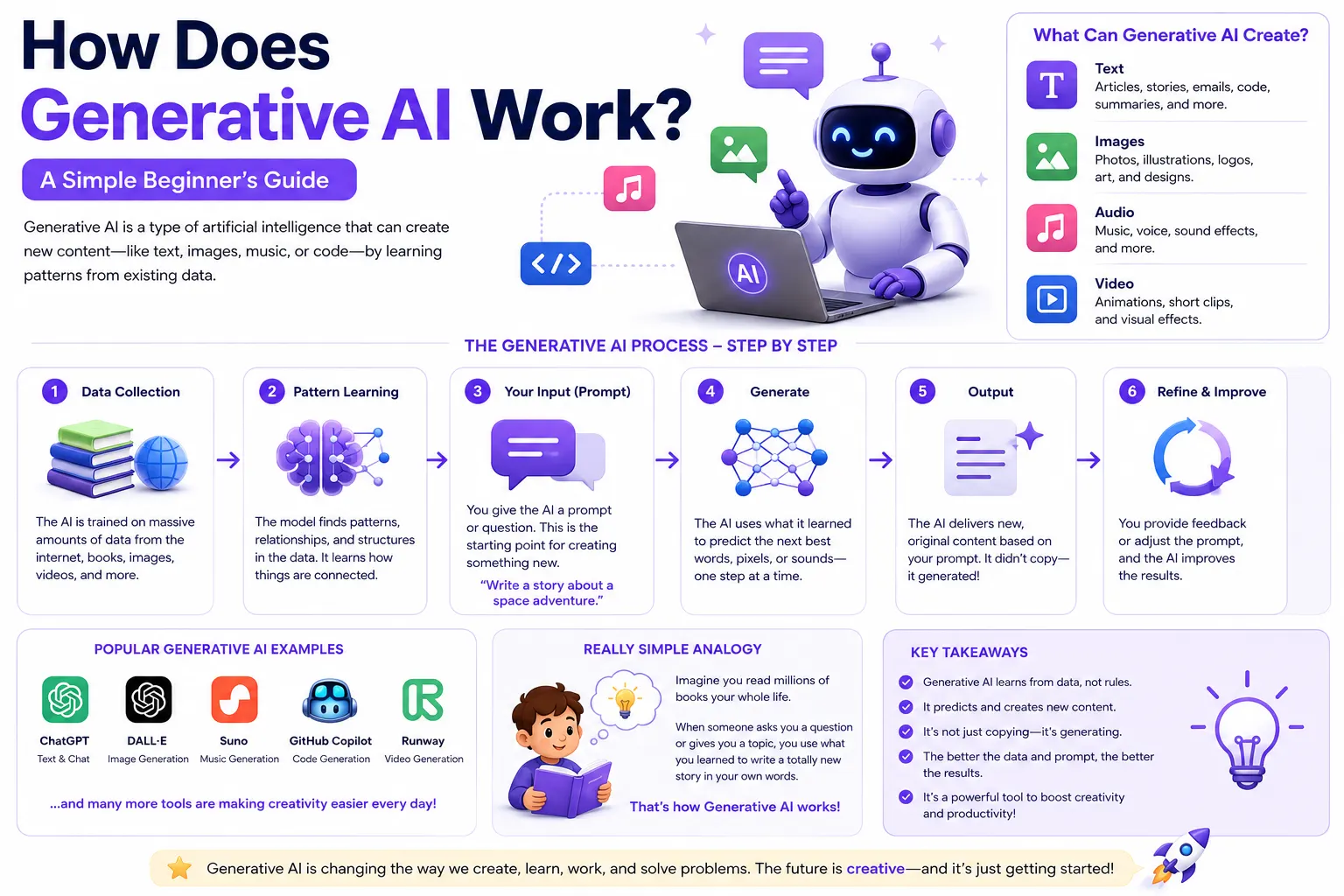

Generative AI is one of the most important developments in modern artificial intelligence. Unlike traditional software that mainly follows predefined instructions, generative AI can create new content based on patterns learned from large amounts of data.
It can generate:
- Text
- Images
- Videos
- Audio
- Music
- Computer code
Tools such as ChatGPT, Google Gemini, Claude, and AI image and video generators use different types of generative AI models to create content from user instructions.
But how does this actually happen?
Let's break it down in simple terms.
What Is Generative AI?
Generative AI is a type of artificial intelligence that can create new content by learning patterns from existing data.
For example, a generative AI system trained on large amounts of text can generate a new article. An image generation model can create an image based on a text description. A music model can generate audio based on a prompt.
The important idea is that the AI isn't simply retrieving one previously stored answer. It uses patterns learned during training to generate a new output.
Generative AI learns patterns from data and uses those patterns to produce new content.
How Does Generative AI Work?
At a high level, generative AI works through a combination of training data, neural networks, machine learning, and generation algorithms.
A simplified process looks like this:
| Stage | What Happens |
|---|---|
| 1. Collect Data | The model is trained using large amounts of relevant data. |
| 2. Train the Model | The AI learns patterns and relationships within the data. |
| 3. Enter a Prompt | The user provides instructions or input. |
| 4. Process the Prompt | The model converts the input into a representation it can process. |
| 5. Generate Content | The model produces an output based on its learned patterns. |
| 6. Deliver the Result | The generated content is presented to the user. |
Step 1: Generative AI Learns From Data
Before a generative AI model can create useful content, it needs to be trained.
Training involves exposing the model to large datasets containing examples relevant to the type of content it needs to generate.
Depending on the model, training data can include:
- Books
- Web pages
- Documents
- Images
- Audio recordings
- Video
- Computer code
The exact data used depends on the model and its developer.
During training, the model learns statistical patterns and relationships within the data.
Step 2: The Model Learns Patterns
Generative AI models don't simply memorize every piece of training data and retrieve it later.
Instead, training adjusts millions, billions, or sometimes more learned parameters inside a neural network.
These parameters help the model represent relationships and patterns in its training data.
For example, a language model can learn patterns involving:
- Grammar
- Vocabulary
- Sentence structure
- Relationships between concepts
- Different writing styles
- Programming syntax
An image model can learn patterns involving:
- Shapes
- Colors
- Textures
- Objects
- Lighting
- Visual composition
Step 3: You Give the AI a Prompt
Once the model has been trained, you can interact with it by providing a prompt.
A prompt is an instruction, question, description, or other input given to an AI system.
For example:
"Write a short explanation of machine learning for beginners."
Or:
"Create a realistic image of a futuristic city at sunset."
The AI analyzes the prompt and uses it as the starting point for generating an output.
Step 4: The AI Processes Your Prompt
The model first converts your input into a representation that its neural network can process.
For text-based systems, the input is generally divided into smaller units called tokens.
Tokens can represent complete words, parts of words, punctuation, numbers, or other pieces of text.
The model then analyzes relationships between the tokens and the surrounding context.
Step 5: The AI Generates the Output
This is where the generative part happens.
The model uses the patterns it learned during training to determine what content should come next.
For language models, this generally involves predicting tokens sequentially.
For example, if the model receives:
"The largest planet in our solar system is..."
It assigns high probability to likely continuations such as "Jupiter."
The process continues until the model produces a complete response.
Modern models can perform this process extremely quickly, which is why an AI assistant can generate paragraphs of text in just a few seconds.
How Does AI Generate Images?
AI image generators work differently from text generators, although they also learn patterns from large datasets.
Many modern image-generation systems use diffusion-based techniques.
A simplified explanation is:
- The model learns relationships between text descriptions and visual patterns.
- The generation process begins from a noisy representation.
- The model repeatedly transforms the representation toward a coherent image.
- The result becomes an image matching the requested concept.
For example, if you enter:
"A futuristic laptop on a modern desk with neon lighting."
The model uses its learned understanding of concepts such as laptops, desks, futuristic environments, and lighting to generate a new image.
How Does AI Generate Video?
AI video generation extends many of the same ideas used in image generation but must also account for time and motion.
A video model needs to generate a sequence of visual information while maintaining consistency between frames.
Modern AI video systems can generate videos from:
- Text prompts
- Images
- Existing videos
- Combinations of text and visual inputs
The model attempts to maintain relationships between objects, characters, backgrounds, lighting, and movement as the video progresses.
How Does AI Generate Audio?
Generative AI can also create speech, music, sound effects, and other forms of audio.
Audio models learn patterns in sound and can generate new audio based on those learned patterns.
For example, a text-to-speech system can transform written text into natural-sounding speech.
Music-generation systems can create musical sequences based on prompts or other inputs.
How Does AI Generate Code?
Generative AI can also generate computer programs.
Large language models can learn patterns from programming languages and code examples.
This allows them to generate:
- Functions
- Scripts
- Web pages
- SQL queries
- Tests
- Documentation
- Debugging suggestions
For example, you can ask an AI:
"Create a JavaScript function that validates an email address."
The model can generate a possible implementation based on patterns learned during training.
However, AI-generated code should always be tested and reviewed before being used in production.
What Are Neural Networks?
Most modern generative AI systems are built using neural networks.
Neural networks are mathematical models made up of interconnected computational units organized into layers.
During training, these networks adjust their parameters to become better at their tasks.
Modern neural networks can contain enormous numbers of parameters and require powerful computing infrastructure to train and operate.
What Is a Transformer?
The Transformer architecture is one of the most important technologies behind modern generative AI, particularly large language models.
Transformers use mechanisms such as attention to analyze relationships between different parts of an input.
This helps language models understand context and generate coherent responses.
Transformers are widely used in modern language models and have also influenced the development of models for other types of data.
What Is a Diffusion Model?
Diffusion models are a class of generative models widely used for image and other media generation.
A simplified explanation is that the model learns how to transform noisy data into structured content.
During training, the model learns relationships between clean data and increasingly noisy versions of that data.
During generation, the process can work in the opposite direction, gradually producing a meaningful result from noise.
This approach has become especially important for AI image generation.
What Is a Generative AI Model?
A generative AI model is a machine learning model designed to generate new content.
Different models specialize in different types of content.
| Model Type | Common Output |
|---|---|
| Language Model | Text and code |
| Image Model | Images |
| Audio Model | Speech, music, and sounds |
| Video Model | Video clips |
| Multimodal Model | Multiple types of content |
What Is Multimodal Generative AI?
Multimodal AI refers to systems that can work with more than one type of information.
For example, a multimodal AI system may be able to understand:
- Text
- Images
- Audio
- Video
It may also generate one type of content from another.
For example, a user could provide an image and ask the AI to describe it, or provide text and ask the system to generate an image.
Multimodal capabilities are becoming increasingly important in modern AI applications.
Why Can Generative AI Create New Content?
A common question is how AI can create something that didn't previously exist.
The answer is that the model has learned general patterns from many examples and can combine those patterns in new ways.
For example, an image generator may have learned concepts related to:
- Cars
- Mountains
- Snow
- Sunsets
- Photography
When you request a "vintage car driving through snowy mountains at sunset," the model can combine these learned concepts to create a new visual composition.
The exact result may never have appeared in its training data.
Does Generative AI Copy Existing Content?
Generative AI systems can sometimes produce outputs that resemble content seen during training, particularly when prompts closely request specific material or when the training data contains repeated patterns.
However, modern generative models generally operate by learning statistical representations and generating outputs from those learned representations rather than simply searching a database and copying an exact item.
Copyright, licensing, training-data practices, and output ownership can be legally complex and vary by jurisdiction and service, so users should review the terms and applicable laws when using AI-generated content commercially.
Why Does Generative AI Sometimes Make Mistakes?
Generative AI does not guarantee that every output will be accurate.
For language models, the system is fundamentally generating likely sequences based on learned patterns and its available context.
This can lead to AI hallucinations, where the model produces information that sounds convincing but is incorrect.
AI image generators can also produce visual errors, such as:
- Incorrect anatomy
- Strange object shapes
- Inconsistent details
- Unnatural text inside images
- Inconsistent characters
This is why human review remains important.
What Is Temperature in Generative AI?
Temperature is a setting used in some generative AI systems to influence the randomness of generated outputs.
A lower temperature can make outputs more predictable, while a higher temperature can encourage more variation.
The exact effect depends on the model and system.
For creative tasks, more variation can sometimes be useful. For tasks where consistency matters, lower randomness may be preferable.
What Is a Prompt?
A prompt is the instruction or input you give to a generative AI system.
The quality and clarity of a prompt can significantly affect the usefulness of the result.
A basic prompt might be:
"Write a blog introduction about artificial intelligence."
A more detailed prompt might specify:
- Audience
- Tone
- Length
- Format
- Topic
- Important points
For example:
"Write a 150-word beginner-friendly introduction to artificial intelligence using a clear and conversational tone."
Why Is Prompt Engineering Important?
Prompt engineering is the practice of designing effective instructions for AI models.
Good prompts can help AI systems understand what you want and produce more useful outputs.
Useful prompting techniques include:
- Clearly explain the task.
- Provide relevant context.
- Specify the desired format.
- Define the target audience.
- Provide examples when useful.
- Set important constraints.
Generative AI vs Traditional AI
Traditional AI systems are often designed to classify, predict, detect, or make decisions.
Generative AI focuses on creating new content.
| Traditional AI | Generative AI |
|---|---|
| Classifies information | Creates new content |
| Predicts outcomes | Generates text, images, audio, or video |
| Detects patterns | Uses learned patterns to create outputs |
| Often produces a label or prediction | Produces new content |
The distinction isn't absolute. Many AI systems can both analyze information and generate content.
Generative AI vs Machine Learning
Generative AI is a category of AI applications and models focused on content generation, while machine learning is a broader approach to building systems that learn patterns from data.
In simple terms:
Machine learning is a method for learning from data.
Generative AI uses machine learning and related techniques to generate new content.
Where Is Generative AI Used?
Generative AI is being used across many industries.
| Industry | Examples |
|---|---|
| Marketing | Ad copy, images, campaigns, and content ideas. |
| Education | Tutoring, explanations, quizzes, and study materials. |
| Software | Code generation, debugging, and documentation. |
| Design | Concept images, illustrations, and creative exploration. |
| Media | Scripts, video, audio, and production assistance. |
| Business | Reports, summaries, analysis, and automation. |
| Customer Support | AI assistants and automated responses. |
Benefits of Generative AI
Generative AI can provide several benefits when used appropriately.
- Speed: It can create drafts and ideas quickly.
- Productivity: It can automate repetitive content tasks.
- Creativity: It can help generate and explore new ideas.
- Accessibility: It can make complex information easier to understand.
- Personalization: Content can be adapted to different users and contexts.
- Automation: AI can perform parts of workflows that previously required manual work.
Limitations and Risks of Generative AI
Generative AI also has important limitations.
- It can produce inaccurate information.
- It can reflect biases in training data.
- Generated content may require human review.
- Privacy can be a concern when sensitive information is entered into AI services.
- AI-generated content can create copyright and intellectual-property questions.
- Models can produce inconsistent results.
- Advanced AI systems can require significant computing resources.
For important decisions and professional work, AI should generally be treated as an assistant rather than an unquestionable authority.
What Happens When You Ask ChatGPT a Question?
When you send a question to a modern AI assistant, the process can be simplified into several stages.
- You enter a prompt.
- The system processes your input and conversation context.
- The model analyzes the tokens and their relationships.
- The model predicts likely next tokens.
- The response is generated token by token.
- The application displays the result.
Additional systems may also be involved, such as safety mechanisms, retrieval tools, external APIs, memory features, or other application components.
Does Generative AI Think Like a Human?
Generative AI can produce impressive answers and perform tasks that appear intelligent, but that doesn't mean it thinks exactly like a human.
AI models process information using mathematical computations and learned representations.
They don't necessarily have human experiences, emotions, consciousness, or understanding of the physical world.
This distinction is important because an AI response can sound confident and intelligent while still being wrong.
What Is the Future of Generative AI?
Generative AI is likely to become increasingly integrated into everyday software and digital services.
Future systems may become better at:
- Understanding complex instructions
- Generating realistic media
- Working across multiple modalities
- Using external tools
- Automating multi-step tasks
- Personalizing content
- Assisting with scientific and technical work
AI agents may also combine generative models with tools, planning systems, databases, and external services to perform more complex workflows.
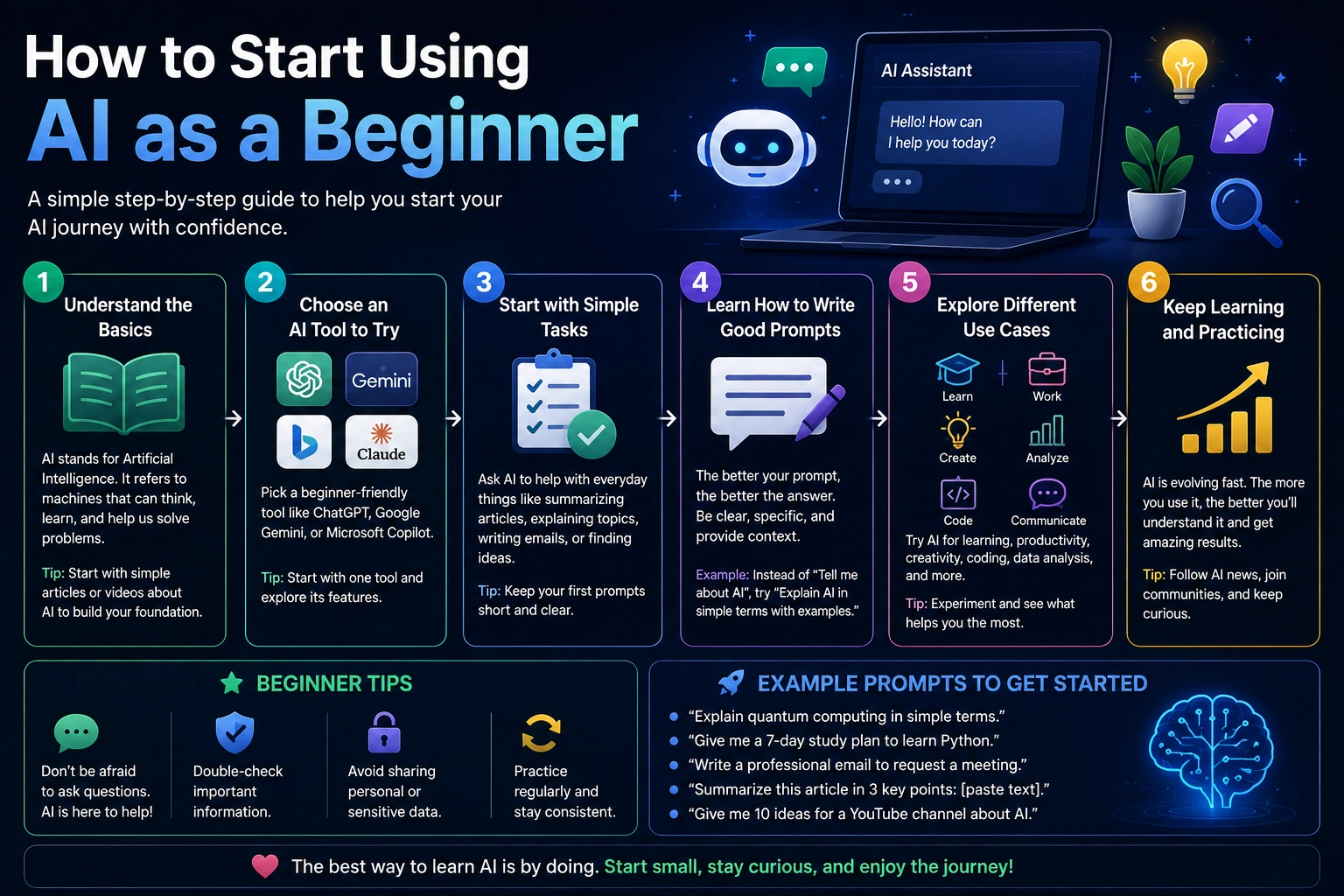
How to Start Using Generative AI
If you're new to generative AI, you don't need to understand all the mathematics behind neural networks to start using it.
A simple approach is:
- Choose an AI tool for your task.
- Start with a clear prompt.
- Provide relevant context.
- Review the generated result.
- Ask the AI to improve or modify it.
- Verify important information.
- Use the final output responsibly.
The more you experiment with prompts and workflows, the better you'll understand what AI can and cannot do.
Our Simple Definition
Generative AI works by learning patterns from large amounts of data and using those learned patterns to generate new content based on a user's input.
Behind the simple experience of typing a prompt and receiving an answer is a sophisticated combination of machine learning, neural networks, data, algorithms, and computing infrastructure.
Understanding these basics makes it easier to use AI tools effectively and evaluate their results critically.
Frequently Asked Questions
How does generative AI work in simple terms?
Generative AI learns patterns from large amounts of data and uses those patterns to create new content in response to a prompt.
How does ChatGPT generate answers?
ChatGPT uses language models that process your input and generate a response by predicting sequences of tokens based on learned patterns and the available context.
How do AI image generators work?
Many modern AI image generators use generative techniques such as diffusion to transform a learned representation or noisy starting point into an image that matches the user's prompt.
Can generative AI create original content?
Generative AI can create new outputs by combining and transforming patterns learned during training. Whether a particular output is legally considered "original" or how it may be used depends on many factors, including applicable law and the service's terms.
What is the difference between generative AI and machine learning?
Machine learning is a broad approach in which systems learn patterns from data. Generative AI refers to AI systems designed to generate new content, often using machine learning techniques.
Why does generative AI make mistakes?
Generative AI models can generate plausible but incorrect information because producing a likely output is not the same as guaranteeing factual accuracy.
Can generative AI generate images and videos?
Yes. Specialized generative AI models can create images, videos, audio, and other types of media from prompts or other inputs.
Is generative AI the future?
Generative AI is likely to remain an important part of the future of software, content creation, productivity, education, and many other industries, although its capabilities and applications will continue to evolve.