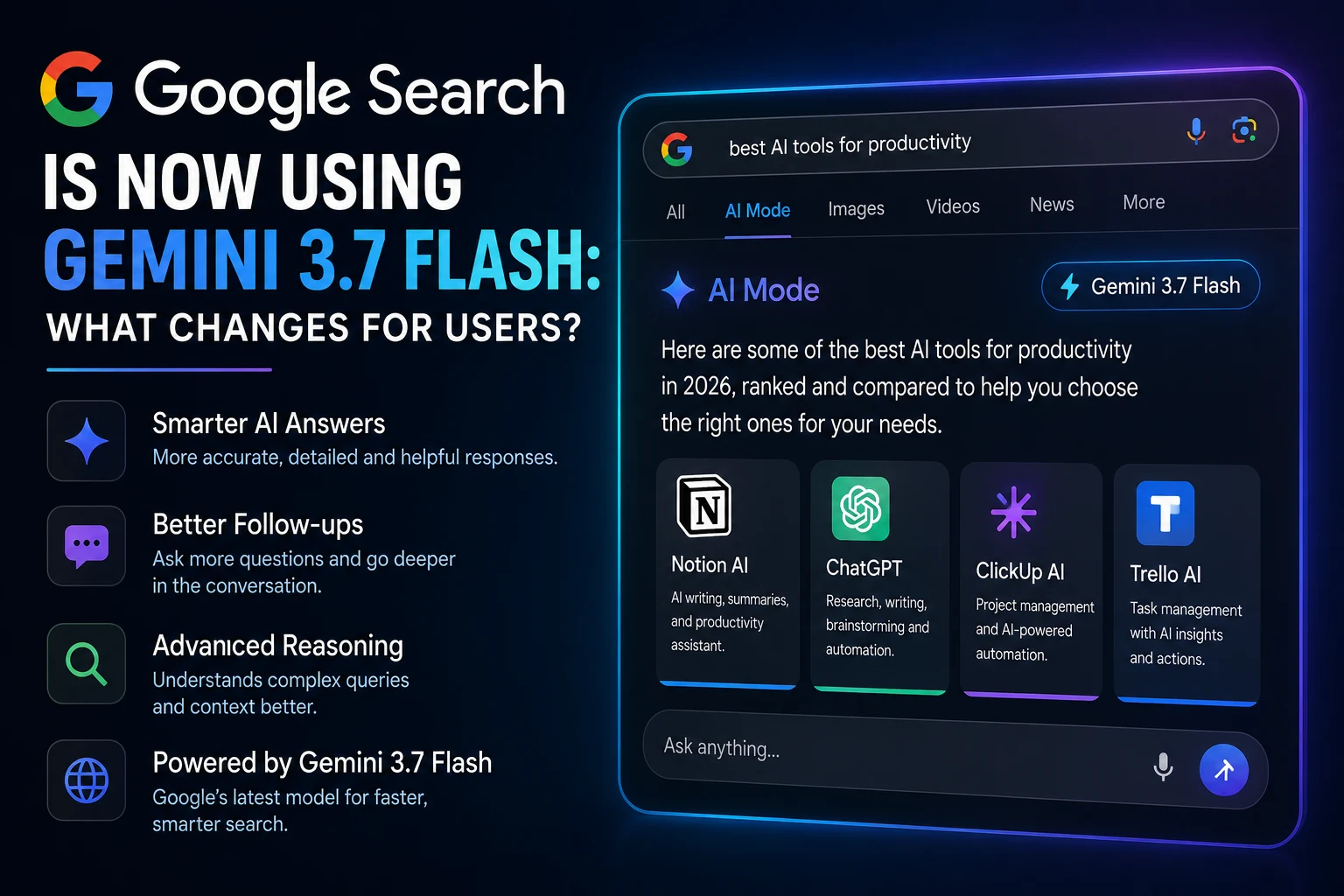

Google is bringing its newest Gemini model to Search. Gemini 3.7 Flash is now rolling out as an option inside Google Search's AI Mode, giving eligible users access to a newer reasoning model designed for more complex questions, better instruction following, and advanced AI-powered workflows.
The change comes just one day after Google announced Gemini 3.7 Flash as its latest "workhorse" model for coding and AI agents. The company says the model delivers improvements in software engineering, web development, knowledge work, and multi-step tasks.
For Search users, however, the most important question is simple: What actually changes when Gemini 3.7 Flash powers an AI search experience?
What Is Gemini 3.7 Flash?
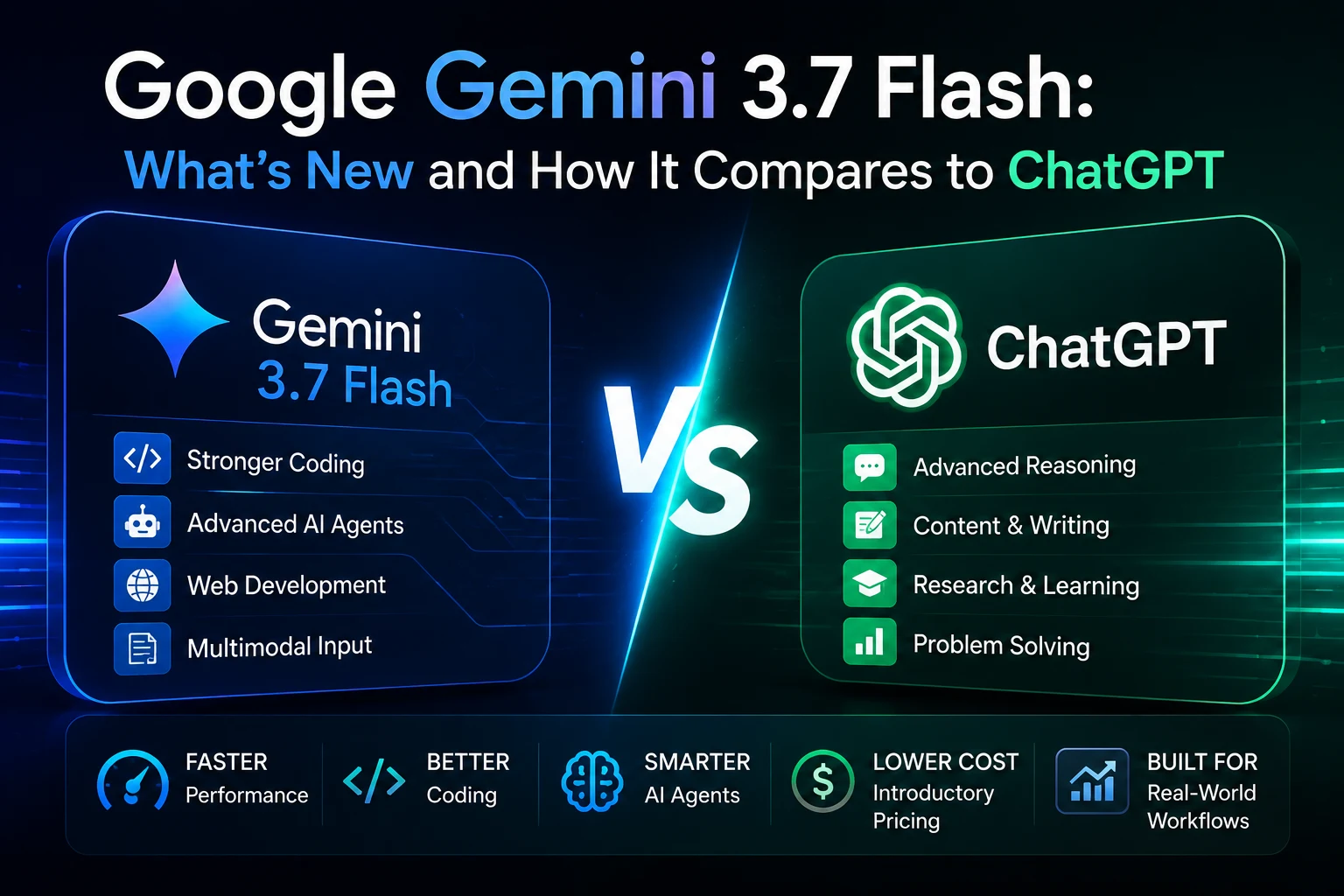
Gemini 3.7 Flash is Google's latest Flash-series AI model. Google describes it as its most intelligent workhorse model yet, with a particular focus on coding, agents, complex workflows, and knowledge work.
The model supports multimodal inputs including text, images, video, audio, and PDFs. It also supports capabilities such as reasoning, function calling, code execution, search grounding, and computer use in preview.
Google launched Gemini 3.7 Flash on August 13, 2026, with an introductory API price of $0.75 per million input tokens and $3.75 per million output tokens through the end of 2026.
What Is Google Search AI Mode?
AI Mode is Google's more conversational search experience. Instead of relying only on traditional blue links and short keyword queries, users can ask longer and more complicated questions and continue the conversation with follow-up questions.
Google has been gradually moving Search toward an AI-powered experience that can understand the intent behind a question, combine information from multiple sources, and provide a more structured response.
Google previously made Gemini 3 Flash the default model for AI Mode globally. Gemini 3.7 Flash now adds a newer model option for eligible subscribers who want the latest Flash capabilities.
What Changes With Gemini 3.7 Flash in Search?
The biggest change is the underlying model used to reason through questions in AI Mode.
Gemini 3.7 Flash is designed to be better at understanding detailed instructions and handling multi-step tasks. That can make a difference when a search query contains several requirements rather than asking for a simple fact.
Better Understanding of Complex Questions
Traditional search works particularly well when you know exactly what you want to find. AI Mode is designed for situations where the question is more complicated.
For example, instead of searching for several individual pages about a topic, users can ask a question containing multiple conditions and then refine the request through follow-up questions.
Gemini 3.7 Flash is designed to improve how the system understands those instructions and constraints.
Improved Follow-Up Questions
AI Mode is designed around conversation rather than one-off searches.
A user can ask an initial question, examine the answer, and then ask a related follow-up without having to repeat the entire context.
A stronger reasoning model can make these conversations more useful because it has to maintain context while understanding what the user is asking next.
More Detailed AI Answers
Gemini 3.7 Flash is built for complex reasoning and knowledge work. In Search, that can translate into more detailed answers for questions that require several reasoning steps.
However, users should still verify important information against the underlying sources. An AI-generated Search response is not automatically correct simply because it is powered by a newer model.
Who Can Use Gemini 3.7 Flash in Google Search?
The initial Search rollout is aimed at Google AI Pro and Google AI Ultra subscribers.
Current reports indicate that Gemini 3.7 Flash is available as a selectable model in AI Mode for these subscribers, with the rollout initially focused on English-language experiences.
Availability can vary by account, country, language, and rollout stage, so users who do not see the model immediately may need to wait for Google's rollout to reach their account.
Does Gemini 3.7 Flash Replace Google Search?
No.
Gemini 3.7 Flash does not replace Google Search itself. Instead, it becomes part of the AI layer used by Google's AI Mode.
Traditional Google Search remains available, while AI Mode provides a more conversational way to explore complicated topics.
This distinction is important because users can still choose the traditional search experience when they want a list of websites, product pages, news results, maps, or other conventional search results.
Google Search With Gemini 3.7 Flash vs Traditional Search
| Feature | Traditional Search | AI Mode with Gemini 3.7 Flash |
|---|---|---|
| Search style | Keyword-based | Conversational |
| Complex questions | Requires multiple searches | Designed for multi-step questions |
| Follow-up questions | Usually requires a new search | Built into the conversation |
| AI reasoning | Limited | Advanced model reasoning |
| Web sources | Direct links | AI-generated responses with supporting Search information |
| Best for | Finding specific websites and information | Exploring complicated topics and tasks |
Why Google Is Putting More AI Into Search
Google is competing in an increasingly crowded AI assistant market.
ChatGPT, Claude, Perplexity, Gemini, and other AI products have changed how people discover information. Instead of entering several short searches, users can now describe what they want in natural language and expect an AI system to organize the information for them.
Google's advantage is that it already operates one of the world's largest search systems.
By combining Search with Gemini, Google can attempt to offer the conversational experience of an AI assistant while maintaining access to the enormous information infrastructure behind Search.
Will Gemini 3.7 Flash Make Search Faster?
Not necessarily in every situation.
The Flash series is designed to provide a balance between intelligence, latency, and cost. Google says Gemini 3.7 Flash is intended to be a practical workhorse model rather than simply maximizing benchmark performance.
For users, the important benefit is not necessarily that every response appears instantly. Instead, the goal is to provide stronger reasoning while maintaining a responsive Search experience.
How Good Is Gemini 3.7 Flash?
Google reports significant improvements over Gemini 3.6 Flash across software engineering, web development, automation, and knowledge-work evaluations.
For example, Google reports that Gemini 3.7 Flash scored 43.6% on FrontierCode 1.1 Main compared with 34.4% for Gemini 3.6 Flash. It also scored 65.3% on DeepSWE v1.1 compared with 48.6% for the previous model.
The model also achieved a 30.4% score on AutomationBench, which is designed to evaluate AI agents performing real-world business workflows.
These benchmarks are encouraging, but benchmark results should not be treated as proof that Gemini 3.7 Flash is the best model for every Search query.
What Does This Mean for Google Search Users?
For users who have access to Gemini 3.7 Flash in AI Mode, the experience should become more useful for complicated requests.
Instead of searching for individual pieces of information, users can ask Search to reason through a problem, compare alternatives, organize information, or continue a research conversation.
For example, a user could ask:
- Compare several laptops based on price, battery life, and performance.
- Explain a complicated technology concept and then ask follow-up questions.
- Research a topic using several constraints.
- Plan a project that requires multiple steps.
- Compare different technical approaches.
What Does This Mean for Website Owners?
The integration of newer Gemini models into Search is particularly important for publishers and website owners.
As Google provides more AI-generated answers directly inside Search, users may have less need to click traditional search results for simple questions.
That makes it increasingly important for websites to provide original, useful, trustworthy information that gives Google a reason to surface the site as a source.
For AIReadily, this means articles should not simply repeat information that already exists across dozens of websites. Original explanations, comparisons, testing, screenshots, examples, first-hand observations, and useful analysis can make an article more valuable.
Will AI Mode Reduce Website Traffic?
It could affect traffic for some types of searches, particularly queries that can be answered completely inside an AI response.
However, users still need websites for detailed information, product pages, original reporting, tutorials, opinions, documentation, and information that requires deeper exploration.
This creates an important opportunity for publishers: instead of optimizing only for traditional blue-link rankings, websites increasingly need to become useful sources that AI-powered Search systems can understand and reference.
Gemini 3.7 Flash vs ChatGPT Search
Google's move also highlights the growing competition between Google Search and AI assistants such as ChatGPT.
ChatGPT is built primarily as a conversational AI assistant, while Google Search has historically been built around discovering websites and information.
Google is now bringing these two approaches closer together by adding increasingly capable Gemini models directly into Search.
The competition is therefore no longer only about which AI model is smarter. It is also about which company can build the best overall information-discovery experience.
Should You Use AI Mode Instead of Regular Google Search?
It depends on the question.
Use traditional Search when you want specific websites, current links, product pages, official documentation, local businesses, or a quick fact.
Use AI Mode when you want to explore a complicated topic, compare multiple options, ask follow-up questions, or work through a multi-step problem.
The two experiences are complementary rather than mutually exclusive.
Final Verdict
Gemini 3.7 Flash marks another step in Google's transition from traditional keyword search toward AI-powered information discovery.
The model is not replacing Google Search. Instead, it is becoming another layer through which users can interact with Search, particularly when they need deeper reasoning and conversational exploration.
For eligible Google AI Pro and Ultra users, Gemini 3.7 Flash provides a newer model option inside AI Mode. Its stronger instruction following, reasoning, coding, and agent capabilities could make complex Search conversations more useful.
For website owners, however, the change is even more significant. Google's Search experience is becoming increasingly capable of answering questions directly, which means publishers need to focus on content that offers genuine value beyond a basic AI-generated summary.
The future of Search is becoming less about simply finding ten blue links and more about helping users understand information and complete tasks. Gemini 3.7 Flash is another important step in that direction.
Frequently Asked Questions
Is Google Search using Gemini 3.7 Flash?
Yes. Google has begun rolling out Gemini 3.7 Flash as a selectable model in AI Mode within Google Search.
Who can use Gemini 3.7 Flash in Search?
The initial rollout is available to Google AI Pro and Google AI Ultra subscribers, with availability currently focused on English-language experiences.
Does Gemini 3.7 Flash replace Google Search?
No. Gemini 3.7 Flash is being integrated into AI Mode, while traditional Google Search remains available.
Is Gemini 3.7 Flash better than Gemini 3.6 Flash?
Google reports significant improvements in coding, web development, automation, and knowledge work compared with Gemini 3.6 Flash.
Will AI Mode replace normal Google Search?
Not at this point. Google continues to offer traditional Search alongside AI Mode. The two experiences are designed for different types of searches.
What does this mean for SEO?
It means that publishers need to focus increasingly on original, helpful, trustworthy content rather than producing pages that simply repeat information already available elsewhere.