
Google has released Gemini 3.7 Flash, a new version of its Gemini AI model designed to handle coding, AI agents, web development, knowledge work, and other complex workflows.
Announced on August 13, 2026, Gemini 3.7 Flash arrives only three weeks after Gemini 3.6 Flash. Google describes it as its most intelligent “workhorse” model yet, with major improvements in software engineering, web development, business automation, and multi-step tasks.
The new model also launches with an introductory API price of $0.75 per million input tokens and $3.75 per million output tokens through the end of 2026.
What Is Gemini 3.7 Flash?
Gemini 3.7 Flash is Google's latest Flash-series reasoning model. It is designed to provide a balance between intelligence, speed, and cost rather than focusing only on maximum benchmark performance.
Google is positioning the model particularly strongly for developers and businesses that need AI agents capable of completing multi-step workflows, writing and debugging software, processing documents, and interacting with tools.
The model is natively multimodal and can accept text, images, video, audio, and PDF files. It also supports features such as thinking, function calling, code execution, search grounding, file search, and computer use in preview.
What's New in Gemini 3.7 Flash?
Compared with Gemini 3.6 Flash, Google says the new model provides substantial improvements across several practical areas.
Better Coding
Coding is one of the main areas where Google is positioning Gemini 3.7 Flash as an upgrade.
On Google's reported evaluations, Gemini 3.7 Flash achieved 43.6% on FrontierCode 1.1 Main, compared with 34.4% for Gemini 3.6 Flash. It also scored 65.3% on DeepSWE v1.1, compared with 48.6% for the previous model.
These improvements are aimed at practical software-engineering tasks such as debugging, issue resolution, code generation, and longer development workflows.
Improved Web Development
Gemini 3.7 Flash also performs better at building websites and applications from instructions and visual references.
Google reports a WebDev Arena Elo score of 1588, compared with 1538 for Gemini 3.6 Flash. The company says the model can produce more functional layouts and more complete applications with fewer prompts.
Stronger AI Agents
Another major focus is agentic workflows.
Gemini 3.7 Flash is designed to plan multi-step tasks, call tools, recover from roadblocks, clarify unclear instructions, and complete workflows with less manual supervision.
Google reports a 30.4% score on AutomationBench, compared with 17.0% for Gemini 3.6 Flash.
Better Document Understanding
The model also improves at processing complex documents. On Google's GDP.pdf evaluation, Gemini 3.7 Flash scored 34.0%, compared with 22.0% for Gemini 3.6 Flash.
This can be useful for users working with reports, research papers, financial documents, legal material, and other information-heavy files.
Gemini 3.7 Flash vs ChatGPT
The comparison is more useful when we look at Gemini 3.7 Flash against the GPT-5.6 models currently used in ChatGPT.
OpenAI currently offers GPT-5.6 Sol in ChatGPT for Plus and Pro users, while GPT-5.6 Luna is becoming the default model for Free and Go users. OpenAI says the updated GPT-5.6 models focus on more reliable facts, more focused answers, and stronger reasoning.
| Feature | Gemini 3.7 Flash | ChatGPT with GPT-5.6 |
|---|---|---|
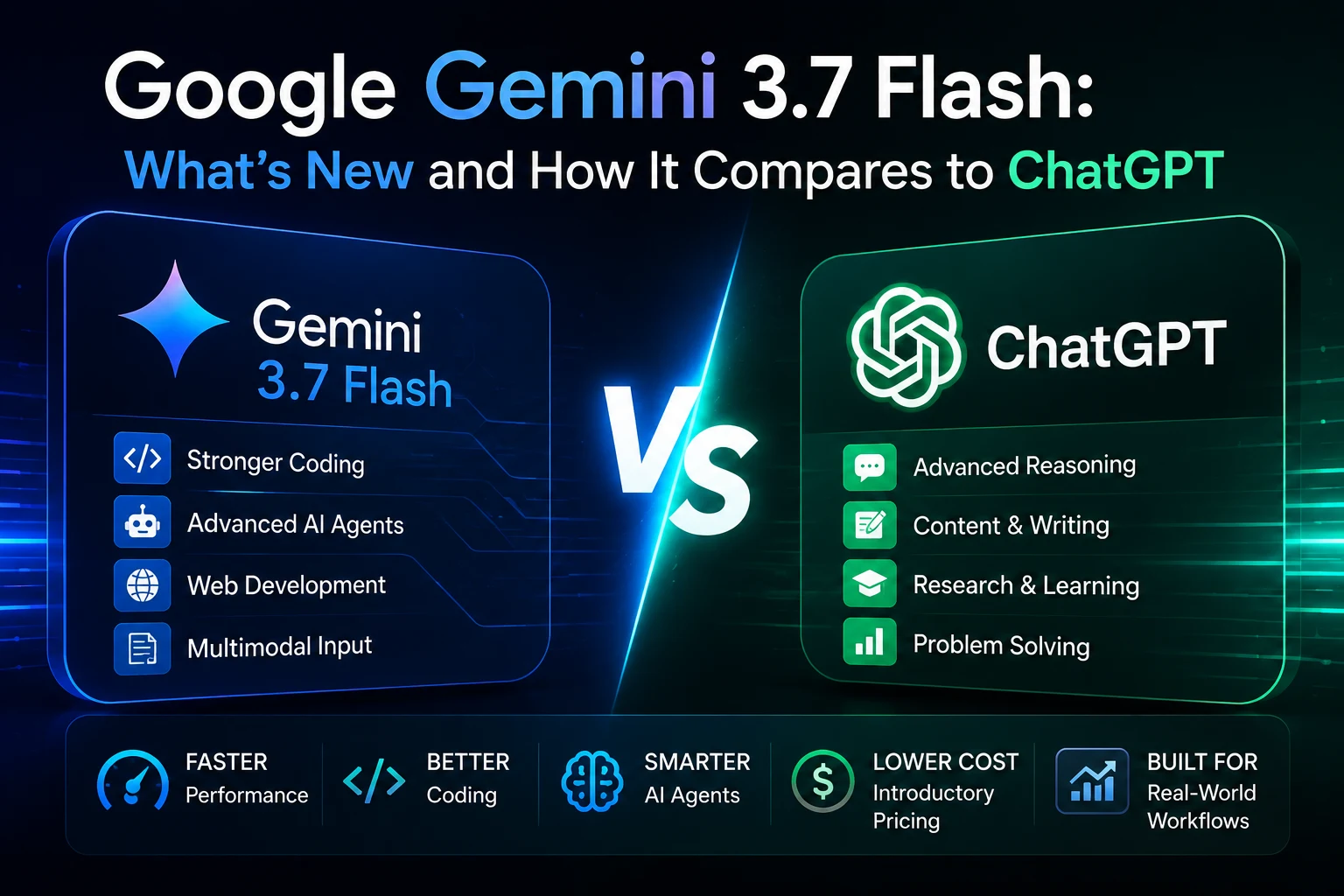
| Main focus | Coding, agents, multimodal workflows, web development | General assistance, reasoning, research, writing, coding |
| Multimodal input | Text, image, video, audio and PDF | Broad multimodal capabilities depending on ChatGPT plan and tools |
| AI agents | Strong focus on agent workflows and tool use | Strong reasoning and tool-assisted workflows |
| Coding | Very strong performance, especially for a Flash model | Strong coding and long-horizon reasoning |
| Web development | Strong | Strong |
| Free access | Availability depends on Google's product and plan | GPT-5.6 Luna is the default for Free and Go users |
Gemini 3.7 Flash vs GPT-5.6: Benchmark Results
There is no single winner across every benchmark.
Google's published model card compares Gemini 3.7 Flash with GPT-5.6 Terra and other models. Gemini scores 43.6% on FrontierCode 1.1 Main, compared with 41.3% for GPT-5.6 Terra. On DeepSWE v1.1, however, GPT-5.6 Terra scores 69.6% compared with 65.3% for Gemini 3.7 Flash.
Gemini also leads GPT-5.6 Terra on Google's reported WebDev Arena result, with an Elo of 1588 versus 1523. On Terminal-Bench 2.1, GPT-5.6 Terra leads with 87.4%, compared with 85.8% for Gemini 3.7 Flash.
These results show why it is better to avoid claiming that one model is simply “better.” The strongest choice depends on the type of work you need to perform.
Gemini 3.7 Flash Pricing
Google launched Gemini 3.7 Flash with introductory API pricing of $0.75 per million input tokens and $3.75 per million output tokens.
The introductory pricing is scheduled to expire on December 31, 2026. Starting January 1, 2027, Google lists prices of $1.50 per million input tokens and $7.50 per million output tokens.
This pricing makes Gemini 3.7 Flash particularly interesting for developers building AI agents or applications that generate large amounts of content and need to keep inference costs under control.
Which Is Better for Coding?
Both Gemini 3.7 Flash and GPT-5.6 are strong coding models.
Gemini 3.7 Flash has a particularly compelling combination of coding performance, speed, multimodal input, and relatively low API pricing. Google's reported results show substantial improvements over Gemini 3.6 Flash in software engineering and production-code benchmarks.
GPT-5.6, however, remains extremely competitive on longer software-engineering tasks. Google's own comparison shows GPT-5.6 Terra ahead of Gemini 3.7 Flash on DeepSWE v1.1 and Terminal-Bench 2.1.
For developers, the best choice may therefore depend on whether the priority is lower cost and fast agent workflows or maximum performance on particular coding tasks.
Which Is Better for AI Agents?
Gemini 3.7 Flash is clearly designed with AI agents in mind.
Google says the model is better at multi-step planning, tool calls, handling roadblocks, and following instructions. Its 30.4% result on AutomationBench also shows a strong focus on real-world business workflows.
ChatGPT also provides powerful tool-assisted workflows, with GPT-5.6 designed to handle research, planning, writing, coding, and other complex tasks. OpenAI says GPT-5.6 Sol can adapt its reasoning effort depending on the task.
Which Is Better for Everyday Users?
For everyday users, the answer depends heavily on the ecosystem they already use.
Gemini can be particularly attractive to people who rely heavily on Google's products and services. Google has also integrated Gemini 3.7 Flash into Gemini Spark for Google AI Pro and Ultra subscribers, where it is used for complex knowledge-work workflows and Google Workspace interactions.
ChatGPT remains attractive for users who want a general-purpose AI assistant for writing, research, reasoning, coding, and everyday questions. OpenAI's latest ChatGPT update also emphasizes more focused answers and improved factual reliability.
Gemini 3.7 Flash vs ChatGPT: Which Should You Choose?
- Choose Gemini 3.7 Flash if you prioritize coding, AI agents, multimodal workflows, web development, and lower API costs.
- Choose ChatGPT if you want a broad general-purpose assistant for writing, research, reasoning, coding, and everyday productivity.
- Choose both if your work depends heavily on AI. Testing the same task in multiple models can reveal important differences in accuracy, speed, and output quality.
Final Verdict
Gemini 3.7 Flash is one of Google's most interesting AI releases of 2026 so far. Instead of simply increasing model size, Google has focused on making the Flash series more capable at practical work such as coding, web development, document processing, and AI-agent workflows.
The benchmark results show a competitive model rather than an across-the-board winner. Gemini 3.7 Flash beats GPT-5.6 Terra on some evaluations, while GPT-5.6 Terra leads on others.
For developers, the combination of strong coding performance and introductory pricing makes Gemini 3.7 Flash particularly compelling. For everyday users, the decision will depend more on the surrounding ecosystem and which assistant fits their workflow best.
The biggest takeaway is simple: the competition between Google Gemini and ChatGPT is becoming increasingly close, and users now have more powerful AI options than ever.
Frequently Asked Questions
What is Gemini 3.7 Flash?
Gemini 3.7 Flash is Google's latest Flash-series reasoning model, designed especially for coding, AI agents, web development, document processing, and complex workflows.
When was Gemini 3.7 Flash released?
Google announced Gemini 3.7 Flash on August 13, 2026.
Is Gemini 3.7 Flash free?
Availability depends on the Google product and plan. The Gemini 3.7 Flash API has introductory usage pricing, while Google's consumer products may provide access through different plans.
Is Gemini 3.7 Flash better than ChatGPT?
Neither model wins every task. Gemini 3.7 Flash performs particularly well in coding, web development, and agent workflows, while GPT-5.6 remains highly competitive across reasoning, coding, and general-purpose tasks.
What is the context window of Gemini 3.7 Flash?
Gemini 3.7 Flash supports an input token limit of 1,048,576 tokens and an output limit of 65,536 tokens.
Can Gemini 3.7 Flash analyze images and PDFs?
Yes. Google's API documentation lists text, image, video, audio, and PDF as supported input types.