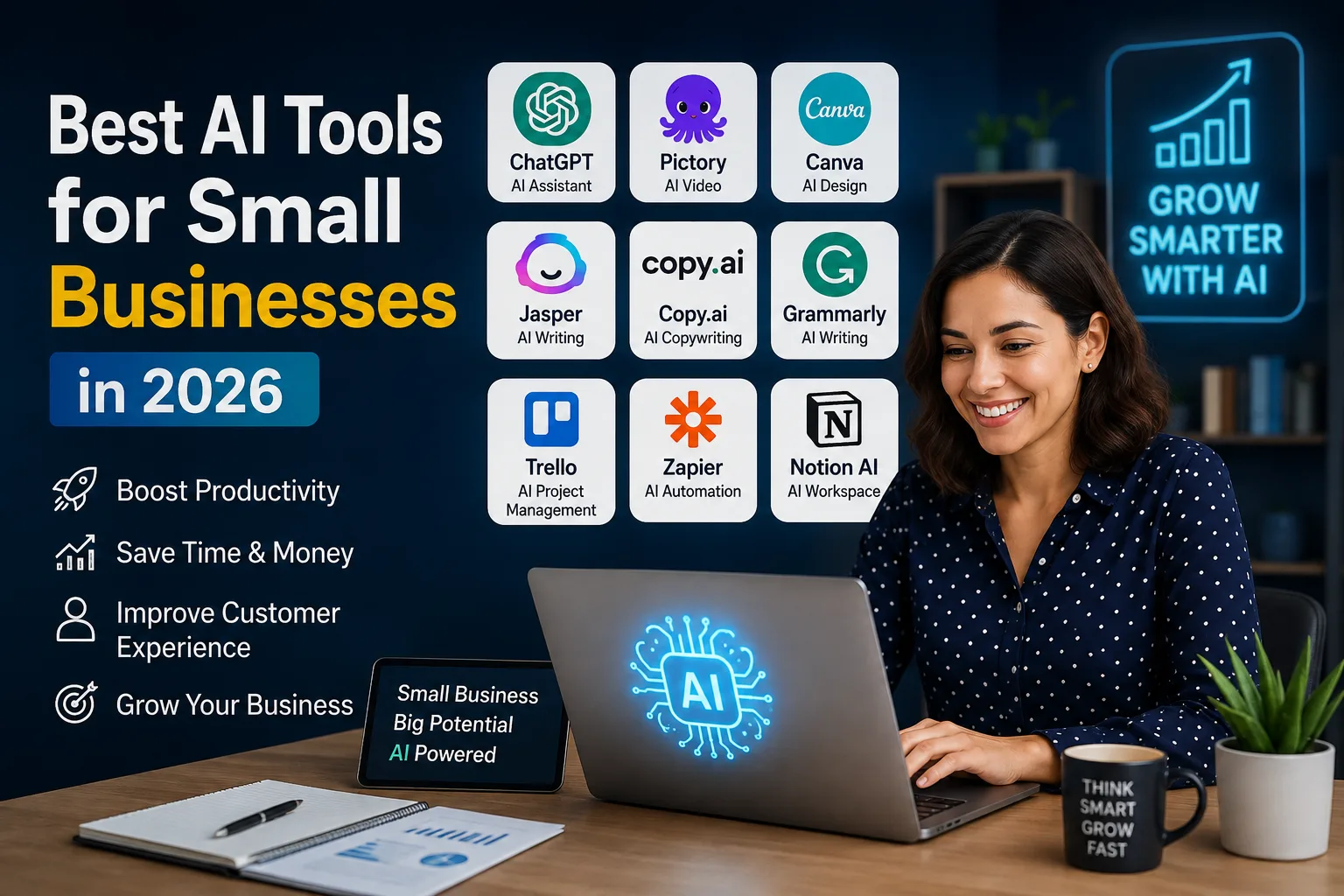

Running a small business means wearing many different hats. You may be responsible for marketing, customer service, sales, administration, content, research, and operations—all while trying to grow the business.
Artificial intelligence can help small businesses handle many of these tasks faster. Modern AI tools can generate marketing content, answer customer questions, analyze information, automate repetitive workflows, organize business knowledge, and help owners make better use of their limited time.
In 2026, the challenge is no longer finding an AI tool. There are thousands of options. The real challenge is choosing a small number of tools that solve genuine business problems without creating unnecessary complexity or subscription costs. Current small-business guidance increasingly emphasizes starting with specific bottlenecks and integrating AI into workflows rather than collecting tools simply because they are popular.
What Can AI Do for a Small Business?
AI can support almost every area of a small business. Common applications include marketing, customer support, sales, administration, research, content creation, data analysis, and workflow automation.
- Write emails, blog posts, product descriptions, and social media content.
- Answer frequently asked customer questions.
- Summarize meetings and documents.
- Analyze spreadsheets and business information.
- Automate repetitive administrative tasks.
- Create images and marketing materials.
- Research competitors, markets, and products.
- Help employees brainstorm and solve problems.
Small businesses are already using AI across marketing, customer support, operations, finance, and data analysis.
Best AI Tools for Small Businesses in 2026
Below are some of the most useful AI tools to consider, organized around common small-business needs rather than simply ranking tools by popularity.
1. ChatGPT
Best for: General-purpose business assistance
ChatGPT is one of the most versatile AI assistants for small business owners. It can help with marketing ideas, emails, proposals, customer communications, brainstorming, research, document analysis, planning, and many other everyday tasks.
A business owner can use it to create a first draft of a sales email in seconds, brainstorm social media campaigns, summarize a long document, or turn rough ideas into a structured business plan.
The biggest advantage is flexibility. Instead of buying a separate tool for every small writing or brainstorming task, one general-purpose AI assistant can support many workflows.
Best for: Solopreneurs, small teams, consultants, marketers, freelancers, and service businesses.
2. Claude
Best for: Writing, documents, analysis, and business communication
Claude is another powerful general-purpose AI assistant that can be particularly useful for businesses that work with large amounts of text.
You can use it to draft proposals, rewrite customer communications, summarize documents, develop marketing ideas, analyze information, and help create internal documentation.
It can be especially useful when the quality and structure of written output are important to your business.
Best for: Agencies, consultants, writers, professional services, and document-heavy businesses.
3. Canva AI
Best for: Marketing design and visual content
Small businesses often need professional-looking graphics but cannot afford a dedicated designer for every project.
Canva combines accessible design tools with AI-powered features that can help businesses create social media graphics, presentations, promotional materials, images, and other visual content.
This makes it particularly useful for businesses that need to publish content regularly without maintaining a large creative team. Canva is frequently included among recommended AI tools for small-business marketing and visual content.
Best for: Restaurants, online stores, freelancers, agencies, local businesses, and content creators.
4. Zapier
Best for: Workflow automation
Zapier helps connect different applications and automate repetitive workflows. Instead of manually copying information from one application to another, you can create an automated process.
For example, a new website lead could automatically be added to a CRM, trigger an email, notify your team, and create a follow-up task.
AI-assisted workflow creation can make automation easier for non-technical business owners who know what they want to automate but do not know how to build the workflow themselves.
Best for: Businesses with repetitive administrative tasks, marketing workflows, lead management, and multiple online applications.
5. HubSpot
Best for: CRM, sales, and customer relationships
Keeping track of customers and potential customers becomes increasingly important as a small business grows.
HubSpot provides CRM capabilities that can help businesses organize contacts, track leads, manage sales activity, and maintain customer information.
Its free CRM tier makes it an interesting starting point for small businesses that want to organize their sales process before investing heavily in enterprise software. AI features can then support various sales and marketing workflows.
Best for: Small sales teams, service businesses, agencies, startups, and businesses building their first CRM system.
6. Perplexity
Best for: Business research
Research is an important part of running a business. You may need to investigate competitors, understand a market, compare products, research customers, or learn about a new industry.
Perplexity is designed around AI-powered search and research. It can help users investigate questions while providing sources that can be reviewed.
This makes it useful for business owners who need to quickly research a topic before making a decision.
Best for: Market research, competitor research, entrepreneurs, consultants, and content teams.
7. Notion AI
Best for: Business knowledge and productivity
Notion is widely used for notes, documentation, project management, and internal knowledge. Its AI capabilities can help teams work with the information stored inside their workspace.
A small business can use a centralized workspace for standard operating procedures, project information, meeting notes, product documentation, and internal processes.
AI can then help summarize information, organize ideas, and speed up common documentation tasks.
Best for: Remote teams, agencies, startups, consultants, and businesses that need organized internal documentation.
8. Tidio
Best for: AI customer support and website chat
Customer service can consume a large amount of time for a small team, especially when customers repeatedly ask the same questions.
AI-powered customer service tools can help answer common questions, qualify leads, collect customer information, and provide support outside normal business hours.
Tidio is one example of a small-business-focused customer service platform with AI chatbot capabilities and a free entry tier.
Best for: E-commerce stores, online services, SaaS businesses, and companies receiving frequent website inquiries.
9. QuickBooks
Best for: Accounting and financial management
Financial administration can be one of the most time-consuming parts of running a small business.
Modern accounting platforms increasingly include AI-assisted features that can help organize financial information, generate insights, categorize transactions, and reduce repetitive bookkeeping work.
AI should not replace professional accounting advice for important financial or tax decisions, but it can help business owners reduce administrative workload.
Best for: Small businesses, freelancers, online businesses, and businesses that need organized financial records.
10. Grammarly
Best for: Professional business communication
Clear communication matters when you're sending proposals, emails, website copy, customer responses, and marketing messages.
Grammarly can help improve grammar, clarity, tone, and readability. AI-assisted writing features can also help users rewrite or develop content more efficiently.
Best for: Freelancers, agencies, sales teams, consultants, and businesses communicating with customers in English.
11. Google Gemini
Best for: Google Workspace users and general business assistance
Google Gemini can help with brainstorming, writing, research, summarization, and everyday business tasks.
It can be particularly convenient for businesses that already rely heavily on Google's ecosystem and want AI assistance integrated into their existing workflow.
Best for: Businesses using Google Workspace, entrepreneurs, marketers, and small teams.
12. AI Website Builders
Best for: Creating or improving a business website
AI website builders can help small businesses create websites without needing extensive technical knowledge.
These platforms can assist with page creation, website copy, layouts, images, and other parts of the website-building process.
AI-powered website solutions are becoming increasingly targeted at small and medium-sized businesses, with newer products even positioning AI agents as a coordinated digital workforce.
Best for: Local businesses, freelancers, startups, restaurants, consultants, and service providers.
Best AI Tools for Small Business by Category
| Business Need | Recommended Tool | Best Use |
|---|---|---|
| General AI | ChatGPT | Writing, brainstorming, analysis |
| Writing | Claude | Documents and business communication |
| Design | Canva AI | Marketing graphics |
| Automation | Zapier | Connecting business apps |
| CRM | HubSpot | Leads and customer management |
| Research | Perplexity | Web research |
| Knowledge | Notion AI | Documentation and organization |
| Customer Support | Tidio | Website chat and FAQs |
| Accounting | QuickBooks | Financial administration |
| Communication | Grammarly | Clearer business writing |
How AI Can Help Small Businesses Save Time
The biggest benefit of AI is not simply generating content. The real value comes from reducing repetitive work and giving a small team more capacity.
For example, imagine a small online store receiving the same questions about shipping, returns, and product availability every day. An AI customer service system can handle common questions while employees focus on complicated requests.
Similarly, an AI workflow can move a new lead from a website form into a CRM, notify the sales team, and trigger a follow-up email without someone manually performing each step.
This workflow-focused approach is increasingly considered more valuable than simply adding AI to isolated tasks.
How to Build a Simple AI Stack for Your Business
You do not need ten or twenty AI subscriptions. A small business can start with a simple stack built around its most important problems.
Step 1: Identify Your Biggest Time-Wasting Task
Look at the tasks that employees repeat every day or every week. These are often the best candidates for AI assistance.
Step 2: Choose One Tool
Start with one tool instead of implementing several platforms at the same time. This makes it easier to measure whether AI is actually helping.
Step 3: Create a Repeatable Workflow
Don't use AI randomly. Define a process that your team can repeat. For example: collect information, ask AI to process it, review the result, and then take action.
Step 4: Measure the Result
Track useful metrics such as time saved, response time, leads generated, content produced, or administrative work reduced.
Step 5: Expand Gradually
Once the first AI workflow works reliably, identify another business bottleneck and add another tool if necessary.
Common Mistakes Small Businesses Make With AI
Using Too Many Tools
Buying a separate AI application for every task can create unnecessary costs and complexity. Start with a small number of tools that cover important workflows.
Trusting AI Without Review
AI-generated content can contain inaccurate information. Customer-facing content, financial information, legal material, and important business decisions should receive appropriate human review.
Ignoring Data Privacy
Avoid placing confidential customer information, passwords, financial credentials, or sensitive business documents into AI tools without first understanding how the provider handles that information.
Focusing on Features Instead of Problems
A long list of AI features does not automatically create business value. Choose tools based on a specific problem you want to solve.
AI and Customer Relationships
Automation can improve customer service, but businesses should be careful not to remove the human element completely.
AI should handle routine questions and repetitive tasks while employees remain available for complicated, sensitive, or high-value conversations.
This is particularly important as AI becomes more involved in shopping and customer discovery. Businesses need to continue building direct relationships with their customers instead of depending entirely on AI intermediaries.
Frequently Asked Questions
What is the best AI tool for a small business?
There is no single best tool for every business. ChatGPT is a strong general-purpose option, while tools such as Canva, Zapier, HubSpot, Tidio, and Perplexity are better suited to specific business functions.
Can small businesses use AI for free?
Yes. Many AI platforms offer free tiers or limited free access. However, advanced features and higher usage limits often require paid plans.
What is the best AI tool for small-business marketing?
Canva AI is useful for visual marketing, while ChatGPT or Claude can help with copywriting, ideas, emails, and content planning.
What is the best AI tool for customer service?
AI customer service platforms such as Tidio can help businesses automate common website questions and qualify leads. Larger or more complex support operations may benefit from more advanced customer-service platforms.
Can AI replace employees in a small business?
AI is better viewed as a capacity-building tool than a complete replacement for employees. It can automate repetitive work and help small teams produce more, while humans remain responsible for judgment, relationships, quality control, and important decisions.
Final Thoughts
The best AI tools for small businesses in 2026 are the ones that solve real problems. You don't need an enormous collection of subscriptions to benefit from artificial intelligence.
A simple combination of a general AI assistant, a design tool, an automation platform, and a CRM or customer-service solution can cover a surprisingly large portion of a small business's daily workload.
Start small, measure the results, protect sensitive information, and expand your AI stack only when a new tool clearly improves your workflow. The goal is not to use more AI—it is to build a more efficient business.