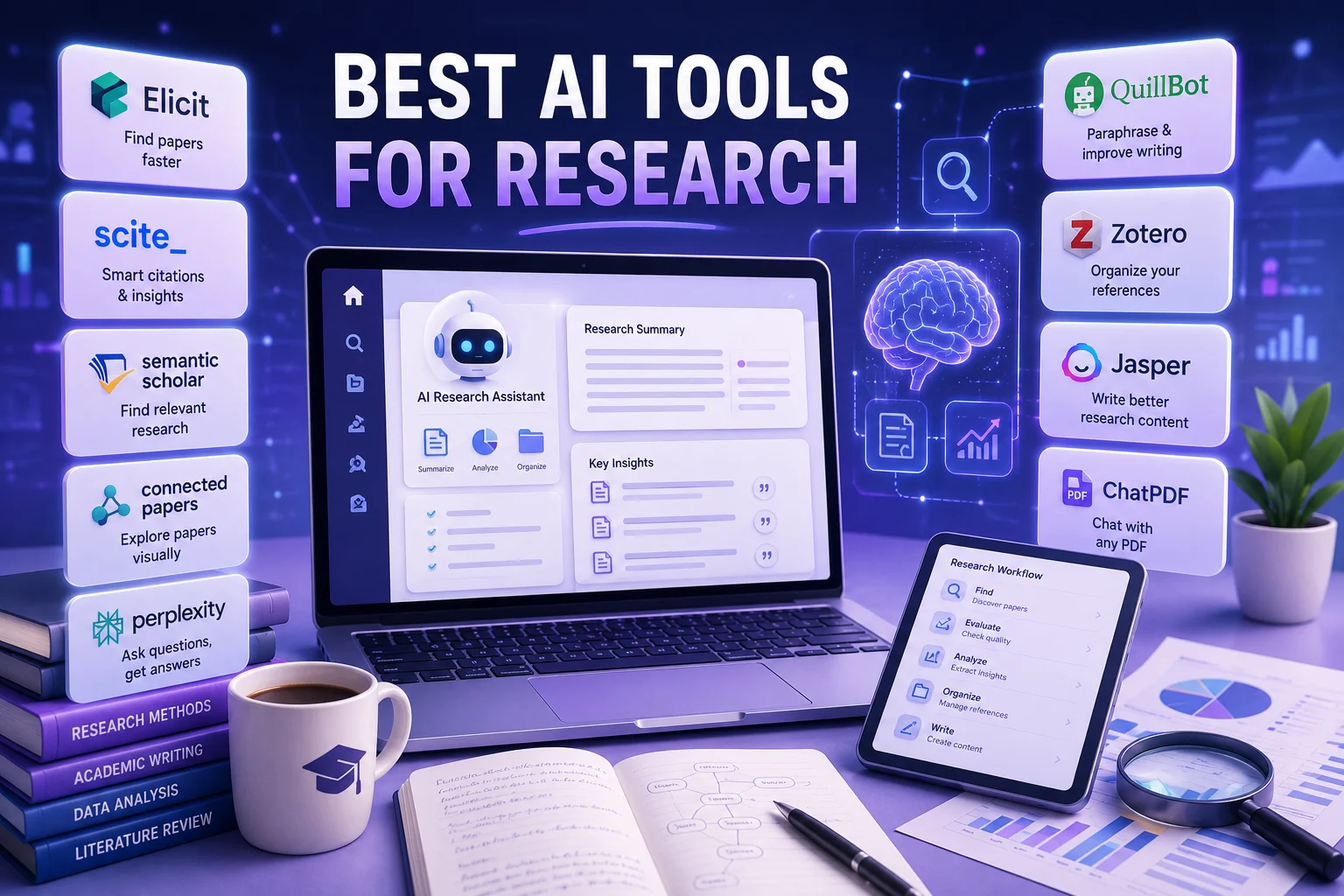

Research can take hours. Finding reliable sources, reading long documents, comparing information, checking facts, and organizing notes are all important parts of the research process.
AI research tools can make many of these tasks faster. Some are designed for searching the web and finding current information, while others focus on academic papers, scientific literature, PDFs, citations, or documents you already have.
In this guide, we'll explore the best AI tools for research in 2026 and explain which tool is best for different research tasks.
Best AI Research Tools at a Glance
| Tool | Best For | Research Type | Free Option |
|---|---|---|---|
| Perplexity | Web research with citations | Web research | Yes |
| ChatGPT | Research analysis and synthesis | General research | Yes |
| Google NotebookLM | Researching your own documents | PDFs & documents | Yes |
| Elicit | Literature reviews | Academic research | Yes / Limited |
| Consensus | Scientific research | Academic research | Yes / Limited |
| Claude | Long documents and analysis | Documents & research | Yes |
| Scite | Citation analysis | Academic research | Limited |
| Semantic Scholar | Finding academic papers | Academic research | Yes |
There is no single AI tool that is best for every type of research. Current comparisons consistently separate general web research, academic literature discovery, source-grounded document analysis, and citation checking into different workflows.
1. Perplexity — Best for Web Research
Perplexity is one of the most useful AI tools for people who need to research topics on the web. It combines search with AI-generated answers and provides citations that can help you investigate the information behind the answer.
This makes it useful when you need to quickly understand an unfamiliar topic, compare products, investigate a company, research a market, or find current information.
What Perplexity Is Best For
- Web research
- Finding current information
- Fact-checking
- Market research
- Competitor research
- Finding sources
- Researching unfamiliar topics
Best for: Students, marketers, journalists, content creators, professionals, and anyone who regularly researches information online.
Current 2026 comparisons commonly position Perplexity as a strong starting point for fast, cited web research, although citations should still be opened and verified rather than trusted automatically.
2. ChatGPT — Best for Research Analysis
ChatGPT can be useful throughout the research process. Instead of simply asking it for an answer, you can use it to organize research questions, analyze information, compare sources, summarize documents, brainstorm ideas, and turn research notes into structured content.
What ChatGPT Is Best For
- Research planning
- Brainstorming research questions
- Summarizing information
- Comparing sources
- Analyzing research notes
- Creating outlines
- Explaining difficult concepts
- Synthesizing information
Best for: General research, students, professionals, writers, and researchers who need help analyzing and organizing information.
3. Google NotebookLM — Best for Your Own Sources
NotebookLM is particularly useful when you already have the documents you want to research. Instead of starting with the entire web, you can work from a collection of approved sources and ask questions about those materials.
This makes it useful for studying books, research papers, reports, lecture notes, PDFs, and other documents.
What NotebookLM Is Best For
- PDF research
- Study materials
- Research notes
- Reports
- Document summaries
- Source-based questions
- Organizing research materials
Best for: Students, researchers, professionals, and anyone who wants to ask questions about a specific collection of documents.
Research-tool comparisons frequently recommend NotebookLM when the evidence is already contained in the user's own documents rather than needing broad web discovery.
4. Elicit — Best for Academic Literature Reviews
Elicit is designed specifically around academic research. It can help researchers discover papers, organize literature, extract information, and compare findings across studies.
For researchers working on literature reviews, Elicit can be more appropriate than a general-purpose chatbot because its workflow is built around academic papers.
What Elicit Is Best For
- Literature reviews
- Academic papers
- Research questions
- Paper discovery
- Study comparison
- Data extraction
- Research synthesis
Best for: University students, academics, PhD students, and researchers conducting literature reviews.
Recent 2026 comparisons consistently identify Elicit as one of the strongest choices for structured literature discovery, screening, extraction, and review workflows.
5. Consensus — Best for Scientific Research
Consensus focuses on scientific literature and can help users find research papers related to specific questions.
It is particularly useful when your research question depends on scientific evidence rather than general information from the open web.
What Consensus Is Best For
- Scientific research
- Academic questions
- Research papers
- Evidence-based questions
- Scientific literature discovery
- Comparing research findings
Best for: Students, researchers, academics, and professionals who need evidence from scientific literature.
Current research-tool comparisons commonly place Consensus among the leading options for evidence-backed answers based on scientific literature.
6. Claude — Best for Long Documents and Research Analysis
Claude can be useful when your research involves long documents, detailed notes, or complex written material. It can help compare information, identify important themes, summarize documents, and turn large amounts of text into a more manageable structure.
What Claude Is Best For
- Long documents
- Research notes
- Document analysis
- Complex summaries
- Comparing information
- Research writing
Best for: Researchers, writers, professionals, and students working with large amounts of text.
7. Scite — Best for Citation Analysis
Finding a research paper is only part of academic research. Researchers also need to understand how a paper has been discussed by later research.
Scite focuses on citation context and can help researchers investigate whether later publications support, contrast with, or mention previous research.
What Scite Is Best For
- Citation analysis
- Checking research claims
- Finding supporting studies
- Finding contrasting studies
- Understanding citation context
Best for: Researchers and students who need to investigate the context surrounding academic citations.
Recent comparisons identify Scite as a specialist tool for citation context rather than a general-purpose research assistant.
8. Semantic Scholar — Best Free Tool for Finding Research Papers
Semantic Scholar is an academic search and discovery platform that can help users find scientific papers and explore related research.
It is particularly useful when you want to discover papers without immediately paying for a specialized research platform.
What Semantic Scholar Is Best For
- Finding research papers
- Academic discovery
- Related-paper searches
- Citation discovery
- Research recommendations
Best for: Students, researchers, and anyone looking for academic papers.
Recent 2026 comparisons continue to highlight Semantic Scholar as a strong free discovery option for academic literature.
Best AI Research Tools by Task
| Research Task | Recommended Tool | Why |
|---|---|---|
| Web research | Perplexity | Fast web search with citations |
| Research analysis | ChatGPT | Reasoning, organization, and synthesis |
| Researching PDFs | NotebookLM | Works from your selected documents |
| Literature reviews | Elicit | Designed around academic literature workflows |
| Scientific questions | Consensus | Focuses on scientific research |
| Long documents | Claude | Strong document analysis and synthesis |
| Citation analysis | Scite | Provides citation context |
| Finding papers | Semantic Scholar | Academic discovery and related papers |
Best Free AI Tools for Research
You don't necessarily need to pay for an AI research platform. Several tools provide free access or free tiers that can be useful for students and casual researchers.
A Simple Free Research Toolkit
- Perplexity: Useful for web research and source discovery.
- ChatGPT: Useful for research planning, analysis, and explanations.
- NotebookLM: Useful for working with your own documents.
- Semantic Scholar: Useful for discovering academic papers.
- Consensus: Useful for exploring scientific literature.
Free limits and features can change over time, so check the current plan details before relying on a particular feature for a large research project.
How to Use AI for Better Research
Step 1: Define Your Research Question
Start with a specific question instead of asking an AI tool to research a broad topic.
For example, instead of asking:
"Tell me about artificial intelligence."
Try:
"How has generative AI changed content marketing since 2023, and what evidence supports the main trends?"
Step 2: Find Your Sources
Use a web research tool for current information or an academic research platform when you need scientific papers.
Step 3: Check the Sources
Don't assume that an AI-generated answer is automatically accurate. Open important sources and check whether they actually support the claims being made.
This is especially important for academic, financial, legal, medical, or other high-impact research.
Step 4: Organize Your Findings
Use an AI assistant to organize your notes into categories, compare sources, identify patterns, and create a structured outline.
Step 5: Write in Your Own Words
AI can help you organize and improve your writing, but your final work should accurately represent the evidence and follow the requirements of your assignment or publication.
Step 6: Verify Important Claims
Before publishing or submitting research, verify important facts against the original sources.
AI Research Tools for Students
Students can use AI research tools to save time while studying and preparing assignments. However, the tools should support learning rather than replace it.
A useful student workflow could combine Semantic Scholar or Consensus for finding academic sources, NotebookLM for studying uploaded documents, and ChatGPT or Claude for explaining difficult concepts and organizing notes.
AI Research Tools for Academic Research
Academic research requires more attention to sources, methodology, citations, and evidence than ordinary web research.
For a literature review, a combination of Elicit + Consensus + Semantic Scholar can help with discovery and screening, while Scite can provide additional context around citations.
No AI tool should replace reading the original research when a claim is important to your work. Current research-tool evaluations emphasize that AI output should be treated as a research aid rather than a substitute for source verification.
AI Research Tools for Business and Market Research
Businesses often need different types of research than universities. Market research may involve competitors, customers, products, pricing, industry trends, and current events.
For this type of work, a practical combination can be Perplexity + ChatGPT.
Perplexity can help discover current information and sources, while ChatGPT can help organize the findings into categories, compare information, and create a structured report.
Can AI Replace a Human Researcher?
No. AI can automate parts of the research process, but researchers still need to evaluate source quality, understand context, identify limitations, and decide whether evidence actually supports a conclusion.
The best approach is to treat AI as a research assistant rather than a replacement for critical thinking.
Common Mistakes to Avoid When Using AI for Research
1. Trusting AI Answers Without Checking Sources
AI systems can make mistakes. Always verify important information using the original source.
2. Using Fake or Incorrect Citations
Never assume that a citation is valid simply because an AI tool provides it. Open the paper or webpage and confirm the source.
3. Using Only One Source
Important research questions often require multiple sources. Comparing independent sources can help reveal disagreements and missing information.
4. Ignoring Publication Dates
Information can become outdated quickly, especially for technology, business, and current events. Check when your sources were published or updated.
5. Copying AI-Generated Text Directly
AI-generated text should be reviewed, fact-checked, and adapted to your own research and writing requirements.
Best AI Research Tool for Beginners
If you're new to AI research tools, start with Perplexity for web research and ChatGPT for analysis and organization.
If your work is mainly academic, add Semantic Scholar or Consensus. If you already have a collection of PDFs or notes, try NotebookLM.
Best AI Research Tool for Students
For students, there is no single winner. A combination of tools is often more useful.
- Semantic Scholar: Find academic papers.
- Consensus: Explore scientific evidence.
- NotebookLM: Study your own documents.
- ChatGPT: Understand difficult concepts and organize ideas.
- Perplexity: Research current information on the web.
Final Thoughts
The best AI research tool depends on what you are researching and where your information comes from.
Perplexity is a strong choice for web research and current information. ChatGPT is useful for analysis and synthesis. NotebookLM is particularly useful when your research is based on your own documents. Elicit and Consensus are better suited to academic and scientific research, while Scite can help investigate citation context.
Instead of looking for one tool that does everything, build a simple research workflow around the type of evidence you need. Most importantly, verify important claims against the original sources before publishing, submitting, or making decisions based on your research.
Frequently Asked Questions
What is the best AI tool for research?
There is no single best tool for every research task. Perplexity is a strong choice for web research, Elicit is well suited to literature reviews, Consensus focuses on scientific evidence, and NotebookLM is useful for researching your own documents.
What is the best free AI research tool?
For general web research, Perplexity offers a useful free option. For academic paper discovery, Semantic Scholar is a strong free resource. ChatGPT and NotebookLM also provide free access with varying limits.
Can I use AI for academic research?
Yes. AI can help with paper discovery, summarization, organization, literature reviews, and understanding difficult concepts. However, researchers should verify important claims against the original academic sources.
Is Perplexity better than ChatGPT for research?
It depends on the task. Perplexity is particularly useful when you need current web information and visible citations. ChatGPT is useful for reasoning, organization, analysis, and synthesis. Many research workflows can benefit from using both.
What AI tool is best for research papers?
Elicit and Consensus are strong choices for academic literature research. Semantic Scholar is also useful for discovering papers, while Scite can help investigate citation context.
Can AI research tools be trusted?
AI research tools can save significant time, but their output should not be treated as automatically correct. Verify important claims, citations, publication dates, and conclusions using the original sources.