
Artificial intelligence, machine learning, and deep learning are three terms that are often used interchangeably, but they do not mean exactly the same thing.
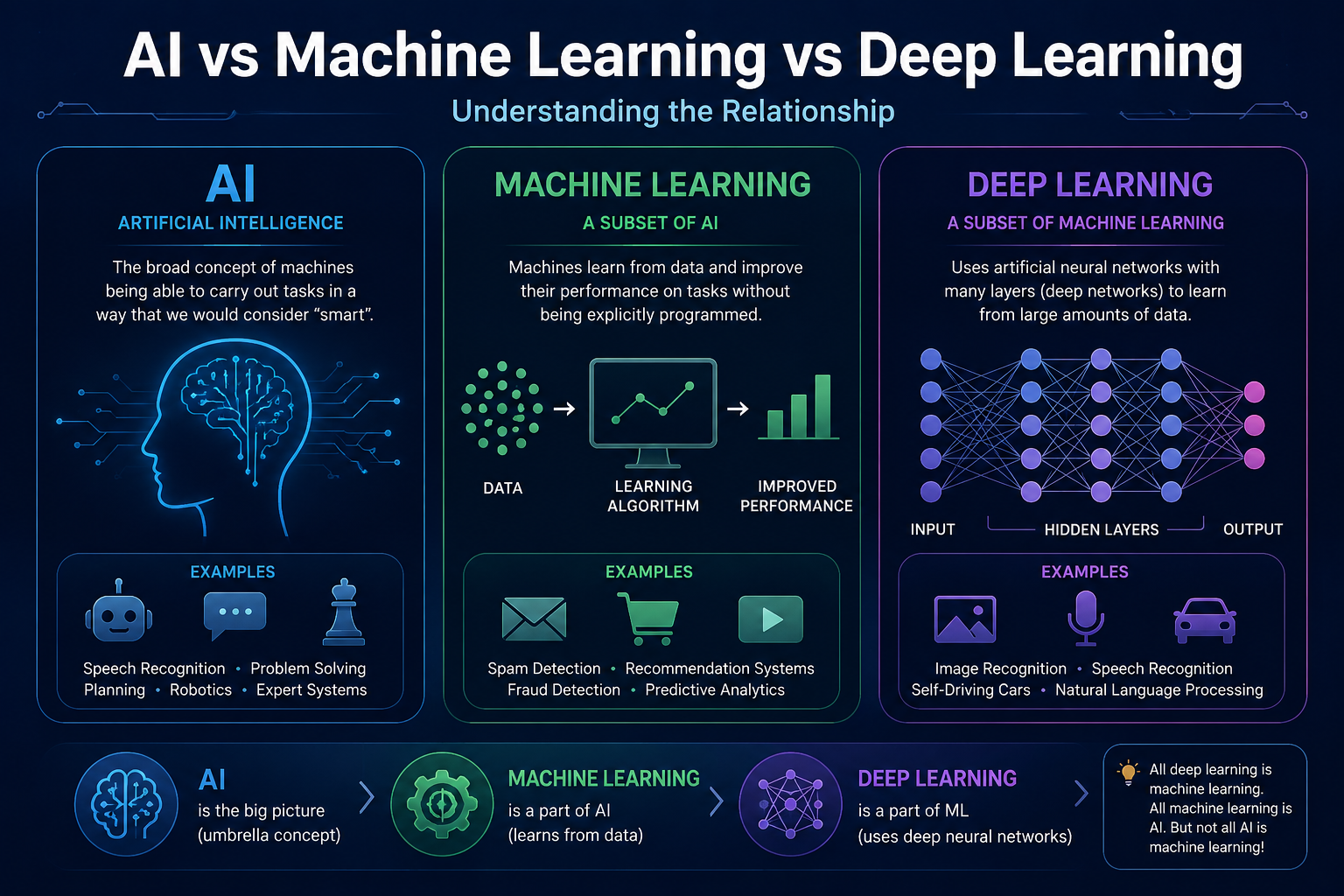
Artificial intelligence is the broadest concept. Machine learning is a subset of artificial intelligence that allows computers to learn patterns from data, while deep learning is a specialized form of machine learning based on multi-layer neural networks.
Understanding the difference between AI, machine learning, and deep learning can make it much easier to understand modern technologies such as ChatGPT, image generators, recommendation systems, autonomous vehicles, speech recognition, and AI-powered search.
In this guide, we'll explain AI vs machine learning vs deep learning, how these technologies are related, how they work, their differences, real-world examples, and when each approach is used.
AI vs Machine Learning vs Deep Learning
The easiest way to understand the relationship is to think of these technologies as layers.
- Artificial Intelligence (AI) — The broad field of creating machines that can perform tasks associated with human intelligence.
- Machine Learning (ML) — A subset of AI that enables systems to learn patterns from data and improve their performance.
- Deep Learning (DL) — A subset of machine learning that uses multi-layer neural networks to learn complex patterns.
In simple terms:
Deep learning is part of machine learning, and machine learning is part of artificial intelligence.
What Is Artificial Intelligence?
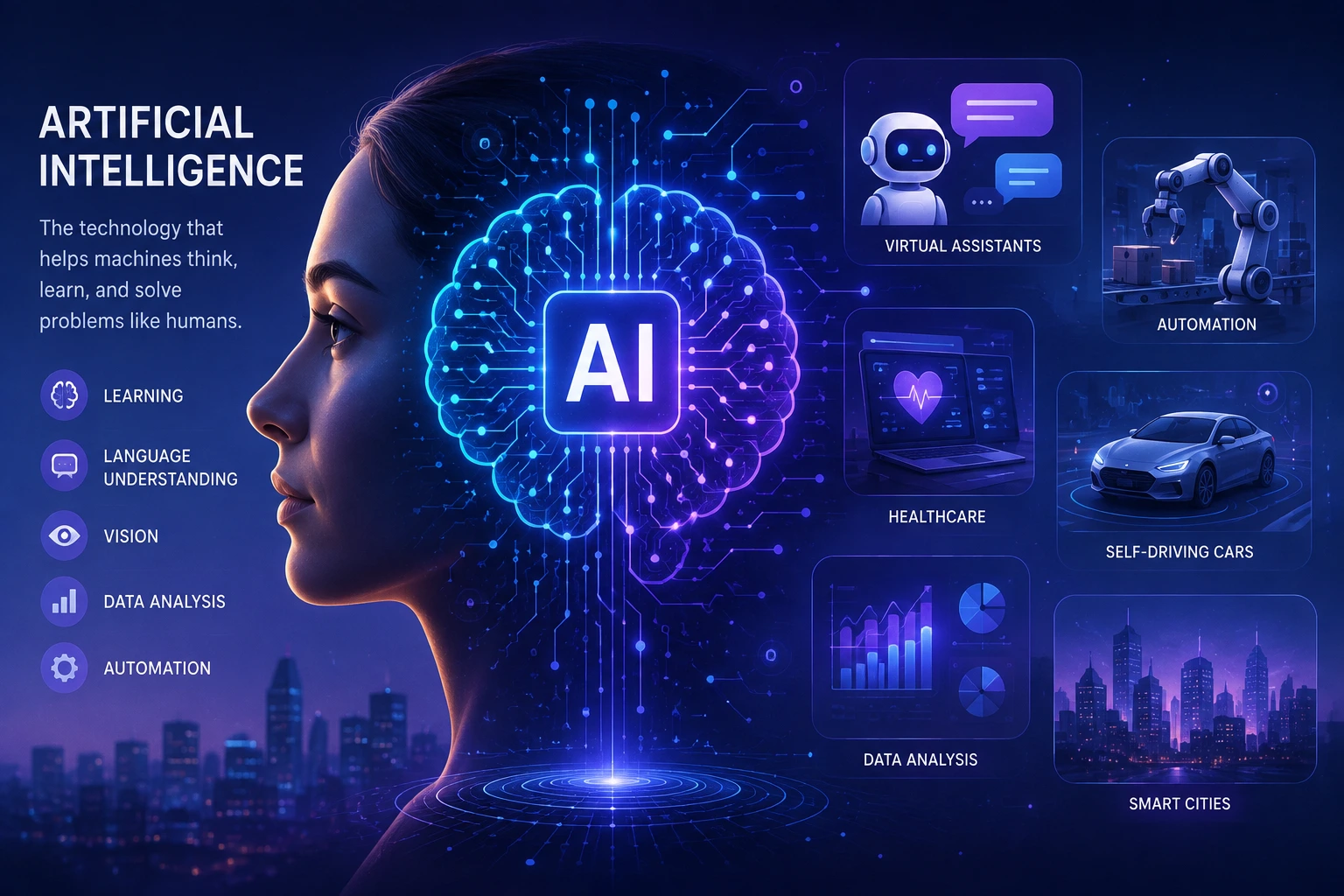
Artificial intelligence, commonly called AI, is the broad field of computer science focused on creating systems that can perform tasks that normally require human intelligence.
These tasks can include understanding language, recognizing images, making predictions, solving problems, generating content, planning actions, and making decisions.
AI does not necessarily have to learn from data. Some AI systems can use explicitly programmed rules, logic, search algorithms, or other techniques to solve problems.
Examples of Artificial Intelligence
- Chatbots
- Virtual assistants
- Recommendation systems
- AI search engines
- Fraud detection systems
- Computer vision systems
- Autonomous vehicles
- AI content generators
- Game-playing systems
- Robotics
Modern generative AI systems are also part of the broader field of artificial intelligence. They can generate text, images, audio, video, software code, and other types of content.
How Does AI Work?
There is no single method that defines how every AI system works.
Depending on the application, an AI system may use rules, algorithms, machine learning models, neural networks, natural language processing, computer vision, search, optimization, or a combination of several techniques.
This is one reason why AI is much broader than machine learning.
What Is Machine Learning?
Machine learning is a branch of artificial intelligence in which computer systems learn patterns from data rather than relying entirely on manually written rules.
Instead of programming every possible situation, developers provide an algorithm with data and allow it to identify useful patterns.
Once trained, the resulting machine learning model can use those learned patterns to make predictions or decisions when it receives new data.
Simple Machine Learning Example
Imagine building a system that predicts whether an email is spam.
A traditional rule-based system might contain rules such as:
- If an email contains certain words, mark it as spam.
- If the sender is on a blocked list, mark it as spam.
- If an email contains suspicious links, mark it as spam.
A machine learning system can instead be trained using a large collection of emails that have already been classified as spam or legitimate.
The model learns patterns associated with spam and then uses those patterns to classify new messages.
Examples of Machine Learning
- Email spam detection
- Credit risk prediction
- Product recommendations
- Fraud detection
- Customer churn prediction
- Search ranking
- Demand forecasting
- Personalized advertising
What Is Deep Learning?
Deep learning is a specialized branch of machine learning that uses artificial neural networks with multiple layers to learn complex patterns from data.
These neural networks are loosely inspired by the structure of biological neural networks, although they are mathematical and computational systems rather than digital copies of the human brain.
Deep learning has become particularly important because it can perform extremely well on complex data such as images, audio, video, natural language, and large collections of unstructured information.
Examples of Deep Learning
- Image recognition
- Speech recognition
- Natural language processing
- Generative AI
- Computer vision
- Object detection
- Machine translation
- Autonomous driving systems
- AI image generation
- AI video generation
Many modern AI systems that appear highly capable are powered by deep learning models trained on very large datasets.
AI vs Machine Learning vs Deep Learning: The Relationship
The relationship between the three technologies can be represented as a hierarchy.
| Technology | Relationship | Main Idea |
|---|---|---|
| Artificial Intelligence | Broadest field | Machines performing tasks associated with intelligence |
| Machine Learning | Subset of AI | Systems learn patterns from data |
| Deep Learning | Subset of ML | Neural networks learn complex patterns through multiple layers |
A useful way to visualize the relationship is:
Artificial Intelligence → Machine Learning → Deep Learning
Every deep learning system is a machine learning system, and every machine learning system is generally considered part of AI. However, not every AI system uses machine learning, and not every machine learning system uses deep learning.
Key Differences Between AI, ML, and Deep Learning
| Feature | AI | Machine Learning | Deep Learning |
|---|---|---|---|
| Scope | Broad | Narrower | Most specialized |
| Learning from data | Not always | Yes | Yes |
| Neural networks required | No | No | Yes |
| Data requirements | Varies | Usually moderate to large | Often very large |
| Human feature engineering | Varies | Often important | Often reduced |
| Computational requirements | Varies | Varies | Often high |
| Typical applications | Reasoning, automation, agents | Prediction and classification | Vision, language, speech, generation |
Traditional AI vs Machine Learning
One of the easiest ways to understand machine learning is to compare it with traditional rule-based AI.
Traditional Rule-Based AI
In a rule-based system, developers explicitly define the rules that determine how the system should behave.
For example, a simple customer-support system might use rules such as:
- If the customer asks about a refund, show the refund policy.
- If the customer asks about shipping, show shipping information.
- If the customer reports a technical problem, create a support ticket.
The system follows the rules created by developers.
Machine Learning
A machine learning system can instead learn patterns from examples.
For example, a model could analyze thousands of previous customer-support conversations and learn how different questions are categorized.
The developer does not necessarily need to write an individual rule for every possible sentence.
Machine Learning vs Deep Learning
Machine learning includes many different algorithms and approaches. Deep learning is one category within machine learning.
Traditional machine learning algorithms can include techniques such as:
- Linear regression
- Logistic regression
- Decision trees
- Random forests
- Gradient boosting
- Support vector machines
- Clustering algorithms
Deep learning instead relies on neural networks containing multiple computational layers.
The choice between traditional machine learning and deep learning depends on the problem, the available data, computational resources, performance requirements, and other factors.
What Are Neural Networks?
A neural network is a machine learning model made up of interconnected computational units commonly called neurons.
These units are organized into layers. A basic neural network can contain:
- Input layer
- One or more hidden layers
- Output layer
During training, the network adjusts numerical parameters called weights so that its predictions become more accurate.
Deep learning generally refers to neural networks with multiple layers capable of learning increasingly complex representations of data.
How Does Machine Learning Learn?
Machine learning models learn by processing examples and adjusting their internal parameters based on the errors they make.
A simplified training process looks like this:
- Collect data: Gather examples relevant to the problem.
- Prepare data: Clean and organize the dataset.
- Choose a model: Select an appropriate machine learning algorithm.
- Train: Give the model examples so it can learn patterns.
- Evaluate: Test the model on data it has not seen during training.
- Improve: Adjust the model or training process.
- Deploy: Use the trained model to make predictions on new data.
The exact process varies significantly depending on the type of machine learning problem.
Supervised Learning
Supervised learning is a machine learning approach in which the training data includes known answers or labels.
For example, a model designed to identify spam emails can be trained using emails labeled as either spam or legitimate.
The model learns the relationship between the input data and the known labels.
Examples of Supervised Learning
- Spam classification
- House price prediction
- Image classification
- Fraud detection
- Customer churn prediction
Unsupervised Learning
Unsupervised learning works with data that does not have predefined labels.
The algorithm attempts to discover patterns, structures, or groups within the data.
For example, a business might use clustering to identify groups of customers with similar purchasing behavior.
Examples of Unsupervised Learning
- Customer segmentation
- Pattern discovery
- Clustering
- Anomaly detection
- Data exploration
Reinforcement Learning
Reinforcement learning is another machine learning approach in which an agent learns by interacting with an environment and receiving rewards or penalties based on its actions.
The goal is to learn a strategy that maximizes the long-term reward.
Reinforcement learning can be used in areas such as:
- Robotics
- Game-playing systems
- Control systems
- Resource optimization
- Decision-making problems
How Deep Learning Works
Deep learning models are trained using large collections of examples. During training, the neural network repeatedly processes data and adjusts its parameters to reduce prediction errors.
One important advantage of deep learning is its ability to learn representations directly from complex data.
For example, an image-recognition model can learn increasingly sophisticated visual features through different layers of the network.
Earlier layers may learn simple patterns, while deeper layers can combine those patterns into more complex representations.
Why Is Deep Learning So Powerful?
Deep learning has become particularly powerful because improvements in computing hardware, large datasets, optimization techniques, and model architectures have made it possible to train increasingly capable neural networks.
Modern deep learning systems can process enormous amounts of data and learn highly complex relationships.
This has contributed to major advances in:
- Natural language processing
- Computer vision
- Speech recognition
- Machine translation
- Generative AI
- Robotics
- Recommendation systems
AI, Machine Learning, and Deep Learning Examples
Chatbots
Modern AI chatbots can use machine learning and deep learning models to understand user requests and generate responses.
The chatbot itself is an AI application, while the underlying language model may be a deep learning system.
Recommendation Systems
Streaming platforms, online stores, and social networks can use machine learning models to predict which content or products a user may find interesting.
Image Recognition
Deep learning models can analyze images and identify objects, faces, scenes, or other visual patterns.
Fraud Detection
Financial institutions can use machine learning models to identify unusual transaction patterns that may indicate fraudulent activity.
Voice Assistants
Voice assistants can combine several AI technologies, including speech recognition, natural language processing, machine learning, and deep learning.
Generative AI and Deep Learning
Generative AI refers to AI systems capable of creating new content such as text, images, audio, video, or code.
Many modern generative AI systems rely heavily on deep learning.
Large language models, for example, use neural network architectures trained on very large datasets to learn patterns in language and generate text.
AI image generators similarly use deep learning techniques to learn relationships between visual patterns and other forms of information.
This means that many of the AI tools people use today are examples of AI applications powered by deep learning.
AI vs ML vs Deep Learning in Real-World Applications
| Application | AI | Machine Learning | Deep Learning |
|---|---|---|---|
| Spam detection | Yes | Yes | Possible |
| Recommendation systems | Yes | Yes | Possible |
| Image recognition | Yes | Yes | Common |
| Speech recognition | Yes | Yes | Common |
| Chatbots | Yes | Yes | Common |
| Rule-based automation | Yes | Not required | Not required |
| Generative AI | Yes | Usually | Common |
What Is the Difference Between AI and Machine Learning?
The main difference is scope.
Artificial intelligence is the broader field concerned with building systems capable of performing tasks associated with intelligent behavior.
Machine learning is one approach used to build AI systems. It allows computers to learn patterns from data instead of requiring developers to manually program every rule.
Therefore, machine learning is AI, but AI is not necessarily machine learning.
What Is the Difference Between Machine Learning and Deep Learning?
Deep learning is a specialized type of machine learning that uses multi-layer neural networks.
Traditional machine learning methods can work very well with structured datasets and may require humans to select or engineer useful features.
Deep learning can often learn useful representations directly from raw or less-structured data, particularly when large datasets and sufficient computational resources are available.
Which Is Better: AI, Machine Learning, or Deep Learning?
There is no universal answer because these terms describe different levels of technology rather than three competing products.
AI is the broad field. Machine learning is one approach within AI, and deep learning is one approach within machine learning.
The appropriate technology depends on the problem you are trying to solve.
Use Rule-Based AI When:
- The rules are simple and clearly defined.
- The behavior must be highly predictable.
- You have limited training data.
- The problem does not require learning from examples.
Use Traditional Machine Learning When:
- You have structured data.
- You need predictions or classifications.
- The dataset is not enormous.
- Interpretability is important.
- Traditional algorithms can solve the problem effectively.
Use Deep Learning When:
- You have large amounts of data.
- The problem involves complex patterns.
- You are working with images, audio, video, or natural language.
- High predictive performance is important.
- You have sufficient computing resources.
Advantages of Artificial Intelligence
- Can automate repetitive tasks
- Can assist with complex decisions
- Can process large amounts of information
- Can improve productivity
- Can provide personalized experiences
- Can operate continuously
Advantages of Machine Learning
- Can learn patterns from data
- Can improve predictions with better data
- Can automate classification and prediction tasks
- Can identify patterns humans may miss
- Can adapt to changing datasets
Advantages of Deep Learning
- Excellent performance on complex problems
- Strong image and video processing capabilities
- Powerful language-processing capabilities
- Can learn complex representations automatically
- Can scale effectively with large datasets and computing resources
Limitations of AI, Machine Learning, and Deep Learning
These technologies also have important limitations.
AI Limitations
- AI systems can make incorrect decisions.
- Some systems can be difficult to understand.
- AI can inherit biases from data or design choices.
- Development and maintenance can be expensive.
Machine Learning Limitations
- Models depend on the quality of their training data.
- Biased data can produce biased predictions.
- Models can perform poorly on situations they were not designed for.
- Training and evaluation require careful design.
Deep Learning Limitations
- Often requires large datasets.
- Can require significant computing resources.
- Training can be expensive.
- Models can be difficult to interpret.
- Large models can require substantial infrastructure.
Do You Need to Learn AI, Machine Learning, or Deep Learning First?
If you are a beginner, you do not need to learn deep learning immediately.
A practical learning path is to start with basic programming and understand the fundamentals of AI before moving into machine learning.
- Learn basic programming.
- Understand what artificial intelligence is.
- Learn basic statistics and mathematics.
- Study machine learning concepts.
- Build simple machine learning projects.
- Learn neural networks.
- Move into deep learning.
- Explore specialized areas such as computer vision or natural language processing.
AI vs Machine Learning vs Deep Learning for Beginners
If you're completely new to the subject, remember these three definitions:
- AI: The broad field of making computers perform tasks associated with intelligence.
- Machine Learning: A way of building AI systems that learn patterns from data.
- Deep Learning: A type of machine learning that uses multi-layer neural networks.
You can think of it as a set of nested circles:
AI contains Machine Learning, and Machine Learning contains Deep Learning.
Why the Difference Matters
Understanding these distinctions helps you evaluate AI products and technologies more accurately.
For example, when a company says that its product uses AI, that does not necessarily tell you what technology is underneath it.
The system could use rules, traditional machine learning, deep learning, or a combination of different technologies.
Knowing the difference also makes it easier to understand technical discussions about AI models, training data, neural networks, and generative AI.
A Simple Example to Remember
Imagine building a system that identifies cats in photographs.
AI describes the overall goal: creating a computer system that can recognize cats.
Machine learning describes an approach where the system learns from examples of cat and non-cat images.
Deep learning describes a machine learning approach where a multi-layer neural network learns complex visual patterns from the images.
The three concepts describe different levels of the same overall problem.
Final Verdict
Artificial intelligence, machine learning, and deep learning are closely related, but they are not identical.
Artificial intelligence is the broadest concept and includes technologies designed to perform tasks associated with human intelligence.
Machine learning is a subset of AI that allows systems to learn patterns from data and use those patterns to make predictions or decisions.
Deep learning is a specialized form of machine learning that uses multi-layer neural networks and is particularly powerful for complex data such as images, audio, video, and natural language.
The easiest way to remember the relationship is:
AI → Machine Learning → Deep Learning
As AI continues to evolve, understanding this hierarchy will make it easier to understand technologies such as generative AI, large language models, computer vision, recommendation systems, and AI agents.
You don't need to become a machine learning engineer to understand AI. Learning the basic differences between these concepts is an excellent starting point for anyone who wants to understand how modern AI technology works.
Frequently Asked Questions
Is machine learning the same as AI?
No. Machine learning is a subset of artificial intelligence. AI is the broader field, while machine learning is one method used to create AI systems.
Is deep learning a type of machine learning?
Yes. Deep learning is a specialized type of machine learning that uses neural networks with multiple layers.
Which is bigger, AI or machine learning?
AI is broader than machine learning. Machine learning is one area within artificial intelligence.
Which is better, machine learning or deep learning?
Neither is universally better. Traditional machine learning can be highly effective for many structured-data problems, while deep learning is particularly powerful for complex data such as images, audio, video, and natural language.
Is ChatGPT AI or machine learning?
ChatGPT is an AI application powered by machine learning and deep learning technologies. Its underlying language models use neural-network-based deep learning techniques.
Is deep learning part of AI?
Yes. Deep learning is part of machine learning, which is part of the broader field of artificial intelligence.
Do all AI systems use machine learning?
No. Some AI systems can use explicitly programmed rules, logic, search, optimization, or other techniques without relying on machine learning.
Do all machine learning systems use deep learning?
No. Machine learning includes many approaches that do not use deep neural networks, including decision trees, linear models, support vector machines, and other algorithms.
Why is deep learning important?
Deep learning has enabled major advances in areas such as computer vision, speech recognition, natural language processing, and generative AI because neural networks can learn highly complex patterns from large datasets.
Can beginners learn deep learning?
Yes. Beginners can learn deep learning, but it is usually easier to start with programming, basic mathematics, AI concepts, and machine learning fundamentals before studying advanced neural networks.