
OpenAI is changing how it approaches data privacy for business customers as companies become increasingly dependent on AI for sensitive and high-value work.
The company has introduced a new privacy-focused approach designed to allow certain business customers to use OpenAI's AI systems while reducing the amount of customer data that needs to be retained.
The move is particularly important for organizations working with confidential business information, customer data, intellectual property, and other sensitive material.
OpenAI's existing business policies already provide stronger data protections than its consumer products. Business customers are not having their inputs and outputs used to train OpenAI's models by default, and qualifying organizations can configure additional data-retention controls. :contentReference[oaicite:0]{index=0}
In this article, we'll explain what OpenAI's latest data-policy changes mean for business users, how data retention works, what zero data retention means, and what companies should consider before using AI with sensitive information.
What Changed in OpenAI's Data Policy?
The latest change focuses on giving business customers more privacy-oriented options around how their AI interactions are handled.
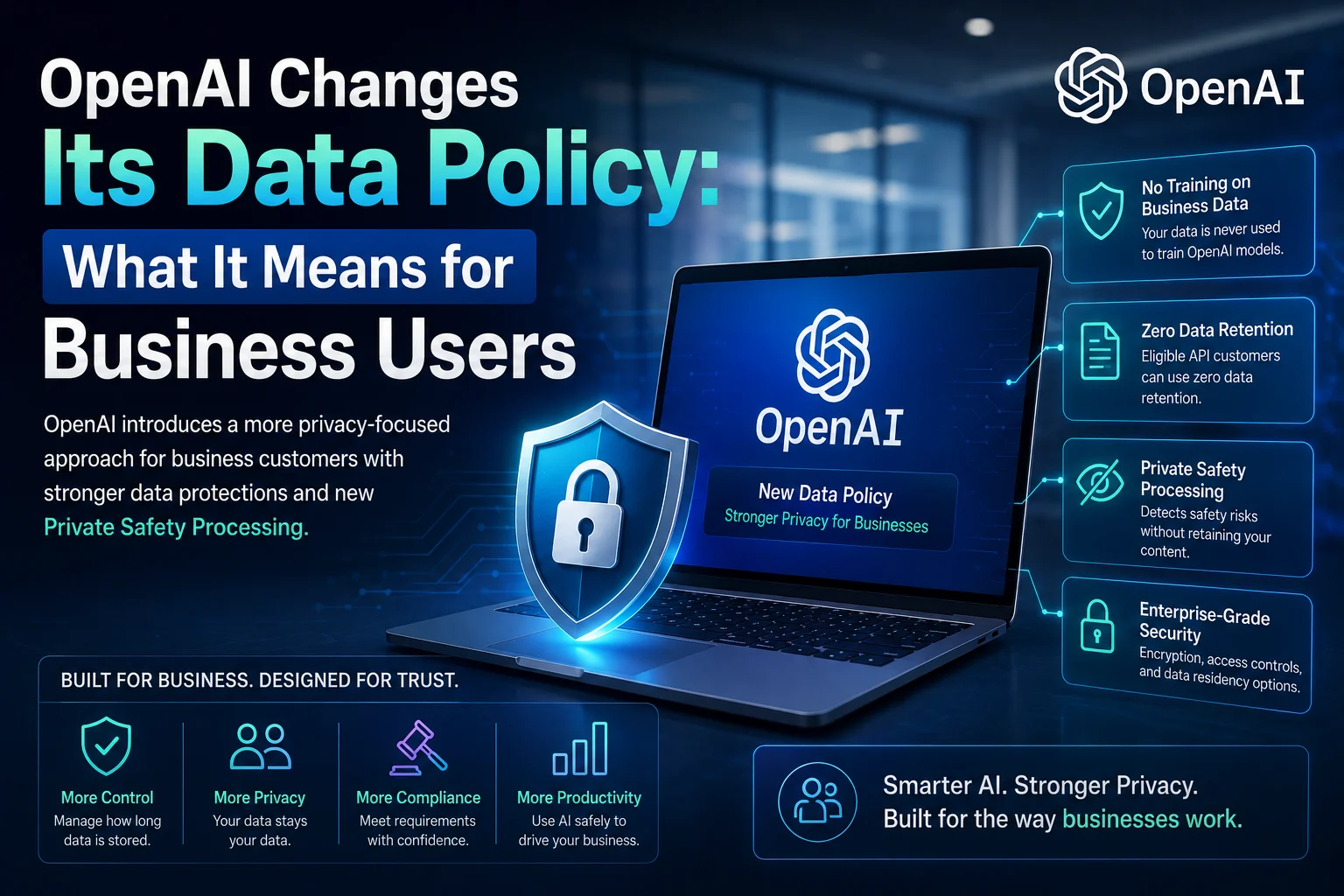
OpenAI has introduced a system called Private Safety Processing, designed to help detect potentially dangerous or abusive activity without requiring the company to retain the underlying customer data.
The system is being tested with business and API customers and is intended to address an important challenge: AI providers need to monitor potentially harmful activity while businesses increasingly want strong guarantees that their data will not be stored unnecessarily.
According to reporting on the announcement, the system can generate a high-level safety signal when potentially dangerous behavior is detected without exposing the underlying customer content to OpenAI. :contentReference[oaicite:1]{index=1}
This represents a shift toward separating safety monitoring from long-term retention of customer data.
Why Is This Important for Businesses?
Businesses often use AI differently from individual consumers.
Employees may use AI systems to analyze internal documents, write software, summarize meetings, review business information, generate reports, or work with proprietary data.
That creates an important question:
How can a company use powerful AI systems without unnecessarily exposing or retaining confidential business information?
For many organizations, data retention is not simply a technical issue. It can affect compliance, contracts, cybersecurity, intellectual property, and internal data-governance policies.
OpenAI already provides enterprise privacy controls, including configurable retention options for qualifying organizations and zero data retention for eligible API use cases. :contentReference[oaicite:2]{index=2}
What Is Zero Data Retention?
Zero Data Retention (ZDR) means that eligible customer data is not retained by the AI provider after it has been processed, subject to the specific terms and technical requirements of the service.
For businesses, this can be especially valuable when AI applications process sensitive information.
OpenAI says qualifying organizations can configure retention controls and can opt for zero data retention on the API platform. :contentReference[oaicite:3]{index=3}
However, businesses should not assume that every OpenAI product or endpoint automatically operates under zero data retention.
Eligibility, product configuration, contractual terms, and technical implementation all matter.
Does OpenAI Train Its Models on Business Data?
For business products, OpenAI states that customer inputs and outputs are not used to train or improve its models by default.
This applies to products such as ChatGPT Business, ChatGPT Enterprise, and the OpenAI API, subject to the applicable terms and configuration. :contentReference[oaicite:4]{index=4}
API organization owners can also choose to opt in to data sharing in supported circumstances. OpenAI notes that some organizations, including customers using Zero Data Retention, have additional restrictions around this option. :contentReference[oaicite:5]{index=5}
How OpenAI Business Data Handling Works
Businesses should think about AI data handling as several separate questions rather than one simple privacy setting.
- Training: Is customer data used to improve AI models?
- Retention: How long is data stored?
- Access: Who can access the data?
- Security: How is the information protected?
- Location: Where is data processed or stored?
- Compliance: Does the configuration satisfy the organization's requirements?
OpenAI's enterprise privacy documentation provides controls and information covering these areas, including retention controls, encryption options, and data residency capabilities. :contentReference[oaicite:6]{index=6}
What Does This Mean for ChatGPT Business Users?
ChatGPT Business is designed as a shared AI workspace for organizations and provides centralized administration, user controls, billing, and workspace-level management.
OpenAI states that it does not train on ChatGPT Business workspace data. :contentReference[oaicite:7]{index=7}
Business administrators can also control how long workspace data is retained. OpenAI's enterprise privacy documentation says that deleted ChatGPT Business conversations are generally removed from OpenAI's systems within 30 days, unless longer retention is required for legal or safety reasons. :contentReference[oaicite:8]{index=8}
This is different from saying that every business account automatically has zero data retention.
Companies that require ZDR or other specialized contractual protections may need a contracted offering rather than the standard self-service Business plan. :contentReference[oaicite:9]{index=9}
What Does This Mean for API Customers?
The OpenAI API has separate data controls that are particularly relevant for companies building AI applications.
OpenAI states that data sent to the API is not used to train or improve its models unless the customer explicitly opts in to share data. :contentReference[oaicite:10]{index=10}
Qualifying API customers can also request or configure zero data retention for eligible use cases.
This can be important for applications that process confidential information, customer records, proprietary documents, or other sensitive business data.
Why Private Safety Processing Matters
Zero data retention creates a difficult challenge for AI providers.
AI companies still need mechanisms to detect abuse, security threats, and potentially dangerous use of their systems.
At the same time, business customers may not want their sensitive prompts or generated content stored for safety review.
Private Safety Processing is intended to address this tension by allowing OpenAI to detect certain safety signals without retaining the customer's underlying data. :contentReference[oaicite:11]{index=11}
This could become increasingly important as AI agents gain the ability to interact with software, access tools, execute code, and perform more complex tasks.
OpenAI's Data Privacy Options for Businesses
| Feature | What It Means | Why Businesses Care |
|---|---|---|
| No training on business data | Business inputs and outputs are not used to train models by default | Protects proprietary information |
| Retention controls | Organizations can control retention in supported products | Helps with data governance |
| Zero Data Retention | Eligible API customers can use a zero-retention configuration | Useful for sensitive workloads |
| Enterprise controls | Additional security and administration features | Supports larger deployments |
| Data residency | Supported customers can select certain processing or storage locations | Helps address sovereignty requirements |
| Private safety processing | Safety monitoring designed to reduce exposure of customer data | Balances safety and privacy |
What Types of Business Data Should You Protect?
Companies should be especially careful when employees use AI with information that could create legal, financial, security, or competitive risks if exposed.
Examples include:
- Customer personal information
- Passwords and authentication credentials
- API keys
- Private source code
- Financial records
- Unreleased business plans
- Confidential contracts
- Employee information
- Proprietary research
- Trade secrets
Even when a company has strong contractual protections, employees should avoid unnecessarily placing sensitive information into AI prompts.
What Businesses Should Do Before Using AI With Sensitive Data
A strong AI data policy should begin before employees start uploading confidential information.
1. Identify Sensitive Information
Create clear categories for information that employees are allowed and not allowed to submit to AI tools.
2. Choose the Correct OpenAI Product
ChatGPT Business, ChatGPT Enterprise, and the API have different capabilities, controls, and contractual arrangements.
Don't assume that a consumer ChatGPT account provides the same data protections as a business deployment.
3. Configure Retention
Review the available retention settings and determine how long business data actually needs to be stored.
4. Review Access Controls
Use administrative controls to determine who can access AI workspaces, applications, connected data, and other business resources.
5. Establish an Internal AI Policy
Employees should know which AI tools are approved and what types of company information can be shared with them.
6. Monitor AI Usage
Companies should regularly review how employees use AI and whether the organization's privacy and security requirements are being followed.
Does the Policy Change Mean Businesses Can Send Anything to AI?
No.
Stronger privacy protections reduce certain risks, but they do not eliminate the need for responsible data handling.
Businesses should continue to minimize the amount of sensitive information they send to AI systems and should follow their own security, privacy, and compliance requirements.
For highly sensitive workloads, companies should evaluate the exact OpenAI product, endpoint, retention configuration, contractual terms, and applicable regulations before deployment.
OpenAI vs Traditional Enterprise Data Systems
AI introduces a different type of data-processing challenge because users can send information to an AI model through natural-language prompts.
A traditional enterprise application may have tightly controlled fields and workflows.
An employee using an AI assistant can potentially paste an entire document, customer conversation, source-code file, or internal report into a prompt.
This means organizations need both technical controls and employee education.
Why Data Privacy Is Becoming More Important for AI Agents
The privacy discussion becomes even more important as AI moves from simple chatbots toward autonomous agents.
An AI agent may be able to read documents, interact with applications, execute code, search databases, send messages, and perform actions on behalf of a user.
That creates a much larger security boundary than a simple question-and-answer chatbot.
For businesses, privacy therefore needs to be considered together with permissions, authentication, monitoring, logging, and access controls.
What This Means for Enterprise AI Adoption
OpenAI's latest approach could make organizations more comfortable deploying AI in environments where data retention is a major concern.
The ability to separate safety monitoring from customer-data retention may be particularly valuable for regulated industries and companies handling sensitive information.
However, businesses should evaluate the actual configuration available to them rather than relying only on general descriptions of OpenAI's privacy policies.
OpenAI Data Policy: What Businesses Should Know
The most important point is that business data handling is different from consumer AI usage.
OpenAI says that business inputs and outputs are not used to train its models by default. It also provides retention controls and zero-data-retention options for qualifying customers and use cases. :contentReference[oaicite:12]{index=12}
The latest private safety approach goes one step further by attempting to address the tension between safety monitoring and data retention.
For companies adopting AI at scale, this is an important development because privacy requirements are increasingly becoming part of AI procurement decisions.
Should Businesses Change Their AI Data Policies?
Companies should review their existing AI policies whenever an AI provider changes its data-handling capabilities.
However, a policy update does not necessarily mean businesses should immediately change their internal rules.
Instead, security and compliance teams should evaluate:
- Which OpenAI products employees use
- Which data is being submitted
- How long data is retained
- Whether data is used for model training
- Whether ZDR is available
- Which users have access
- Which third-party applications are connected
- Whether regulatory requirements are satisfied
Final Verdict
OpenAI's latest data-policy changes highlight a broader shift in enterprise AI: businesses want powerful AI capabilities without giving up control over sensitive information.
OpenAI already provides business customers with protections such as no training on business data by default, retention controls, enterprise security features, and zero data retention for qualifying API use cases. :contentReference[oaicite:13]{index=13}
The introduction of Private Safety Processing is particularly notable because it aims to solve a difficult problem: how to monitor AI safety risks without retaining the underlying customer content. :contentReference[oaicite:14]{index=14}
For business users, the key takeaway is simple: don't treat "business privacy" as a single setting. Data training, retention, access, security, residency, and contractual protections all need to be evaluated separately.
Companies using OpenAI for sensitive workloads should review their current configuration and determine whether additional retention controls or a zero-data-retention arrangement is appropriate for their use case.
As AI agents become more capable, strong data governance will become just as important as model performance. Businesses that establish clear rules for AI data today will be better positioned to adopt more powerful AI systems safely.
Frequently Asked Questions
Does OpenAI train on business data?
OpenAI states that it does not use inputs and outputs from business products such as ChatGPT Business, ChatGPT Enterprise, and the API to improve its models by default. :contentReference[oaicite:15]{index=15}
What is OpenAI Zero Data Retention?
Zero Data Retention is a data-handling configuration available to qualifying OpenAI API customers that is designed to prevent eligible customer data from being retained after processing, subject to the applicable requirements and exceptions.
Does ChatGPT Business have zero data retention?
Not automatically. ChatGPT Business provides workspace retention controls, but OpenAI indicates that customers requiring Zero Data Retention and certain other specialized options should use a contracted offering. :contentReference[oaicite:16]{index=16}
What is Private Safety Processing?
Private Safety Processing is an OpenAI approach designed to help detect potentially harmful activity while reducing the need to retain the customer's underlying data. It is being tested with business and API customers. :contentReference[oaicite:17]{index=17}
Can businesses use OpenAI with confidential information?
Businesses can use OpenAI for sensitive workflows, but they should first evaluate the specific product, data-retention settings, contractual protections, security controls, and applicable compliance requirements.
Is OpenAI's business data policy the same as its consumer policy?
No. OpenAI provides different data-handling policies and controls for business products and consumer services. Business users receive stronger default protections around model training and have additional enterprise data controls. :contentReference[oaicite:18]{index=18}
Should companies use Zero Data Retention?
It depends on the organization's requirements and the type of data being processed. ZDR can be particularly valuable for sensitive workloads, but companies should confirm that their specific product, endpoint, and use case are eligible.
What should businesses avoid sending to AI?
Businesses should avoid unnecessarily sending passwords, API keys, private credentials, highly sensitive personal information, confidential contracts, and other information that employees are not authorized to share with an AI service.