
Claude Opus 5 is Anthropic's latest high-capability AI model, designed for complex reasoning, agentic coding, long-running tasks, research, and demanding professional workflows.
Released in July 2026, Claude Opus 5 represents a major upgrade over Claude Opus 4.8. Anthropic describes it as a step-change improvement in deep reasoning, agentic work, and the ability to use additional computation to improve difficult tasks.
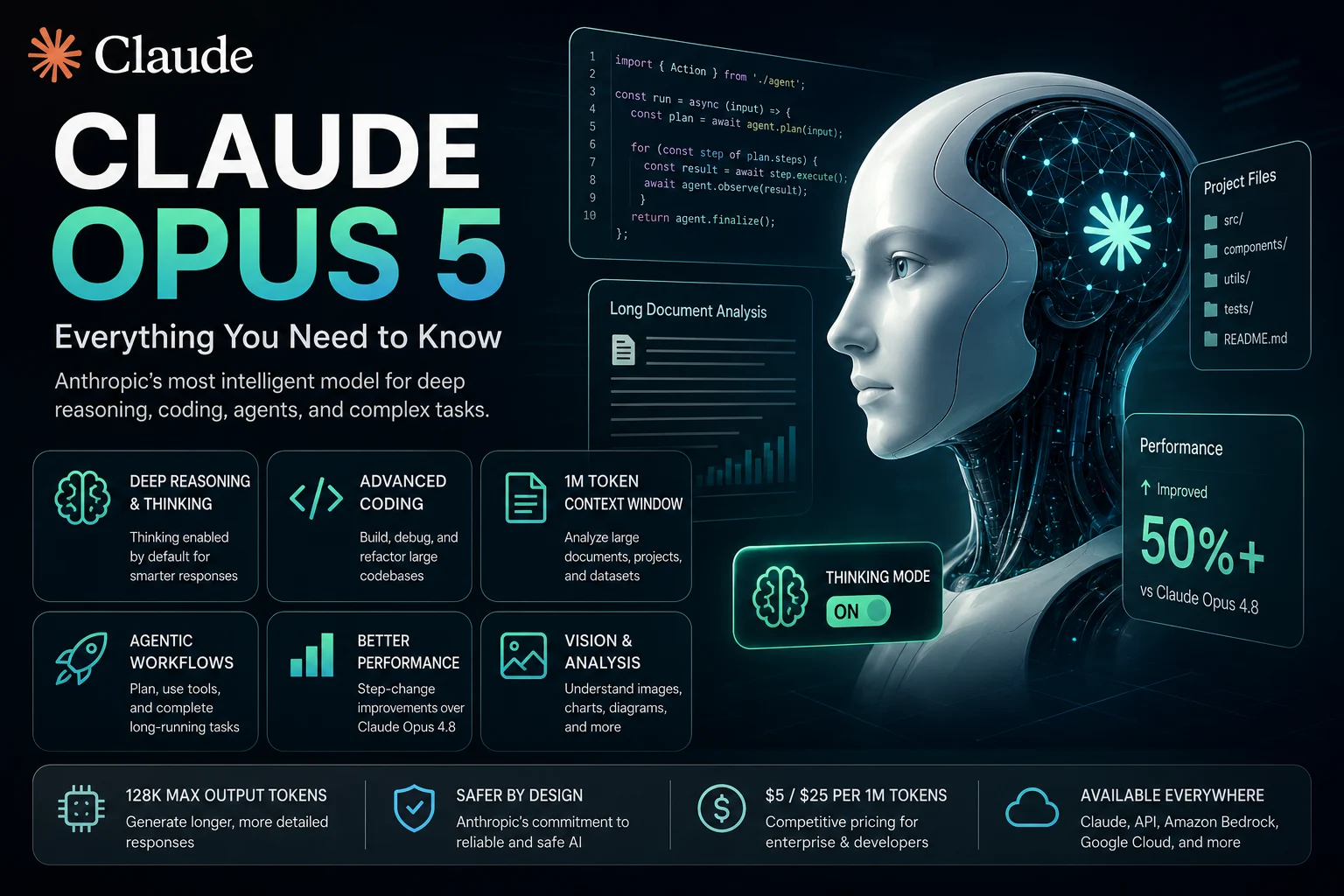
One of the biggest changes is that Claude Opus 5 has a 1 million token context window, supports up to 128,000 output tokens, and uses thinking by default. This makes it particularly suitable for large codebases, lengthy documents, complex research projects, and multi-step AI agent workflows.
In this guide, we'll explain what Claude Opus 5 is, what it can do, its key features, pricing, context window, coding capabilities, reasoning modes, API availability, and how it compares with previous Claude models.
What Is Claude Opus 5?
Claude Opus 5 is Anthropic's latest Opus-class AI model. It is designed for users who need more than basic chat, writing, or simple code generation.
The model focuses heavily on deep reasoning, agentic coding, long-horizon tasks, document analysis, research, and complex professional workflows.
Claude Opus 5 can reason through multi-step problems, use tools, analyze large amounts of context, work across multiple files, review its own work, and continue working through complicated tasks without losing track of the overall objective.
The model is available through Claude, the Claude API, and major cloud platforms, making it accessible to both individual users and developers building AI-powered applications.
Model ID: claude-opus-5
What's New in Claude Opus 5?
Claude Opus 5 introduces several important improvements compared with previous Opus models.
- 1 million token context window
- 128,000 maximum output tokens
- Thinking enabled by default
- Adaptive reasoning and effort controls
- Stronger agentic coding
- Improved long-horizon task performance
- Better code review and bug detection
- Improved vision capabilities
- Stronger document and office-work capabilities
- Improved multi-agent coordination
- Mid-conversation tool changes in beta
- Fast mode on the Claude API
These improvements make Opus 5 particularly interesting for tasks where the AI needs to reason through multiple steps instead of simply producing a short response.
Claude Opus 5 Context Window
One of Claude Opus 5's most important technical features is its 1 million token context window.
The context window allows the model to work with extremely large amounts of information in a single interaction. This can be valuable when analyzing large codebases, lengthy reports, collections of documents, or complex projects.
Claude Opus 5 also supports up to 128,000 output tokens, allowing it to generate substantially larger responses when a task requires them.
The 1 million token context window is both the default and maximum context size for Opus 5 rather than being limited to a smaller standard context window.
What Can You Do With a Large Context Window?
- Analyze large software projects
- Review long documents
- Compare multiple reports
- Work with large research datasets
- Analyze extensive legal or business documents
- Maintain context during long coding tasks
- Process large collections of project files
A large context window does not automatically make every answer better. The quality of the instructions, source material, and task structure still matters.
Claude Opus 5 Thinking and Reasoning
Claude Opus 5 introduces an important behavioral change compared with Opus 4.8: thinking is enabled by default.
Instead of requiring developers to explicitly enable adaptive thinking for every request, Opus 5 can decide how much reasoning is appropriate for the task.
Developers can also control the amount of effort used by the model.
The available effort levels are:
- Low — Faster responses for simpler tasks
- Medium — Balanced reasoning and efficiency
- High — More computation for difficult tasks
- XHigh — Deeper reasoning for demanding problems
- Max — The deepest available reasoning level
This gives developers more control over the trade-off between speed, cost, and reasoning depth.
Claude Opus 5 for Coding
Coding is one of the areas where Claude Opus 5 is designed to provide major improvements.
The model is built for long-running software-development tasks that can involve multiple files, debugging, testing, refactoring, code review, and repeated tool use.
What Can Claude Opus 5 Do for Developers?
- Generate application code
- Understand large codebases
- Debug complex problems
- Find bugs
- Refactor multiple files
- Write automated tests
- Review pull requests
- Explain unfamiliar code
- Build frontend interfaces
- Work with APIs
- Use development tools
- Complete multi-step engineering tasks
The biggest advantage is not simply generating individual lines of code. Opus 5 is designed to maintain the broader context of a development task and continue working through multiple stages.
Claude Opus 5 for Large Codebases
Large software projects can require an AI assistant to understand relationships between files, dependencies, APIs, tests, configuration, and existing architecture.
Claude Opus 5's large context window and agentic capabilities make it suitable for these workflows.
For example, you can ask it to analyze an existing application, identify the files involved in a feature, implement the change, update related tests, run the test suite, investigate failures, and revise the implementation.
This is significantly different from asking an AI assistant to generate a single isolated function.
Claude Opus 5 for AI Agents
Claude Opus 5 is also designed for agentic workflows where an AI system needs to plan, use tools, inspect results, and continue working toward a goal.
An AI agent may need to perform many actions before completing a task. For example, a coding agent might inspect a repository, search files, modify code, run tests, examine errors, and make additional changes.
Opus 5 is designed to handle these longer sequences more reliably than previous models.
Examples of Agentic Tasks
- Software development
- Codebase migration
- Automated code review
- Research workflows
- Data analysis
- Document processing
- Business analysis
- Multi-step planning
- Tool-based automation
- Long-running project tasks
The model's ability to verify its work is particularly useful for agentic systems. Instead of immediately returning a result, an agent can inspect what it produced, identify problems, and make corrections.
Claude Opus 5 for Research
Claude Opus 5 can also be useful for research and analytical workflows.
Its large context window allows researchers to work with substantial amounts of source material, while its reasoning capabilities can help compare evidence and identify relationships between documents.
For example, a researcher could provide several reports and ask Claude to:
- Summarize each source
- Compare the findings
- Identify disagreements
- Extract important statistics
- Identify methodological differences
- Find potential limitations
- Organize the evidence into themes
- Create a structured research outline
Important research claims should still be verified against the original sources rather than being accepted solely because an AI model produces a confident answer.
Claude Opus 5 for Document Analysis
Claude Opus 5 can analyze large documents and help transform unstructured information into useful summaries and structured outputs.
Potential applications include:
- Business reports
- Research papers
- Financial documents
- Technical documentation
- Contracts
- Product specifications
- Meeting materials
- Long-form reports
Instead of asking for a generic summary, you can provide a specific analysis framework.
Analyze this document and provide the main argument, key findings, important evidence, limitations, risks, unanswered questions, and final conclusions. Separate information directly supported by the document from your own interpretation.
Claude Opus 5 Vision Capabilities
Claude Opus 5 also improves visual understanding and can work with images, charts, documents, diagrams, and visual interfaces.
This can be useful when a task involves more than plain text.
- Analyzing charts
- Understanding diagrams
- Inspecting documents
- Analyzing screenshots
- Understanding user interfaces
- Working with frontend designs
- Reviewing visual layouts
For software development, visual understanding can be especially useful when an AI coding agent needs to compare a generated interface with an expected design.
Claude Opus 5 Pricing
Claude Opus 5 is priced at the same base API rates as Claude Opus 4.8.
| Pricing | Cost |
|---|---|
| Input tokens | $5 per million tokens |
| Output tokens | $25 per million tokens |
The pricing makes Opus 5 considerably less expensive than Anthropic's higher-priced Fable-class model while targeting many of the same demanding professional workflows.
Anthropic also offers a Fast mode for Opus 5 on the Claude API. Fast mode provides substantially higher output speed but comes at a higher price than standard inference.
Claude Opus 5 vs Claude Opus 4.8
Claude Opus 5 is positioned as a major improvement over Claude Opus 4.8 rather than a minor update.
| Feature | Claude Opus 4.8 | Claude Opus 5 |
|---|---|---|
| Context window | Up to 1M tokens | 1M tokens |
| Maximum output | 128K tokens | 128K tokens |
| Thinking | Optional adaptive thinking | Enabled by default |
| Deep reasoning | Strong | Significantly improved |
| Agentic coding | Strong | Improved |
| Long-horizon tasks | Strong | Improved |
| API input price | $5 / 1M tokens | $5 / 1M tokens |
| API output price | $25 / 1M tokens | $25 / 1M tokens |
The most important difference is therefore not a dramatic increase in the basic context size or API price. The major improvement is how effectively Opus 5 uses reasoning and computation for difficult tasks.
Claude Opus 5 vs Claude Sonnet 5
Claude Opus 5 and Claude Sonnet 5 serve different purposes.
Sonnet 5 is designed to provide strong performance at a lower cost and is particularly attractive for everyday AI use and many agentic workloads.
Opus 5 is aimed at more demanding tasks where deeper reasoning, long-horizon execution, and maximum capability are more important.
| Use Case | Better Choice |
|---|---|
| Everyday AI assistance | Claude Sonnet 5 |
| High-volume workloads | Claude Sonnet 5 |
| Complex reasoning | Claude Opus 5 |
| Large codebases | Claude Opus 5 |
| Long-running agents | Claude Opus 5 |
| Cost-sensitive applications | Claude Sonnet 5 |
Claude Opus 5 for Professional Work
Claude Opus 5 is not limited to software development. Its capabilities can also be useful for professional knowledge work.
Potential applications include:
- Financial analysis
- Business research
- Legal document analysis
- Data analysis
- Strategy development
- Technical writing
- Research synthesis
- Presentation creation
- Spreadsheet analysis
- Operational automation
The model can be especially valuable when a task requires combining information from multiple sources and maintaining a consistent understanding throughout a long workflow.
Claude Opus 5 and Multi-Agent Workflows
Complex AI systems increasingly use multiple specialized agents instead of relying on one model to perform every task.
For example, one agent might research a topic, another might analyze the findings, and a third might verify the result.
Claude Opus 5 is designed to work effectively in these multi-agent workflows, including patterns where one agent produces an output and another agent checks it.
This can be useful for:
- Software engineering teams
- Research systems
- Business automation
- Document processing
- Data analysis pipelines
- AI-powered enterprise applications
How to Get Better Results From Claude Opus 5
Although Opus 5 is highly capable, clear instructions remain important.
Instead of:
Fix my application.
provide more context:
Analyze this React application and identify the cause of the checkout error. First inspect the relevant components and API calls. Then explain the root cause, make the smallest safe change, run the relevant tests, and verify that the existing checkout behavior has not been changed unnecessarily.
A strong Opus 5 prompt should usually include:
- The objective
- Relevant project context
- Constraints
- Expected behavior
- Available tools
- Required output
- Testing requirements
- Security requirements
- Success criteria
Important Behavior Changes for Developers
Developers migrating from Claude Opus 4.8 should be aware that Opus 5 changes how thinking works.
Thinking is enabled by default, meaning applications that previously ran without thinking may behave differently after switching models.
Developers should also review token limits because the maximum output token setting applies to both the model's reasoning and visible response.
When migrating an existing application, test important prompts and workflows rather than assuming that every Opus 4.8 interaction will behave identically.
Claude Opus 5 API
Developers can access Claude Opus 5 through the Claude API using the model ID:
claude-opus-5The model is also available through supported cloud platforms, including Amazon Bedrock, Google Cloud, and Microsoft Foundry.
This allows developers to integrate Opus 5 into applications, coding agents, research systems, enterprise workflows, and other AI-powered products.
Who Should Use Claude Opus 5?
Claude Opus 5 is best suited to users who regularly work on complex tasks where higher reasoning quality is worth the additional computation.
Developers
Developers working on large applications, difficult debugging problems, multi-file refactoring, code review, and autonomous coding workflows can benefit from Opus 5.
Researchers
Researchers can use the model to analyze large collections of documents, compare evidence, summarize research, and structure complex findings.
Businesses
Businesses can use Opus 5 for knowledge work, document analysis, financial workflows, research, automation, and complex internal processes.
AI Developers
Developers building AI agents can use Opus 5 when their systems require strong reasoning, tool use, long context, and reliable multi-step execution.
Who Should Not Use Claude Opus 5?
Opus 5 is not necessarily the best choice for every AI task.
If your application generates millions of simple requests where latency and cost are more important than maximum reasoning capability, a smaller or less expensive model may be more appropriate.
For simple summarization, classification, extraction, or basic content generation, using the most capable model available can be unnecessary.
The best approach is to match the model to the difficulty of the task.
Claude Opus 5 Strengths
- Excellent deep reasoning capabilities
- Strong agentic coding performance
- Large 1M token context window
- 128K maximum output
- Strong long-horizon task performance
- Improved self-verification
- Strong document analysis
- Improved visual understanding
- Flexible reasoning effort levels
- Competitive API pricing for an Opus-class model
Claude Opus 5 Limitations
Despite its capabilities, Claude Opus 5 is not perfect.
- More reasoning can increase latency
- High-effort tasks can consume more tokens
- AI-generated information still requires verification
- Complex agent workflows can introduce unexpected behavior
- Large context does not guarantee perfect understanding
- Developers must review model-specific behavior when migrating applications
- Some security-related requests are subject to additional safeguards
The model should therefore be treated as a powerful assistant rather than an infallible autonomous system.
Final Verdict
Claude Opus 5 is a major upgrade to Anthropic's Opus family, with its biggest improvements focused on deep reasoning, agentic coding, long-running tasks, and the efficient use of additional computation.
Its 1 million token context window and 128,000-token maximum output make it particularly well suited to large projects and information-heavy workflows.
For developers, Opus 5 is especially interesting for complex coding tasks, large codebases, debugging, code review, refactoring, and AI agents that need to work through multiple steps.
For researchers and professionals, the model can help analyze documents, synthesize information, perform complex analysis, and work through demanding knowledge tasks.
At $5 per million input tokens and $25 per million output tokens, Claude Opus 5 also keeps the same base API pricing as Opus 4.8 while delivering substantial capability improvements.
The best reason to use Claude Opus 5 is not simply that it is a newer model. Its real advantage is the ability to handle difficult tasks that require sustained reasoning, tool use, context, verification, and multiple steps.
For simple tasks, a faster and less expensive model may be enough. For complex problems where quality matters more than minimizing every token, Claude Opus 5 is one of the strongest options available in 2026.
Frequently Asked Questions
What is Claude Opus 5?
Claude Opus 5 is Anthropic's latest high-capability Opus model, designed for deep reasoning, coding, AI agents, research, document analysis, and complex professional workflows.
When was Claude Opus 5 released?
Anthropic released Claude Opus 5 on July 24, 2026.
What is the context window of Claude Opus 5?
Claude Opus 5 has a 1 million token context window, which allows it to work with very large amounts of information in a single interaction.
What is the maximum output of Claude Opus 5?
Claude Opus 5 supports up to 128,000 output tokens.
How much does Claude Opus 5 cost?
Claude Opus 5 costs $5 per million input tokens and $25 per million output tokens on the standard Claude API.
Is Claude Opus 5 good for coding?
Yes. Claude Opus 5 is designed for complex software engineering, including large codebases, debugging, refactoring, testing, code review, and long-running agentic coding tasks.
Is Claude Opus 5 better than Opus 4.8?
Yes. Anthropic positions Opus 5 as a step-change improvement over Opus 4.8, particularly in deep reasoning, agentic coding, long-horizon tasks, code review, and test-time compute scaling.
Does Claude Opus 5 have thinking enabled by default?
Yes. Claude Opus 5 uses thinking by default. Developers can control reasoning depth through effort levels ranging from low to max.
Can Claude Opus 5 analyze large documents?
Yes. Its 1 million token context window makes it particularly suitable for analyzing large documents, reports, research materials, and collections of source information.
Can Claude Opus 5 build AI agents?
Yes. Claude Opus 5 is designed for agentic workflows involving planning, tool use, multi-step execution, verification, and long-running tasks.
Is Claude Opus 5 available through an API?
Yes. Developers can access the model through the Claude API using the model ID claude-opus-5. It is also available through supported cloud platforms.
Should I use Claude Opus 5 for every AI task?
No. Opus 5 is best suited to demanding tasks where its stronger reasoning and agentic capabilities provide meaningful value. Simpler tasks may be better handled by faster and less expensive models.
Is Claude Opus 5 free?
Claude Opus 5 is available through Claude plans and developer platforms with usage limits and pricing that depend on the product and plan. API usage is billed according to token consumption.