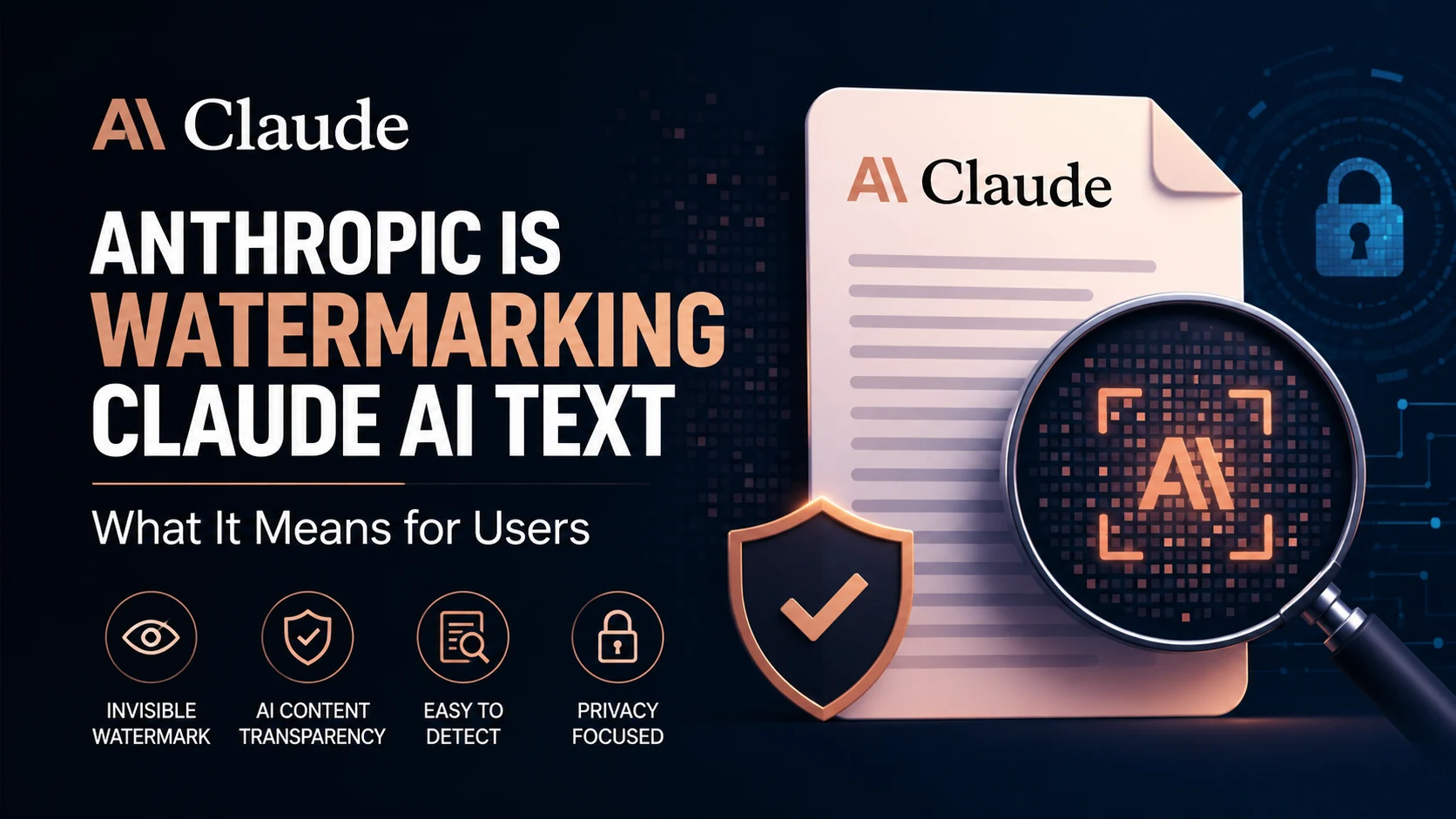

Anthropic is introducing a new way to identify content produced by Claude. Future Claude models will generate text containing an invisible watermark designed to help determine whether Claude was involved in producing the content.
Anthropic announced the technology on August 14, 2026, explaining that the change is part of its efforts to comply with the European Union's AI transparency requirements. The company says the watermark is designed to be invisible to readers and should not change the meaning or readability of the generated text.
What Is the Claude AI Watermark?
The Claude watermark is an imperceptible statistical pattern embedded directly into generated text. Unlike a visible label or simple piece of metadata, the watermark is incorporated into the model's text-generation process.
Anthropic says this allows authorized detection systems to estimate whether Claude was involved in producing a piece of text.
How Does Claude's Watermark Work?
The system works by subtly influencing the model's choice between words that are similarly appropriate in a given context. Over a sufficiently long piece of text, these small choices can create a statistical pattern that can be detected using the appropriate watermark key.
The important point is that users do not see a special symbol, label, or notification in the text. The watermark is designed to remain invisible while providing a machine-detectable signal.
Does the Watermark Change Claude's Writing?
Anthropic says the watermark is designed not to affect the meaning, quality, or readability of Claude's responses.
However, watermarking necessarily introduces constraints into the model's token-selection process. This means the system is making additional statistical considerations when selecting among possible words and phrases.
For normal users, the practical goal is for those changes to be small enough that the output remains natural and useful.
Will the Claude Watermark Survive Copy and Paste?
Yes. Because the watermark is embedded in the text-generation process rather than being simple file metadata, it can travel with text when users copy and paste it into another document or website.
Anthropic also says that the watermark may persist through some forms of editing. However, it should not be treated as an infallible AI detector.
Can Editing Remove the Watermark?
Anthropic acknowledges that substantial rewriting can make detection more difficult. A complete rewrite can potentially remove the statistical pattern because the original Claude-generated wording is no longer present.
This is an important limitation. A watermark detector can help determine whether Claude was likely involved with a piece of text, but an absence of a watermark does not automatically prove that a human wrote the content.
Why Is Anthropic Adding Watermarks to Claude?
The main reason is AI transparency.
The European Union's AI Act includes transparency requirements for certain AI-generated content. Anthropic says its watermarking approach is part of its commitments under the transparency framework associated with the EU AI Act.
Rather than using a visible label that readers could easily remove, Anthropic is using a machine-detectable approach that is incorporated into the model's output.
Does the Watermark Contain Personal Information?
No. Anthropic says the watermark is designed to identify the likelihood that Claude was involved in generating the text rather than identifying the individual user who generated it.
In other words, the watermark should not be interpreted as a hidden user ID or a personal tracking mechanism.
What About Claude Code?
The watermarking approach also raises questions about AI-assisted programming. Code generated by Claude can contain natural-language elements such as comments and documentation, but programming languages themselves provide a different environment from ordinary prose.
Anthropic has explained that watermarking is not equally applicable to every type of code output, making AI-assisted programming an area that requires additional consideration.
What About Images and Files?
Anthropic is also using provenance technology for supported generated files. For compatible image formats, the company uses signed provenance metadata based on the C2PA standard.
This is different from the statistical watermark used for text. Provenance metadata can provide information about how a file was produced and whether its provenance information has been altered.
What Does This Mean for Claude Users?
For most Claude users, the biggest change is that AI-generated text may become easier for authorized systems to identify.
- Copying Claude text into another document does not necessarily remove the watermark.
- Light editing may not eliminate the signal.
- Major rewriting can make detection more difficult.
- The watermark is invisible during normal reading.
- The system is designed to indicate possible Claude involvement rather than identify a specific person.
Is Claude's Watermark an AI Detector?
Not exactly.
A watermark detector and a conventional AI detector are different technologies. Traditional AI detectors generally analyze linguistic characteristics and attempt to estimate whether text was generated by an AI model.
Claude's watermark is different because it is intentionally inserted during generation. This gives a detection system a specific signal to look for rather than requiring it to guess solely from writing style.
However, the technology still has limitations. Detection results should not automatically be interpreted as definitive proof of authorship.
Why This Matters for AI-Generated Content
Claude's watermarking system could become an important development in the broader effort to establish the origin of AI-generated content.
As AI writing becomes increasingly difficult to distinguish from human writing, technology that provides machine-readable signals could help publishers, platforms, educators, businesses, and other organizations understand whether AI systems were involved in creating content.
At the same time, watermarking raises questions about how AI-assisted work should be treated. Someone might use Claude to improve grammar, translate a paragraph, summarize information, or edit an existing document without asking Claude to create the original ideas.
That makes the distinction between AI-generated and AI-assisted content increasingly important.
Claude Watermark vs Traditional AI Detection
| Feature | Claude Watermark | Traditional AI Detector |
|---|---|---|
| How it works | Embedded during generation | Analyzes the finished text |
| Visible to readers | No | No |
| Designed specifically for Claude | Yes | Usually analyzes multiple AI models |
| Survives copy and paste | Designed to | Not applicable |
| Can prove human authorship when absent? | No | No |
What Happens Next?
Anthropic's move could encourage other major AI companies to adopt similar approaches as AI transparency requirements become more important.
For users, the larger trend is clear: AI-generated content is moving toward a future where its origin can increasingly be identified by machines.
That does not mean every piece of AI-assisted writing will automatically be considered deceptive or problematic. Instead, the technology could provide another signal that organizations can use when deciding how AI-generated content should be handled.
Final Thoughts
Anthropic's Claude watermark is an important step in the evolution of AI-generated content. The technology attempts to balance transparency with usability by embedding an invisible statistical signal into Claude's generated text.
For everyday Claude users, the change should not dramatically alter how the chatbot works. But for publishers, businesses, educators, developers, and anyone using Claude to create professional content, understanding how AI provenance works is becoming increasingly important.
As OpenAI, Google, Meta, Anthropic, and other AI companies respond to new transparency standards, AI watermarking could become a normal part of how generated content is created and identified.
Frequently Asked Questions
Does Claude watermark every response?
Anthropic says future Claude models will generate text containing an imperceptible watermark as part of its AI transparency approach.
Can people see the Claude watermark?
No. The watermark is designed to be invisible to normal readers and detectable by appropriate technical systems.
Can copying Claude text remove the watermark?
Copying and pasting the text does not necessarily remove the watermark because the signal is embedded in the generated text itself.
Does the Claude watermark identify the user?
No. Anthropic describes the watermark as a signal indicating possible Claude involvement, not as a personal identifier.
Can Claude watermarks be removed?
Substantial rewriting can make the watermark harder to detect. Therefore, watermark detection should not be considered an infallible method of determining authorship.