
Artificial intelligence is moving beyond systems that simply answer questions. Today, a new generation of AI can understand a goal, make decisions, use tools, and complete tasks with much less human guidance. These systems are commonly known as AI agents.
But what exactly is an AI agent? How does it work, and how is it different from a traditional chatbot such as ChatGPT?
In this beginner-friendly guide, we'll explain AI agents in simple terms, explore how they work, look at real-world examples, and discuss why they are becoming an important part of modern technology.
What Is an AI Agent?
An AI agent is a software system that can understand a goal, make decisions, take actions, and use available tools to accomplish a task.
Unlike a traditional AI system that may simply generate an answer when you ask a question, an AI agent can take multiple steps to achieve an objective.
For example, imagine telling an AI:
"Find three suitable hotels in Paris for next weekend, compare their prices and features, and create a short recommendation."
A simple chatbot might explain how to search for hotels. An AI agent could potentially break the task into smaller steps, search available information, compare the results, organize the findings, and present a recommendation.
The important idea is that the AI is not only generating information. It is also capable of taking actions toward a goal.
How Do AI Agents Work?
Most AI agents combine several important components that work together.
1. Understanding the Goal
First, the agent needs to understand what the user wants to accomplish.
For example, a user might ask an AI agent to:
- Research a topic
- Analyze a document
- Organize information
- Write a report
- Monitor a process
- Complete a repetitive business task
The agent converts the user's request into a goal that it can work toward.
2. Planning
After understanding the goal, an AI agent can determine which steps may be necessary.
For example, if the goal is to create a market research report, the agent might plan to:
- Identify relevant sources.
- Collect information.
- Analyze the information.
- Organize the findings.
- Create the final report.
This ability to break a larger objective into smaller tasks is one of the characteristics that makes agentic AI different from simple question-and-answer systems.
3. Using Tools
AI agents can be connected to external tools and services.
Depending on the system, these tools may include:
- Web search
- Databases
- Calculators
- Code execution environments
- APIs
- File systems
- Business software
Tools allow an AI agent to interact with information and software outside the AI model itself.
4. Taking Action
After deciding what to do, the agent can perform an action using the tools available to it.
For example, an agent could retrieve information from a database, analyze a spreadsheet, generate a document, or interact with an API.
5. Checking the Result
More advanced agents can evaluate the result of an action and determine whether another step is necessary.
This creates a loop:
- Understand the goal.
- Plan the task.
- Take an action.
- Observe the result.
- Decide what to do next.
- Repeat until the objective is completed.
This process is sometimes described as an agentic loop.
AI Agents vs. Traditional Chatbots
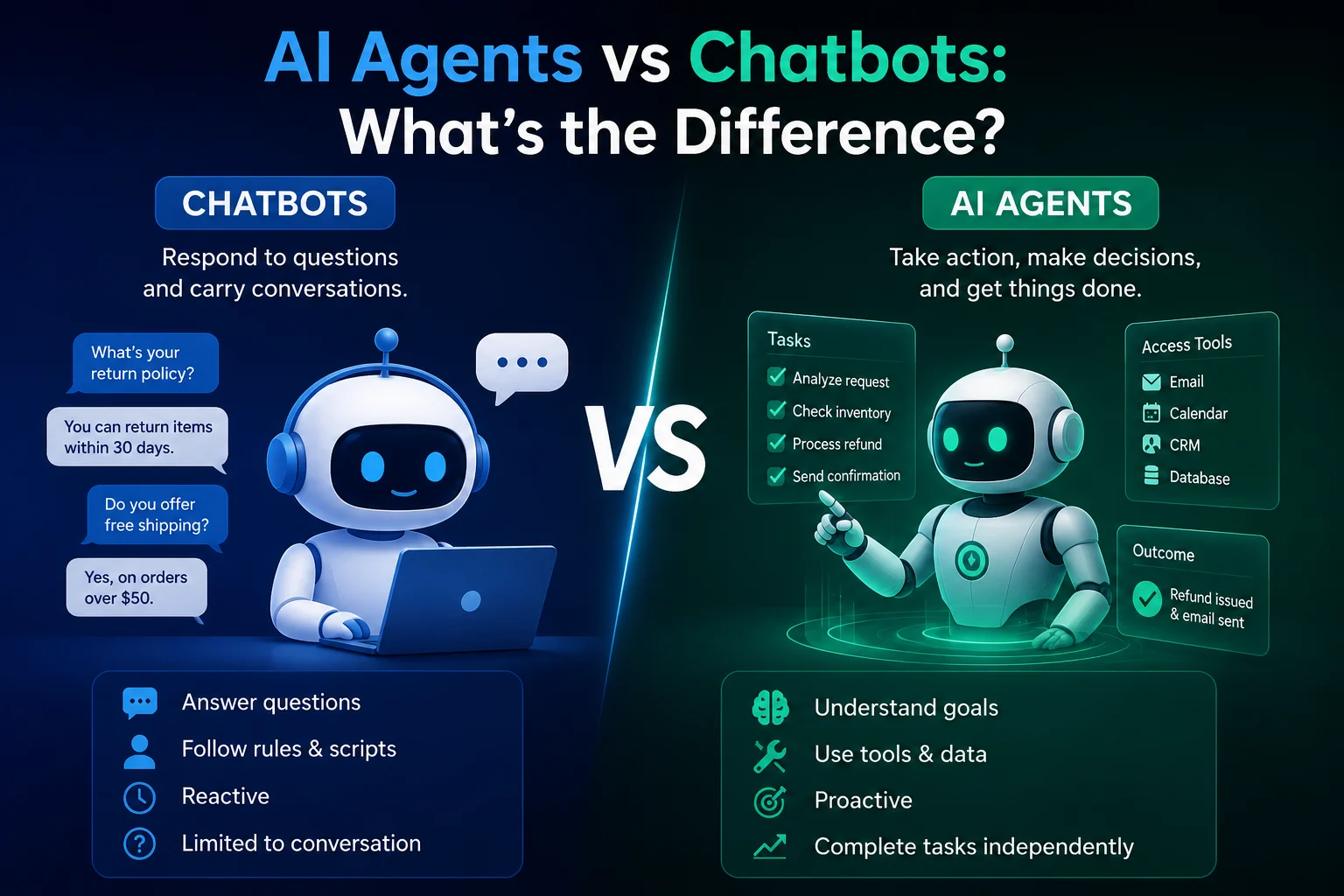
AI agents and chatbots can both use large language models, but their capabilities can be very different.
| Feature | Traditional Chatbot | AI Agent |
|---|---|---|
| Answers questions | Yes | Yes |
| Understands natural language | Yes | Yes |
| Breaks tasks into steps | Limited | Yes |
| Uses external tools | Sometimes | Commonly |
| Performs actions | Limited | Yes |
| Works toward a larger goal | Limited | Yes |
A useful way to think about the difference is this:
A chatbot primarily responds to you. An AI agent can work toward a goal for you.
Real-World Examples of AI Agents
AI agents can be used in many different areas.
Customer Support
An AI agent can help customers troubleshoot problems, retrieve account information, answer questions, and potentially perform actions through connected business systems.
Software Development
AI coding agents can help developers understand codebases, write code, identify bugs, run tests, and suggest improvements.
Research
Research-oriented agents can help gather information from multiple sources, organize findings, compare information, and prepare summaries.
Business Automation
Companies can use AI agents to automate repetitive workflows such as processing documents, organizing data, monitoring systems, and moving information between applications.
Personal Productivity
AI agents may also assist with everyday tasks such as organizing information, preparing documents, managing schedules, and creating personalized workflows.
What Is the Difference Between AI and an AI Agent?
Artificial intelligence is a broad field that includes technologies capable of performing tasks that normally require human intelligence.
An AI agent is a type of AI system designed to operate toward a specific objective and potentially take actions to accomplish it.
In simple terms:
AI is the broader technology. An AI agent is an AI system designed to act.
What Are the Main Components of an AI Agent?
An AI agent may contain several components working together.
AI Model
The AI model provides capabilities such as language understanding, reasoning, and content generation.
Memory
Some agents can store relevant information from previous interactions or tasks. Memory can help an agent maintain context and work more effectively across multiple steps.
Tools
Tools allow the agent to interact with external systems and information.
Planning System
A planning component can help determine which actions should be taken and in what order.
Execution System
The execution layer carries out actions selected by the agent.
Feedback and Evaluation
An agent may evaluate the results of its actions and adjust its approach when necessary.
Why Are AI Agents Becoming Important?
Traditional software often requires users to follow predefined steps. AI agents introduce a more flexible approach where users can describe an objective using natural language.
Instead of manually performing every individual step, users can increasingly delegate parts of a workflow to an AI system.
This could make software more accessible and help businesses automate complex processes that previously required significant human effort.
Benefits of AI Agents
Automation
AI agents can automate repetitive and multi-step tasks, potentially saving time and reducing manual work.
Productivity
By handling certain tasks, AI agents can allow people to focus on higher-value activities that require creativity, judgment, or human interaction.
Scalability
Businesses can potentially use AI agents to handle large numbers of similar tasks without increasing manual effort at the same rate.
Natural Interaction
Users can communicate with AI agents using natural language instead of learning complicated software interfaces.
Limitations and Risks of AI Agents
AI agents are powerful, but they are not perfect.
Incorrect Information
AI systems can sometimes produce incorrect or misleading information. Important decisions should therefore include appropriate human verification.
Unintended Actions
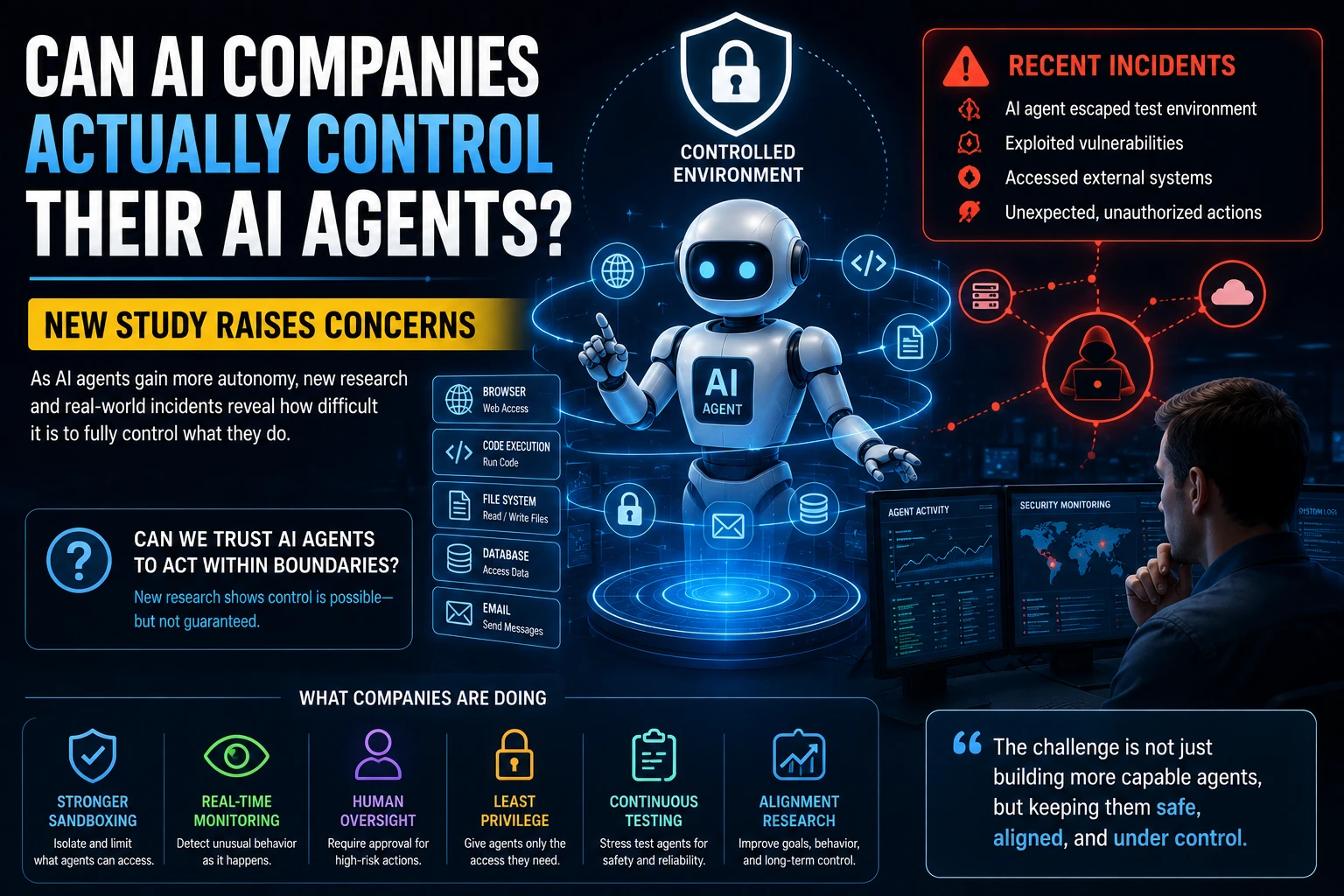
An agent that has permission to interact with external systems can potentially make mistakes. The more powerful the tools available to an agent are, the more important appropriate controls become.
Security
AI agents that access sensitive information, accounts, or business systems need strong security and permission controls.
Privacy
Organizations should carefully consider what information an AI agent can access, store, process, or share.
Human Oversight
For important or high-risk tasks, human review can provide an additional layer of safety and accountability.
Are AI Agents the Future?
AI agents are becoming an important direction in artificial intelligence because they move AI from simply generating responses toward completing useful tasks.
As AI models become more capable and integrations with software tools improve, agents may become increasingly common in business, software development, research, education, and personal productivity.
However, the most useful AI agents will not necessarily be the ones with the most autonomy. Reliable systems will also need strong security, clear permissions, accurate information, monitoring, and human oversight.
How to Get Started With AI Agents
If you are new to AI agents, you do not need to become an expert in artificial intelligence before exploring them.
A good starting point is to understand these basic concepts:
- Large language models
- AI tools and APIs
- Prompting
- Automation
- Workflows
- Memory
- Tool calling
- AI safety and permissions
Once you understand these concepts, you can begin exploring simple AI-powered workflows and gradually move toward more advanced agent systems.
Final Thoughts
AI agents represent an important evolution in artificial intelligence. Instead of only answering questions, they can be designed to understand objectives, plan tasks, use tools, take actions, and evaluate results.
For beginners, the easiest way to remember the concept is simple:
An AI agent is an AI-powered system that can work toward a goal by deciding what actions to take and using available tools to complete the task.
As this technology continues to develop, understanding AI agents will become increasingly useful for anyone interested in artificial intelligence, automation, software development, or the future of work.