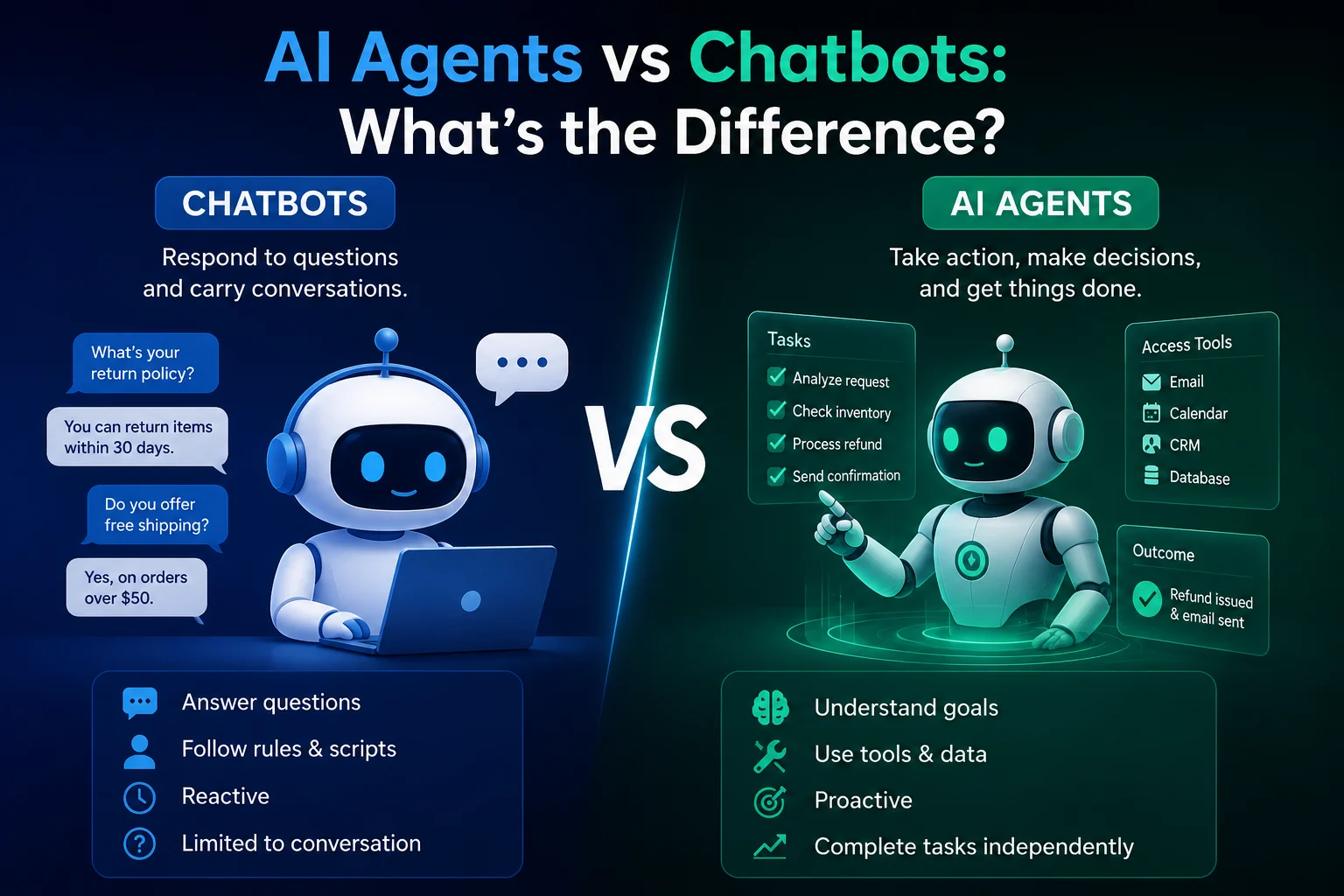

Artificial intelligence is changing the way we interact with software. Two terms you will often hear are AI agents and AI chatbots. While they may seem similar, they are designed to do different things.
Chatbots are primarily built to communicate with users, answer questions, and provide information. AI agents can go further by planning tasks, using tools, making decisions, and taking actions with limited human intervention.
In this guide, you'll learn the difference between AI agents and chatbots, how they work, their main use cases, and when you should use each one.
What Is an AI Chatbot?
An AI chatbot is a software application that uses artificial intelligence to communicate with people through natural language.
Modern AI chatbots can understand questions, generate responses, summarize information, explain concepts, write content, and help users complete simple tasks.
Common chatbot capabilities include:
- Answering questions
- Writing and editing text
- Summarizing documents
- Translating languages
- Generating ideas
- Explaining complex topics
- Providing customer support
- Helping with research
A chatbot generally follows a conversational model: you ask → the chatbot processes your request → it responds.
For example, you could ask a chatbot:
"Summarize this article in five bullet points."
The chatbot processes your request and generates the answer.
What Is an AI Agent?
An AI agent is an AI-powered system designed to accomplish a goal by reasoning about a task, planning steps, using available tools, and taking actions.
Instead of simply responding to a question, an AI agent can potentially determine what needs to be done and execute multiple steps.
For example, instead of asking:
"What are the best flights from London to Paris?"
You could give an agent a broader goal:
"Find a suitable flight to Paris for next Friday and prepare the information I need to book it."
Depending on its tools and permissions, an AI agent could search for flights, compare options, collect relevant information, and guide you toward the next step.
The important difference is action.
A chatbot primarily communicates.
An AI agent can communicate, reason, plan, use tools, and act.
AI Agents vs Chatbots: The Main Difference
The simplest way to understand the difference is:
A chatbot answers. An AI agent works toward a goal.
| Feature | AI Chatbot | AI Agent |
|---|---|---|
| Conversation | Yes | Yes |
| Answers questions | Yes | Yes |
| Generates content | Yes | Yes |
| Plans multiple steps | Limited | Yes |
| Uses external tools | Sometimes | Often |
| Takes actions | Limited | Yes |
| Works toward a goal | Limited | Yes |
| Autonomous behavior | Low | Higher |
| Multi-step workflows | Limited | Strong |
The boundary isn't always strict. Some modern AI assistants combine chatbot and agent capabilities.
How AI Chatbots Work
A typical AI chatbot follows a relatively straightforward process.
1. You Provide an Input
You type a question, instruction, or request.
2. The AI Analyzes the Request
The system interprets the meaning of your message using an AI model.
3. The Model Generates a Response
The AI generates an appropriate response based on its model, context, and available information.
4. You Receive the Answer
The chatbot returns the generated response in the conversation.
This makes chatbots especially useful for tasks where the primary objective is communication and information exchange.
How AI Agents Work
AI agents generally involve more steps.
A simplified agent workflow looks like this:
Goal → Planning → Tool Use → Action → Evaluation → Next Action
For example, imagine you ask an AI agent to organize research for a project.
The agent might:
- Understand the objective.
- Break the objective into smaller tasks.
- Search for relevant information.
- Analyze the results.
- Organize the information.
- Identify missing information.
- Perform additional searches.
- Produce the final result.
The exact process depends on the agent's design, tools, permissions, and underlying AI model.
Key Differences Between AI Agents and Chatbots
1. Conversation vs Action
Chatbots are primarily conversation-oriented. They are excellent at answering questions and generating content.
AI agents are designed to combine conversation with action. An agent might receive a goal and then perform several operations to accomplish it.
2. Single-Step vs Multi-Step Tasks
Chatbots are often best suited to individual requests.
For example:
"Write a professional email about a delayed delivery."
An AI agent can be useful for workflows containing multiple steps.
For example:
"Review these customer complaints, categorize them, identify urgent issues, and prepare a report."
3. Tool Usage
Traditional chatbots may operate mostly within the conversation.
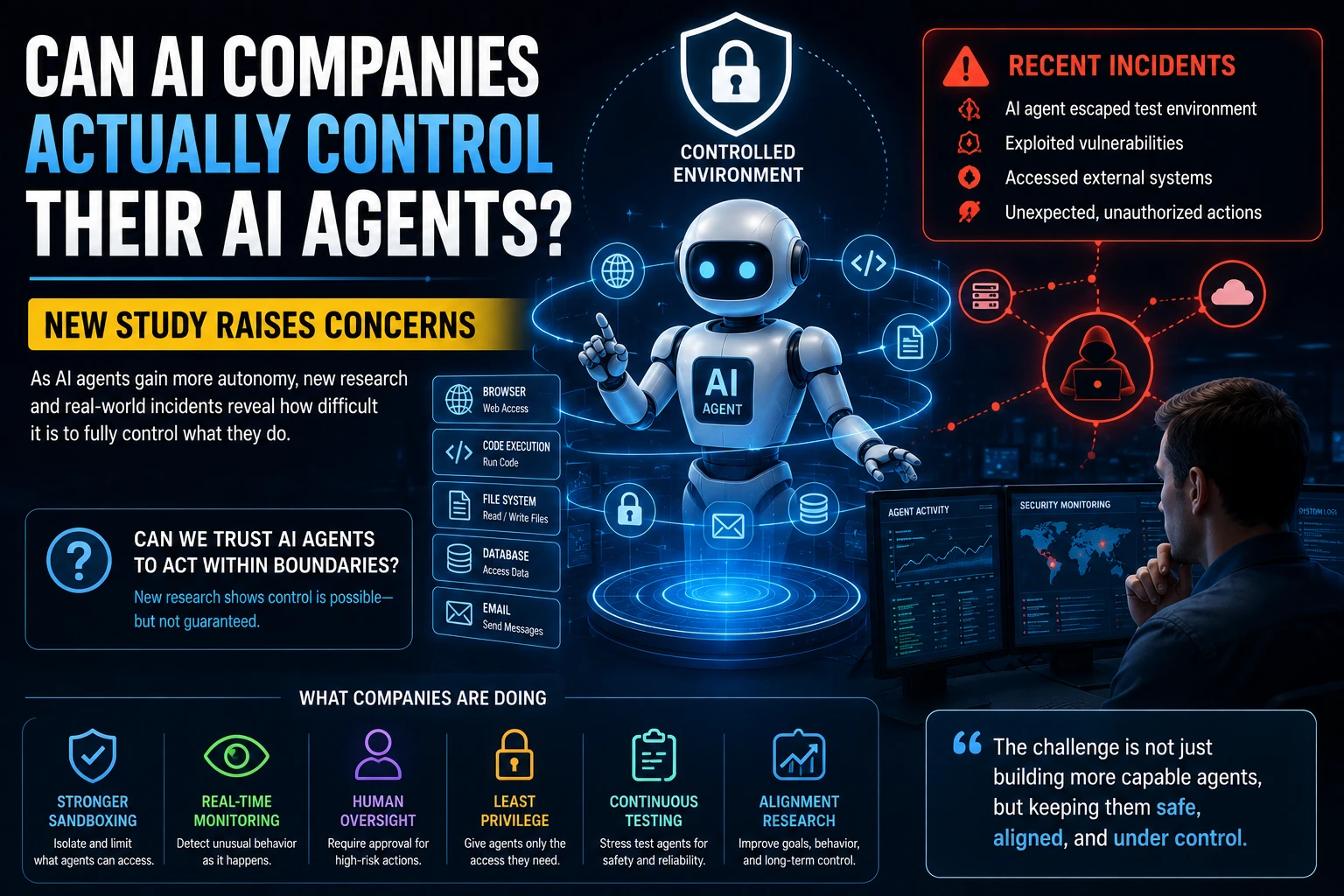
AI agents can be connected to external tools such as:
- Web search
- Databases
- APIs
- Calendars
- Email systems
- Business software
- Code execution environments
- File systems
Tool access allows agents to interact with systems outside the conversation.
4. Autonomy
A chatbot normally waits for your next message.
An AI agent can potentially continue working through a workflow after receiving a high-level objective.
This doesn't mean agents should have unlimited autonomy. In real-world applications, permissions, approval steps, monitoring, and security controls are important.
5. Goal-Oriented Behavior
Chatbots generally focus on responding to individual messages.
Agents are usually designed around a broader objective.
For example:
Chatbot: "Here are five ways to improve your website."
Agent: "Analyze my website, identify performance problems, prioritize improvements, and prepare a list of recommended changes."
The second example requires a workflow rather than just an answer.
Examples of AI Chatbots
AI chatbots can be useful for many everyday tasks.
Customer Support
A chatbot can answer frequently asked questions about:
- Orders
- Returns
- Shipping
- Products
- Account information
Education
Students can use chatbots to:
- Explain difficult concepts
- Generate practice questions
- Summarize lessons
- Improve writing
- Learn languages
Content Creation
Chatbots can help create:
- Blog outlines
- Social media posts
- Emails
- Product descriptions
- Marketing ideas
Personal Assistance
A chatbot can help users brainstorm, plan, explain information, and organize ideas.
Examples of AI Agents
AI agents are particularly useful for workflows that require several operations.
Research Agents
A research agent can search multiple sources, compare information, organize findings, and create a structured report.
Coding Agents
Coding agents can inspect a codebase, identify problems, write code, run tests, and suggest or implement fixes depending on their permissions.
Sales Agents
A sales agent could help qualify leads, update customer records, prepare follow-ups, and assist sales teams with repetitive workflows.
Business Automation
Agents can connect different applications and automate repetitive processes involving multiple systems.
Can a Chatbot Become an AI Agent?
Yes. A chatbot can become more agent-like when it gains capabilities such as:
- Tool access
- Memory
- Planning
- Task execution
- External API access
- Workflow management
- Decision-making
- Feedback loops
This is why the distinction between chatbots and agents can sometimes be confusing.
A modern AI system may look like a chatbot because you interact with it through a chat interface, while internally it may operate as an agent.
The interface does not necessarily define the system.
AI Assistant vs AI Agent
You may also hear the term AI assistant.
An AI assistant can refer to a broad category of AI software designed to help users complete tasks.
Some assistants are essentially chatbots, while others include agent-like capabilities.
For example:
AI assistant: "Help me prepare a presentation."
AI agent: "Create the presentation outline, research the required information, organize the slides, and prepare the final content."
The second example describes a more autonomous workflow.
When Should You Use a Chatbot?
A chatbot is usually a good choice when you need:
- Quick answers
- Explanations
- Brainstorming
- Writing assistance
- Summaries
- Translation
- Simple customer support
- Conversational assistance
If the task can be completed effectively through a single interaction, a chatbot may be all you need.
When Should You Use an AI Agent?
An AI agent becomes more useful when a task requires:
- Multiple steps
- External tools
- Repeated actions
- Data gathering
- Decision-making
- Workflow automation
- Interaction with other software
- A clearly defined objective
Agents are especially valuable when the task is repetitive and follows a predictable workflow.
Are AI Agents Better Than Chatbots?
Not necessarily. They solve different problems.
A chatbot can be simpler, easier to control, and less expensive to operate.
An AI agent can be more powerful for complex workflows, but greater autonomy also introduces additional challenges.
These can include:
- Incorrect actions
- Security risks
- Unexpected behavior
- Higher costs
- Tool failures
- Privacy concerns
- Difficulty monitoring complex workflows
The best choice depends on the task.
AI Agents vs Chatbots: A Simple Example
Imagine you run an online store.
A customer asks:
"Where is my order?"
A chatbot can check the available order information and provide an answer.
Now imagine the request is:
"Find all delayed orders, identify customers who need to be contacted, prepare personalized messages, and organize them for review."
This is much closer to an agent workflow because it involves multiple steps and potentially several tools.
The Future of AI Agents and Chatbots
The difference between chatbots and AI agents will likely become less obvious as AI systems become more capable.
Future AI assistants may combine:
- Natural language conversation
- Long-term context
- Planning
- Tool use
- Automation
- Personalization
- Real-time information
- Multi-step execution
Instead of thinking about chatbots and agents as completely separate technologies, it may be more useful to think of them as different levels of AI capability.
A simple chatbot primarily responds.
A more advanced AI system can reason and use tools.
An AI agent can potentially pursue a goal and take actions.
Final Thoughts
AI chatbots and AI agents are related, but they are not exactly the same.
Chatbots are primarily designed for conversation and responses, while AI agents are designed to accomplish goals through planning, tool use, and actions.
For simple questions, writing, explanations, and everyday assistance, a chatbot can be extremely useful.
For complex, repetitive, multi-step workflows, AI agents can provide much greater automation.
As AI technology continues to evolve, the most useful systems will likely combine the conversational abilities of chatbots with the planning and action capabilities of agents.
In simple terms: Chatbots talk with you. AI agents work for you.