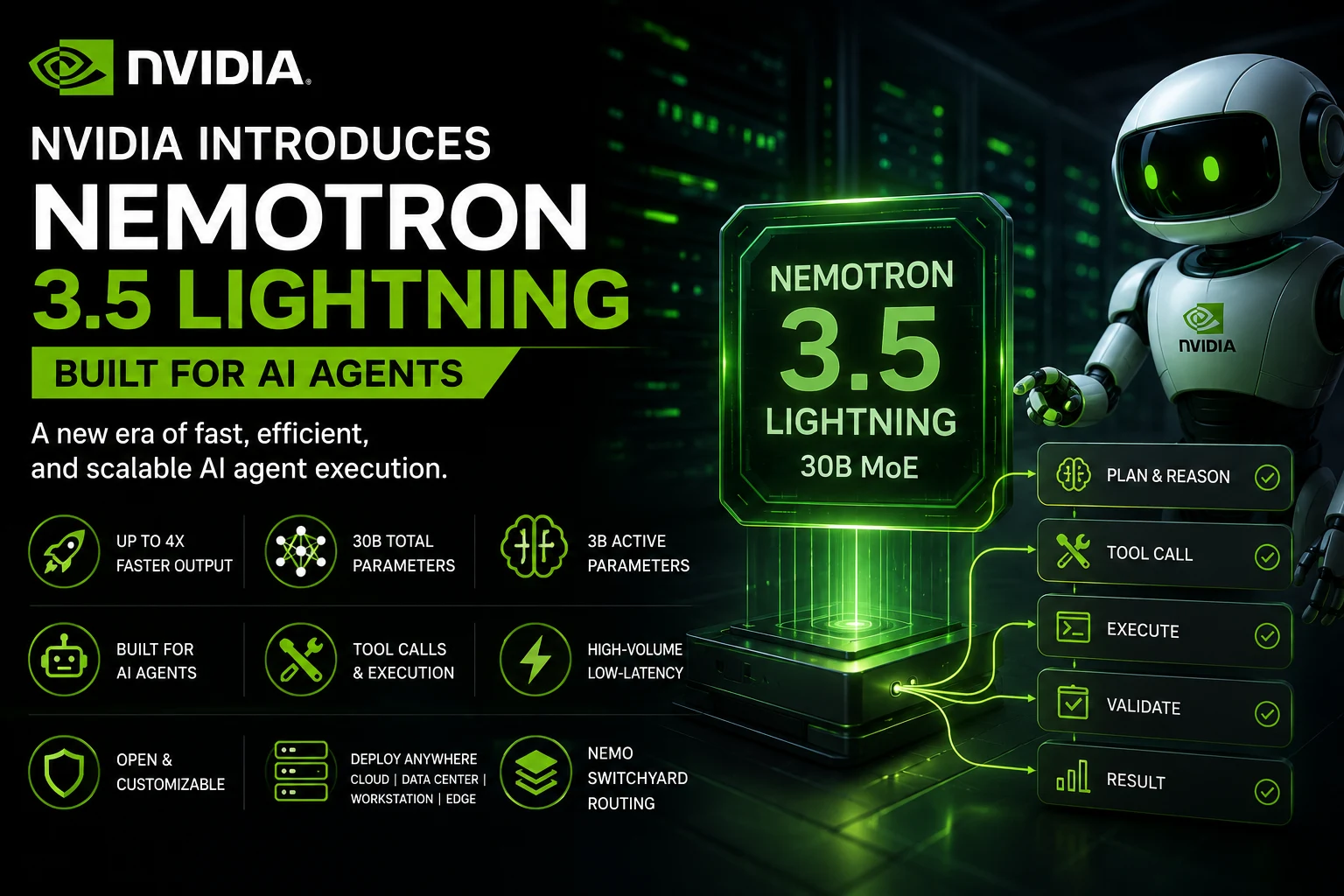

Nvidia has introduced Nemotron 3.5 Lightning, a new open AI model designed specifically to make long-running AI agents faster and more efficient.
Unlike general-purpose AI models that attempt to handle every part of an AI workflow, Nemotron 3.5 Lightning is focused on the execution layer of agentic systems. It is designed to handle repetitive, high-volume tasks such as tool calls, checking results, formatting information, and executing steps after a larger model has created a plan.
The model is part of Nvidia's broader strategy for building AI agents from multiple specialized models rather than relying on one large model for every task.
Nemotron 3.5 Lightning uses a 30-billion-parameter Mixture-of-Experts architecture with only 3 billion parameters active for each token. This design allows the model to provide the capacity of a larger model while reducing the amount of computation required for individual requests.
In this guide, we'll explain what Nvidia Nemotron 3.5 Lightning is, how it works, why Nvidia built it for AI agents, what makes it different from larger AI models, and what it could mean for the future of agentic AI.
What Is Nvidia Nemotron 3.5 Lightning?
Nemotron 3.5 Lightning is an open 30B Mixture-of-Experts AI model from Nvidia designed for high-volume specialized tasks inside long-running AI agents.
The model is not primarily positioned as a replacement for the largest reasoning models. Instead, Nvidia designed it to handle the repeated execution steps that occur after an AI agent has decided what it needs to do.
An AI agent may need to call APIs, inspect files, execute commands, validate results, format information, or delegate smaller tasks thousands of times during a long workflow.
Sending every one of these operations to a large frontier model can increase latency and computing costs. Nemotron 3.5 Lightning is designed to handle these repetitive operations more efficiently.
This creates a division of labor between AI models. Larger reasoning models can focus on planning and difficult decisions, while Nemotron 3.5 Lightning handles fast and repetitive execution.
Key Features of Nemotron 3.5 Lightning
Nvidia designed Nemotron 3.5 Lightning around the requirements of always-on AI agents and high-volume workloads.
- 30B total parameters — A large Mixture-of-Experts model with 3B active parameters per token
- Fast inference — Designed for low-latency and high-volume execution
- Agent-focused design — Built for tool calls, execution, validation, and repetitive tasks
- Open model — Designed to be customizable and deployable across different environments
- Speculative decoding — Uses techniques that can accelerate token generation
- Long context — Supports large context windows for complex workflows
- Local deployment — Can run on supported local NVIDIA hardware
- Multiple deployment options — Can be used across desktops, workstations, data centers, and cloud environments
Why Did Nvidia Build Nemotron 3.5 Lightning?
AI agents are becoming more complex.
A traditional chatbot may generate one answer after receiving a prompt. An AI agent can perform a sequence of actions before completing a task.
For example, a software development agent might:
- Understand a user's request.
- Inspect the project.
- Search files.
- Modify code.
- Run tests.
- Read test results.
- Fix errors.
- Run the tests again.
- Check the final changes.
- Prepare a response.
Many of these individual operations do not require the largest reasoning model available.
Using a powerful frontier model for every step can increase inference costs and slow down the overall workflow.
Nemotron 3.5 Lightning is designed to address this problem by acting as a specialized execution model.
Nemotron 3.5 Lightning Is Designed for AI Agents
The most important aspect of Nemotron 3.5 Lightning is its focus on agentic AI.
Long-running agents repeatedly interact with external tools and environments. They may execute commands, call APIs, retrieve information, inspect files, validate outputs, and communicate with other software systems.
Nvidia designed Lightning to handle these high-volume execution steps efficiently.
Instead of thinking about an AI agent as a single model, Nvidia's approach treats an agent as a system of specialized models.
A larger model can handle:
- Complex reasoning
- Planning
- Strategic decisions
- Task decomposition
- Complex problem solving
Nemotron 3.5 Lightning can then handle:
- Tool calls
- Result validation
- Information formatting
- Routine execution
- Subtask execution
- High-volume repetitive operations
This approach can reduce the amount of expensive reasoning required from larger models while keeping agents responsive.
30 Billion Parameters With 3 Billion Active Parameters
Nemotron 3.5 Lightning uses a Mixture-of-Experts architecture.
The model contains approximately 30 billion total parameters, but only around 3 billion parameters are active for each token.
This is an important distinction.
A traditional dense model generally uses its parameters for every token generated. A Mixture-of-Experts model can route different inputs through selected portions of the network.
This allows Nemotron 3.5 Lightning to maintain a larger overall model capacity while using fewer active parameters during individual inference operations.
For AI agents that generate many tokens and perform many repeated operations, reducing the active computation can be particularly valuable.
How Fast Is Nemotron 3.5 Lightning?
Speed is one of the main reasons Nvidia created Nemotron 3.5 Lightning.
Nvidia says the model can deliver up to four times faster output speed than comparable models in its class.
Nvidia also reports that Nemotron 3.5 Lightning achieved an 86% accuracy score on PinchBench and completed 10,000 tasks 30% faster than Qwen3.6 35B at a comparable level of accuracy.
These results are particularly relevant to AI agents because agent performance depends on more than the quality of a single answer.
If an agent performs thousands of individual operations, small improvements in execution speed can have a significant effect on the total time required to complete a workflow.
What Is Speculative Decoding?
Nemotron 3.5 Lightning uses techniques designed to accelerate token generation, including speculative decoding.
Speculative decoding allows a smaller draft model or prediction mechanism to propose tokens ahead of time. The main model can then verify those predictions more efficiently instead of generating every token independently.
Nvidia has also released draft-model options including DSpark and DFlash for different inference scenarios.
The goal is to increase token generation speed without sacrificing the quality of the final output.
Nemotron 3.5 Lightning and NeMo Switchyard
Nvidia introduced Nemotron 3.5 Lightning alongside NeMo Switchyard, an open model-routing system designed for multi-model AI architectures.
The idea is simple: different AI models can be used for different tasks.
A complex reasoning request may be sent to a powerful model, while a repetitive execution task can be routed to a faster specialized model such as Nemotron 3.5 Lightning.
This approach can allow developers to build AI systems that balance intelligence, speed, cost, and control.
Instead of asking one model to perform every operation, the system can choose the most appropriate model for each stage of a workflow.
How AI Agents Can Use Nemotron 3.5 Lightning
Nemotron 3.5 Lightning can be useful in many types of agentic workflows.
1. Coding Agents
Software development agents frequently perform repetitive operations such as searching files, running commands, checking test results, modifying code, and interacting with development tools.
A specialized execution model can help handle these repeated operations while a larger reasoning model remains responsible for planning and more complicated decisions.
2. Research Agents
Research agents can perform repeated searches, retrieve information, process documents, organize results, and validate intermediate outputs.
A fast execution model can potentially handle many of these repetitive operations without requiring the most expensive reasoning model for every step.
3. Data Processing Agents
AI agents working with business data may repeatedly retrieve records, transform information, validate results, and generate structured outputs.
Nemotron 3.5 Lightning can be used as part of a system where these high-volume operations are separated from complex reasoning.
4. Automation Agents
Business automation agents can interact with APIs, databases, internal applications, and other software tools.
Because these systems may execute many tool calls during a single workflow, inference efficiency becomes increasingly important.
5. Customer-Service Agents
Agentic customer-service systems can use multiple models for different stages of a conversation.
A larger model could handle complex reasoning while a specialized model handles routine classification, tool execution, information formatting, or other repetitive tasks.
Nemotron 3.5 Lightning for Local AI
One notable aspect of Nemotron 3.5 Lightning is its support for local deployment on compatible NVIDIA hardware.
Nvidia says the model can be deployed across environments including NVIDIA Jetson systems, GeForce RTX 5090-class hardware, DGX Spark, workstations, and data-center infrastructure.
Local deployment can be useful for developers and organizations that want more control over where their AI workloads run.
Running an AI model locally can also reduce dependence on external API services for certain workloads, although hardware requirements, performance, and operational complexity still need to be considered.
Nemotron 3.5 Lightning for Developers
Developers building AI applications can use Nemotron 3.5 Lightning as one component in a larger model architecture.
Instead of treating the model as a general chatbot, developers can assign it a specific role.
For example:
Use a large reasoning model to create the plan, then use Nemotron 3.5 Lightning to execute repetitive tool calls, validate intermediate results, and format the outputs.
This architecture can make an agent more efficient because each model is responsible for the type of work it handles best.
What Makes Nemotron 3.5 Lightning Different?
Many AI models are optimized primarily for general-purpose conversations, coding, reasoning, or multimodal tasks.
Nemotron 3.5 Lightning takes a more specialized approach.
Its primary focus is fast execution inside long-running AI systems.
| Feature | Nemotron 3.5 Lightning | Large Reasoning Model |
|---|---|---|
| Primary purpose | High-volume agent execution | Complex reasoning and planning |
| Architecture | Mixture-of-Experts | Varies by model |
| Total parameters | 30B | Often much larger |
| Active parameters | 3B per token | Depends on architecture |
| Agent execution | Strong focus | Usually broader |
| Tool calls | Designed for high-volume use | Supported by many models |
| Local deployment | Supported on compatible hardware | Depends on model and hardware |
Nemotron 3.5 Lightning vs Traditional AI Chatbots
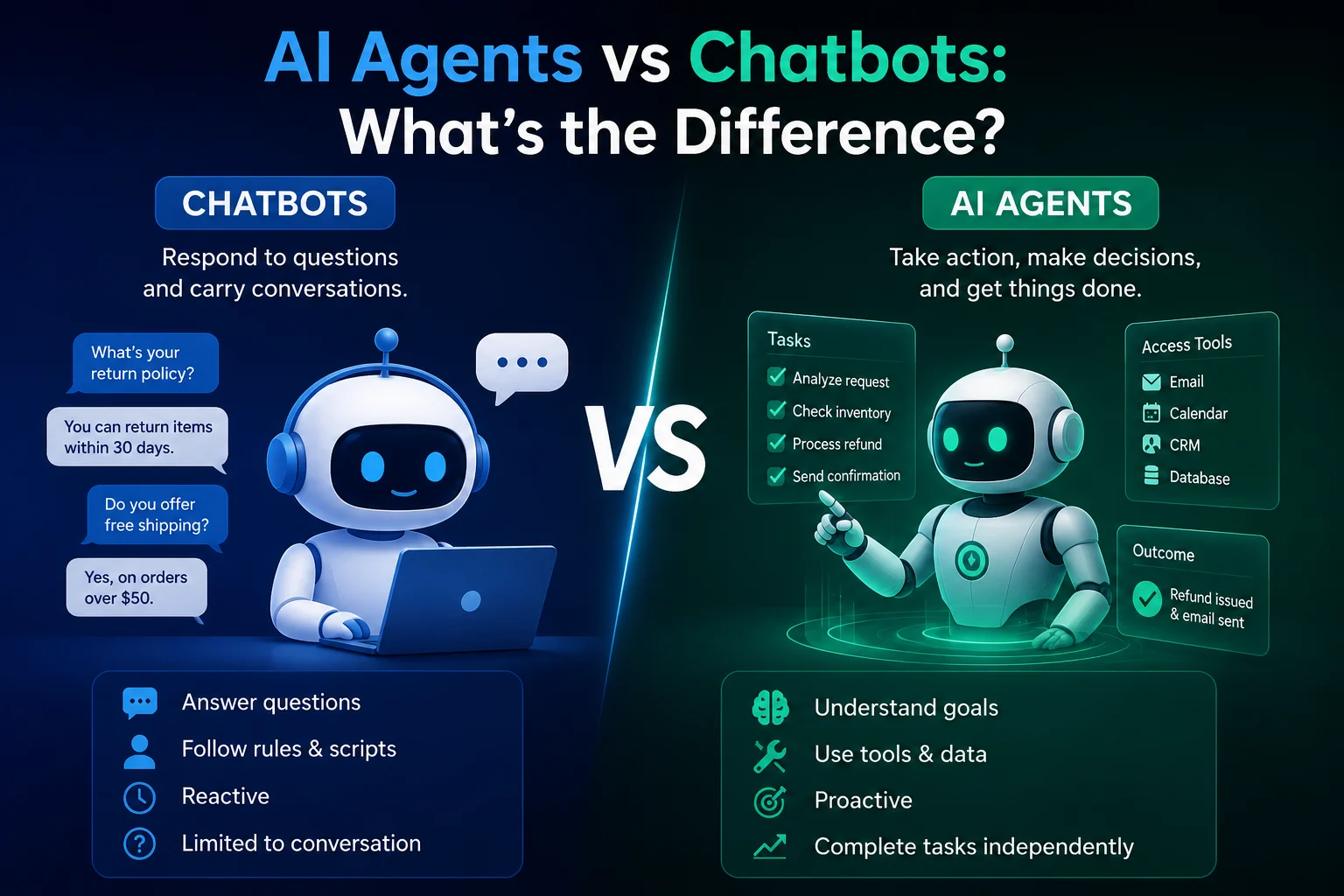
Traditional AI chatbots are generally designed to respond to individual user prompts.
AI agents are different because they can perform multiple actions to achieve a goal.
For example, a chatbot might answer:
How do I fix this JavaScript error?
An AI coding agent could instead inspect the project, locate the relevant file, modify the code, run tests, inspect the results, fix additional errors, and prepare a final response.
The second workflow requires many more model interactions.
This is why inference speed becomes increasingly important as AI systems move from simple chatbots toward autonomous agents.
Why Fast AI Models Matter for Agents
An AI agent can make dozens, hundreds, or even thousands of model calls during a long-running task.
If each operation takes slightly less time, the total workflow can become significantly faster.
The same applies to inference costs.
Using a large model for every small operation can be inefficient. A specialized model can potentially perform routine operations at lower computational cost while reserving the larger model for tasks that actually require advanced reasoning.
This model-routing approach could become increasingly important as companies deploy more autonomous AI systems.
Open AI Models and Nvidia's Strategy
Nemotron 3.5 Lightning is also part of Nvidia's broader push into open AI models and agent infrastructure.
The company is not only providing GPUs for AI workloads. It is increasingly providing models, software, routing systems, and development tools for building AI applications.
By making models such as Nemotron available for customization and deployment, Nvidia can participate more directly in the AI software ecosystem.
For developers, this creates another option between fully proprietary AI APIs and completely self-built AI systems.
Potential Benefits of Nemotron 3.5 Lightning
- Faster AI agent execution
- Lower inference overhead for repetitive workloads
- Efficient use of computing resources
- Specialized execution for agentic workflows
- Open and customizable model approach
- Support for local AI deployment
- Integration with multi-model architectures
- Potentially lower latency for high-volume tasks
Potential Limitations
Nemotron 3.5 Lightning is not designed to replace every type of AI model.
Its main strength is specialized execution rather than being the only model responsible for every complex reasoning problem.
Developers building advanced agents may still need a larger reasoning model for planning, complex decisions, and difficult tasks.
Hardware requirements are another consideration for local deployment. Running the model efficiently depends on the available GPU, memory, quantization format, concurrency, and inference software.
Developers should also benchmark the model using their own workloads rather than assuming published benchmarks will perfectly represent production performance.
Who Should Use Nemotron 3.5 Lightning?
Nemotron 3.5 Lightning is particularly interesting for developers and organizations building AI systems that perform many repeated operations.
- AI agent developers
- Software engineering teams
- AI automation developers
- Enterprise AI teams
- Researchers working on agentic AI
- Developers building local AI applications
- Organizations running high-volume AI inference
It may be less useful for someone who simply wants a general-purpose chatbot for occasional questions.
How Nemotron 3.5 Lightning Could Change AI Agents
The release highlights an important shift in AI development.
The future of AI agents may not depend on finding one model that is capable of doing everything.
Instead, sophisticated AI systems may combine several models, each optimized for a specific role.
One model could handle planning. Another could handle coding. Another could perform document retrieval. Another could execute tools quickly.
A routing system can then decide which model should handle each operation.
Nemotron 3.5 Lightning is designed for this type of architecture.
A Practical Example of a Multi-Model AI Agent
Imagine an AI software-development agent that receives the following request:
Build a new authentication feature and test it.
A multi-model system could divide the workflow into several stages.
- Planning: A larger reasoning model analyzes the project and creates an implementation plan.
- Execution: Nemotron 3.5 Lightning performs routine tool interactions.
- Coding: A specialized coding model generates or modifies source code.
- Testing: The execution model runs commands and collects results.
- Reasoning: The larger model analyzes test failures.
- Execution: The fast model runs the required fixes and verification steps.
- Final review: The reasoning model evaluates the completed work.
This approach can reduce the amount of expensive model inference needed for routine operations.
What Developers Should Know About Nemotron 3.5 Lightning
The most important point is that Nemotron 3.5 Lightning is designed around a specific problem: efficient execution for long-running AI agents.
Its 30B Mixture-of-Experts architecture, 3B active parameters, fast token generation, and support for local deployment make it particularly interesting for developers building agentic systems.
However, the model should not necessarily be viewed as a replacement for larger reasoning models.
Its value comes from using the right model for the right task.
Final Verdict
Nvidia's Nemotron 3.5 Lightning is an important development in the growing AI agent ecosystem. Instead of attempting to compete solely as another general-purpose chatbot, the model focuses on the execution layer of long-running AI workflows.
Its 30-billion-parameter Mixture-of-Experts architecture activates approximately 3 billion parameters per token, helping it target high-volume inference with lower computational requirements.
Nvidia says Nemotron 3.5 Lightning can deliver up to four times faster output speed than comparable models in its class and reports 30% faster completion on a 10,000-task PinchBench comparison at a similar accuracy level.
The model becomes even more interesting when combined with Nvidia's NeMo Switchyard routing technology. Together, they support an architecture where large models can focus on difficult reasoning and planning while specialized models handle repetitive execution.
For developers building AI agents, automation systems, coding agents, and other long-running AI workflows, this approach could become increasingly important.
The broader lesson is that the future of agentic AI may not be about using the biggest model for every task. Instead, efficient AI systems may combine multiple specialized models and automatically route each operation to the model that can perform it most effectively.
Nemotron 3.5 Lightning represents Nvidia's bet on that future: faster specialized models working alongside larger reasoning systems to make AI agents more efficient, responsive, and scalable.
Frequently Asked Questions
What is Nvidia Nemotron 3.5 Lightning?
Nvidia Nemotron 3.5 Lightning is an open 30B Mixture-of-Experts AI model designed primarily for high-volume execution inside long-running AI agents.
How many parameters does Nemotron 3.5 Lightning have?
Nemotron 3.5 Lightning has approximately 30 billion total parameters, with around 3 billion parameters active for each token because of its Mixture-of-Experts architecture.
What is Nemotron 3.5 Lightning used for?
It is designed for specialized agent tasks such as tool calls, result validation, repetitive execution, information formatting, and other high-volume operations inside AI agent workflows.
Is Nemotron 3.5 Lightning an AI agent?
No. Nemotron 3.5 Lightning is an AI model that can serve as part of an AI agent system. An AI agent typically combines one or more models with tools, memory, planning, and an execution environment.
Is Nemotron 3.5 Lightning open?
Yes. Nvidia describes Nemotron 3.5 Lightning as an open and customizable model intended for developers building AI agents and other AI applications.
Can Nemotron 3.5 Lightning run locally?
Yes. Nvidia says Nemotron 3.5 Lightning can be deployed on supported local NVIDIA hardware as well as workstations, data centers, and cloud environments.
Is Nemotron 3.5 Lightning better than larger AI models?
Not necessarily. It is optimized for a different role. Nemotron 3.5 Lightning focuses on fast, repetitive execution, while larger reasoning models may be better suited to complex planning and difficult reasoning tasks.
What is NeMo Switchyard?
NeMo Switchyard is Nvidia's model-routing technology designed to direct different tasks within an AI workflow to the most appropriate model. It can allow specialized models such as Nemotron 3.5 Lightning to handle high-volume execution while larger models focus on complex reasoning.
How fast is Nemotron 3.5 Lightning?
Nvidia reports up to four times faster output speed compared with comparable models in its class. The company also reports 30% faster completion on a 10,000-task benchmark at a comparable accuracy level.
Can Nemotron 3.5 Lightning be used for coding agents?
Yes. Coding agents perform many repetitive operations such as searching files, running commands, executing tests, checking results, and modifying projects. Nemotron 3.5 Lightning can be used as an execution model within this type of workflow.
Why are specialized models important for AI agents?
AI agents can perform hundreds or thousands of individual operations during a long-running task. Using a large reasoning model for every operation can increase latency and computing costs. Specialized models can handle repetitive operations more efficiently while larger models focus on complex decisions.
Will Nemotron 3.5 Lightning replace large reasoning models?
No. The model is designed to complement larger reasoning models rather than replace them. Nvidia's approach is based on using different models for different stages of an AI agent workflow.