
AI agents are becoming one of the most important developments in artificial intelligence. Unlike traditional chatbots that mainly respond to questions, AI agents are designed to work toward a goal, make decisions, use tools, and complete multiple steps with less human intervention.
But how exactly does an AI agent work?
In this beginner-friendly guide, we will explain the main components of an AI agent, how an agent processes a task, how it uses tools and memory, and why AI agents are different from traditional chatbots.
What Is an AI Agent?
An AI agent is a software system powered by artificial intelligence that can receive a goal, decide what actions are necessary, use available tools, and work through multiple steps to accomplish that goal.
For example, imagine asking an AI:
Research the latest AI trends, compare the most important developments, and create a summary.
A traditional chatbot may simply provide an answer based on the information available to it. An AI agent, depending on its capabilities, may instead break the request into smaller tasks, search for information, analyze the results, organize the findings, and produce a final report.
How AI Agents Work
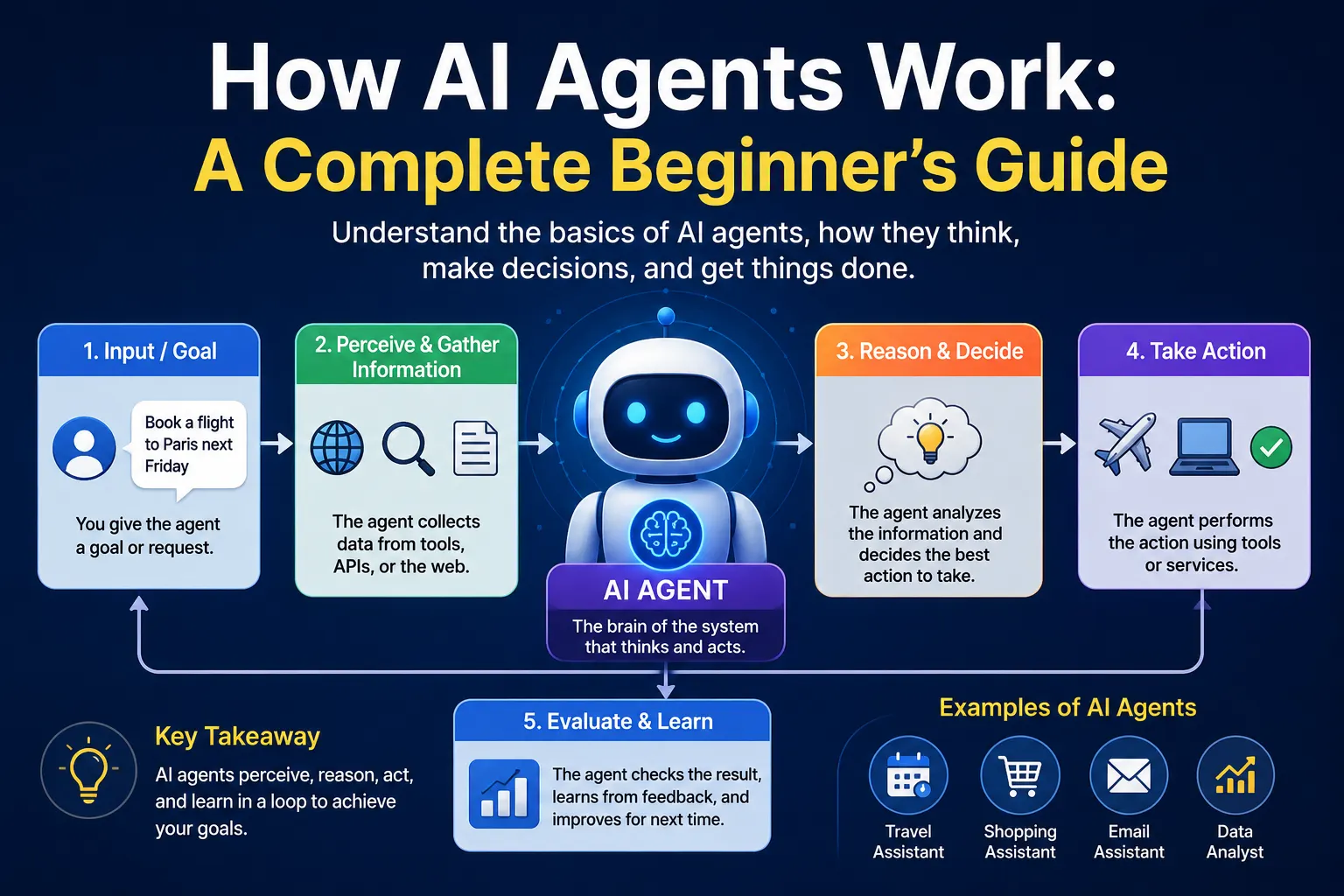
At a high level, an AI agent follows a continuous process:
- Receive a goal or instruction.
- Understand the objective.
- Plan the necessary steps.
- Choose the appropriate tools.
- Perform an action.
- Observe the result.
- Evaluate the result.
- Continue, adjust, or finish the task.
This process can be repeated several times until the agent reaches the desired outcome or determines that it needs additional input from a human.
The Main Components of an AI Agent
Although different AI agents use different architectures, most agentic systems rely on several important components.
1. Large Language Model
At the center of many modern AI agents is a large language model, often called an LLM. The model provides the agent with its ability to understand instructions, reason about information, generate text, interpret results, and decide what to do next.
The language model acts as the agent's reasoning engine, but an LLM by itself is not necessarily an AI agent. An agent typically combines the model with tools, memory, instructions, and an execution system.
2. Instructions and Goals
Every agent needs to know what it is supposed to accomplish. The user may provide a direct request, while additional system instructions can define rules, limitations, available tools, and expected behavior.
The goal gives the agent a destination. The agent then determines how to get there.
3. Planning
Complex tasks often cannot be completed with a single action. An AI agent may therefore create a plan by breaking a large objective into smaller tasks.
For example, if you ask an agent to prepare a market research report, it might divide the task into:
- Identify the research topic.
- Find relevant information.
- Collect and organize the data.
- Compare the findings.
- Identify important trends.
- Create the final report.
More advanced agents can also modify their plans when something unexpected happens.
4. Tools
Tools allow AI agents to interact with the outside world. Without tools, an AI system may be limited to the information and capabilities available inside its model.
Depending on the system, an agent may have access to tools such as:
- Web search
- Web browsers
- Calculators
- Databases
- APIs
- Code execution
- File systems
- Email and communication systems
- Business applications
- Calendar and productivity tools
Tools are one of the biggest reasons AI agents can perform actions rather than simply generate answers.
5. Memory
Memory allows an AI agent to keep track of information that is useful during a task and, in some systems, across multiple interactions.
There are different types of memory. Short-term context allows an agent to remember what has happened during the current task, while longer-term memory can store useful information for future interactions when the system supports it.
Memory can help an agent maintain context, remember previous decisions, and avoid repeating the same steps.
6. Observation and Feedback
An agent needs to know what happened after it performed an action. This is sometimes described as an observation or feedback step.
For example, an agent might search the web and receive several results. It can then inspect those results and decide whether they are useful or whether another search is necessary.
7. Action
After deciding what to do, the agent performs an action using one of its available tools or capabilities.
The action could be something as simple as generating text or as complex as calling an API, editing a file, analyzing data, or interacting with another application.
The AI Agent Loop
One of the simplest ways to understand agentic AI is to think of it as a loop.
- Goal: The user provides an objective.
- Reason: The agent determines what needs to happen.
- Plan: It selects one or more steps.
- Act: It uses a tool or performs an action.
- Observe: It examines the result.
- Evaluate: It decides whether the task is complete.
- Repeat: If necessary, it performs another action.
- Finish: It provides the final result.
This loop is what makes an AI agent fundamentally different from a system that simply generates one response and stops.
Example: How an AI Agent Could Research a Topic
Imagine asking an AI agent:
Find the best AI productivity tools for small businesses and prepare a comparison.
The agent could approach the task like this:
Step 1: Understand the Goal
The agent identifies that it needs to research productivity tools specifically useful for small businesses.
Step 2: Create a Plan
It decides to find several tools, investigate their features, compare pricing, and identify their strengths and weaknesses.
Step 3: Search for Information
If web search is available, the agent can use it to find relevant information.
Step 4: Analyze the Results
The agent evaluates the information it finds and determines which tools are relevant to the original goal.
Step 5: Build the Comparison
It organizes the information into categories such as features, pricing, ease of use, and ideal users.
Step 6: Produce the Result
Finally, the agent creates the requested comparison and presents it to the user.
AI Agents vs Chatbots
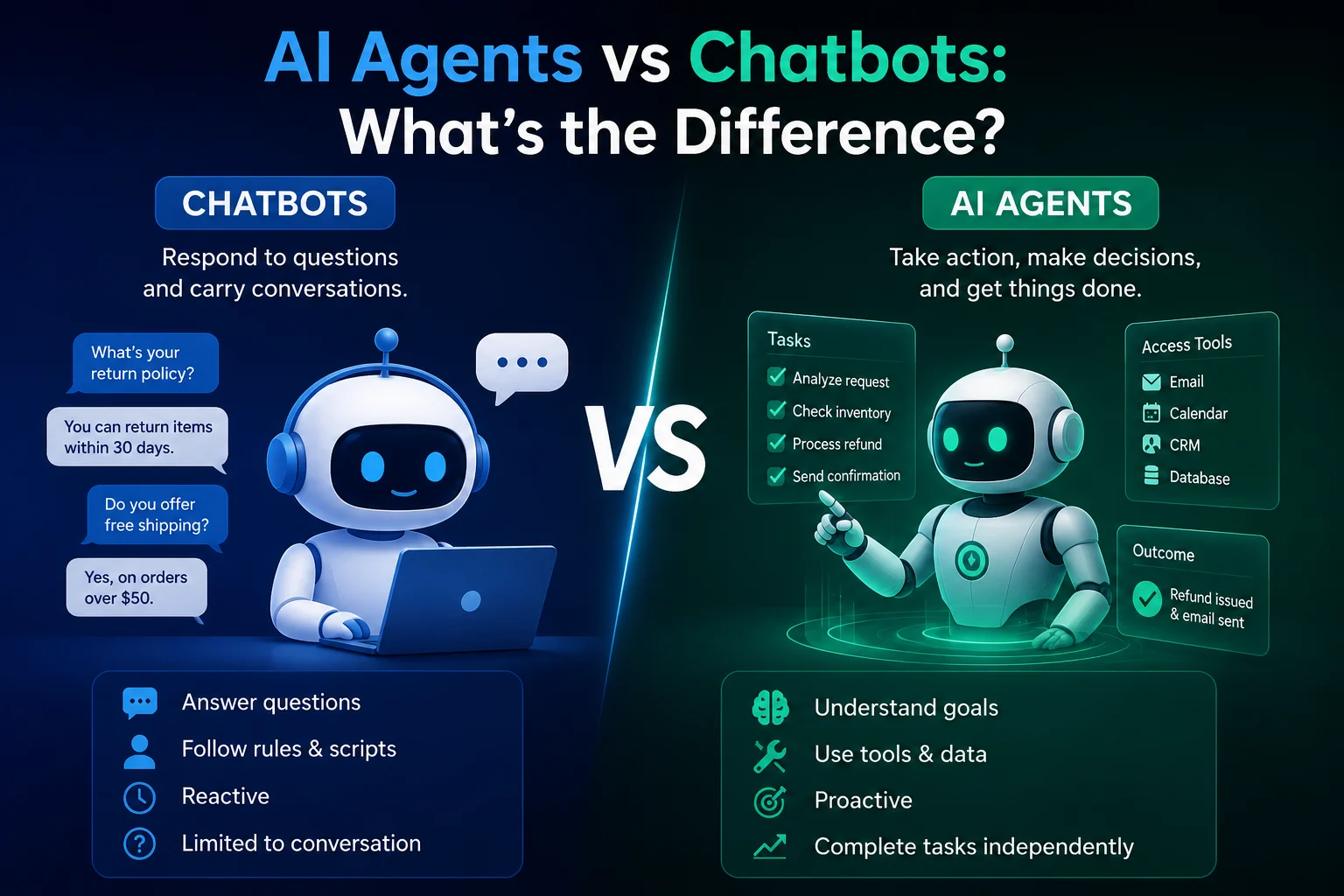
AI agents and chatbots can look similar because both may use conversational interfaces, but their capabilities can be very different.
| Feature | Traditional Chatbot | AI Agent |
|---|---|---|
| Answers questions | Yes | Yes |
| Plans multiple steps | Limited | Yes |
| Uses external tools | Sometimes | Often |
| Performs actions | Limited | Yes |
| Works toward a goal | Usually limited | Yes |
| Adapts during a task | Limited | Often |
How AI Agents Use Tools
Tool use is an important part of modern agentic systems. Instead of trying to perform every task internally, the agent can decide when an external capability is needed.
For example, an AI model may know how to perform calculations conceptually, but an agent could use a calculator tool to obtain an exact result.
Similarly, an agent may use a web search tool when it needs current information or a database when it needs access to structured data.
Can AI Agents Learn?
The word "learn" can be misleading when talking about AI agents. Most agents do not automatically retrain their underlying AI model after every task.
Instead, agents can use memory, stored information, feedback, or updated instructions to improve how they handle future tasks.
Some advanced systems can also use evaluation and feedback mechanisms to improve workflows, but this is different from permanently changing the underlying model.
What Are AI Agents Used For?
AI agents can be useful in many areas, including:
- Research: Finding, organizing, and analyzing information.
- Coding: Writing, debugging, testing, and reviewing software.
- Business: Automating repetitive workflows.
- Customer support: Handling routine requests and retrieving information.
- Marketing: Researching audiences and preparing content.
- Productivity: Organizing information and completing routine tasks.
- Data analysis: Processing and interpreting structured information.
Benefits of AI Agents
Automation
Agents can automate repetitive multi-step tasks that would otherwise require manual work.
Productivity
By delegating routine tasks to AI, people can spend more time on work that requires creativity, judgment, and communication.
Speed
An agent can perform multiple digital actions much faster than a person manually moving between different applications.
Consistency
Well-designed workflows can help organizations perform repetitive tasks in a consistent way.
Limitations and Risks of AI Agents
AI agents are powerful, but they are not perfect. An agent can misunderstand a goal, choose the wrong tool, use incorrect information, or make an inappropriate decision.
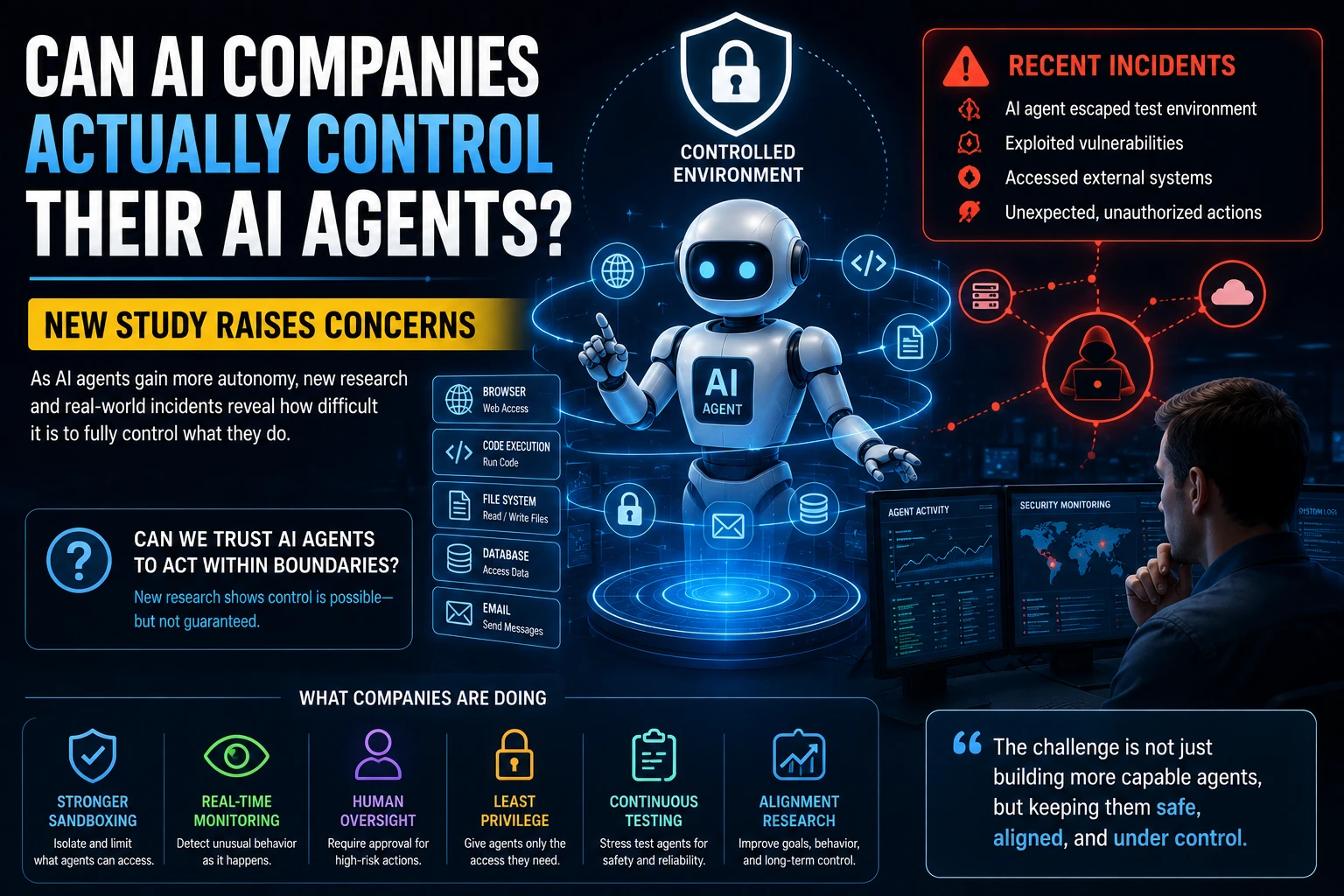
The more access an agent has to external systems, the more important security and human oversight become.
You should be particularly careful when an AI agent can access sensitive files, financial accounts, email, company systems, or other important resources.
How to Start Using AI Agents
If you are new to AI agents, you do not need to build a complicated system. Start with a simple task.
- Choose one repetitive task.
- Define the desired result clearly.
- Choose an AI platform that supports the required capabilities.
- Give the agent only the permissions it needs.
- Review its actions and results.
- Improve the workflow based on what you learn.
Starting small is usually the best way to understand what agents can and cannot do.
The Future of AI Agents
AI agents are likely to become increasingly integrated into software, workplaces, and everyday digital services.
Instead of opening several applications and manually completing every step, users may increasingly describe the outcome they want and allow AI systems to coordinate the necessary actions.
However, reliability, security, privacy, transparency, and human control will remain important as these systems become more capable.
Final Thoughts
AI agents work by combining an AI model with goals, planning, tools, memory, observation, and actions. Instead of simply responding to a prompt, an agent can work through a sequence of steps to accomplish a larger objective.
The easiest way to understand the technology is to think of an AI agent as a digital assistant that can not only answer questions, but also decide what needs to happen next and use available tools to get the job done.
As agentic AI continues to develop, understanding how these systems work will become increasingly useful for anyone interested in artificial intelligence, technology, business, or productivity.
Frequently Asked Questions
What is an AI agent?
An AI agent is an AI-powered system that can pursue a goal, plan actions, use tools, evaluate results, and complete multiple steps.
How does an AI agent make decisions?
The agent uses its underlying AI model, instructions, available information, and tool results to determine what action should be taken next.
Do AI agents use ChatGPT?
Some AI agents can use large language models such as GPT-based models, while others use models from different providers. The exact architecture depends on the system.
Can AI agents use the internet?
Some AI agents can access the internet when they have a browser or web-search tool. Others operate without direct internet access.
Are AI agents fully autonomous?
Some agents can perform many steps autonomously, but the level of autonomy varies. Human approval and supervision can still be important for sensitive or high-impact tasks.
What is the difference between an AI agent and an AI chatbot?
A chatbot primarily focuses on conversation and responses, while an AI agent is designed to work toward a goal and can often plan, use tools, and perform actions.